

6–8 Week Legal First Downsizing After Divorce With Help Options


Before you toss anything: pause and confirm the legal and financial constraints on shared property, then work through a staged declutter plan built around essentials, storage, and slow decisions. Sort by urgency, not emotion. Move nonessential items into temporary storage while you settle housing and finances, and if the sorting itself feels like too much on top of everything else, a professional moving and decluttering service can handle the heavy lifting of a small move or a full decluttering reset.
TL;DR:
Confirm ownership of shared property before disposal to avoid legal complications and gather documentation to support your settlement process.
Renting initially provides flexibility and lower costs compared to buying, especially without a finalized divorce settlement and a sufficient emergency fund.
Declutter room by room using a staged approach, prioritizing low-emotion areas first, and utilize storage for sentimental items to prevent decision fatigue.
Separate and review all financial accounts, including debts and retirement funds, before making any asset transfers or sales to prevent future legal or tax issues.
Plan a 6 to 8 week timeline that includes legal, decluttering, packing, and moving steps, with clear tasks like finalizing housing, labeling, transferring utilities, and updating ID.
Table of Contents
How Do You Start Downsizing After Divorce the Right Way?
The order matters more than the speed. Get the legal groundwork settled first, then let a repeatable sorting method carry you through the physical work.
Start by confirming which items are actually yours to sell, donate, or discard. Shared or marital property that hasn’t been formally divided is a legal gray area, and disposing of it early can complicate a settlement later. Once that’s clear, use a four-bin system for everything else: keep, sell, donate, store. Apply the same three filters to each item: how often you use it, what it costs to replace, and what it costs you emotionally to see it every day.
Work room by room, not category by category. A 2 to 3 hour session per room keeps decision fatigue from setting in.
Start with low-emotion spaces first. Kitchens, bathrooms, and garages are easier to clear than bedrooms or shared offices, and an early win builds momentum.
Sell what moves fast, donate what doesn’t. Local buy-and-pickup services and online marketplaces work well for furniture and electronics; everything else, especially clothing and books, usually moves faster through donation than a listing that sits for weeks.
Use short-term storage as a decision buffer. Anything sentimental or ambiguous goes into storage rather than the trash pile, giving you 30 to 90 days before you have to decide.
Label boxes by destination, not just contents. “Kitchen, Apartment” beats “Misc.” when you’re unpacking under stress.
Pack a first-two-weeks essentials kit separately. Toiletries, chargers, a few days of clothes, and basic kitchen items should never end up buried in a storage unit.
A companion room-by-room guide walks through this same method in more depth if you want a printable version.
Pro Tip: Set a timer for each room session. When it goes off, stop, even mid-decision. Momentum matters more than finishing one room perfectly before you touch the next.
What Housing Choice Makes Sense on One Income?
Run the math before you run the search. Add up projected monthly housing cost, utilities, insurance, transportation, and any support obligations, then compare that total against a conservative estimate of your post-divorce income, not your old household income.
Renting first is usually the safer move if your finances are still settling. It buys time without locking you into a mortgage before you know what your new budget can actually absorb. Buying can still work, but only with a real emergency reserve and a fully finalized division of the marital home’s equity.
A few ways to keep housing costs down while you stabilize:
Choose a smaller footprint than you think you need. Extra square footage means more to furnish, heat, and clean.
Consider a roommate or co-living arrangement if it fits your lifestyle. It’s a bigger cost lever than people expect.
Delay large furniture purchases for a few months. Sitting on a mattress and a folding table for a while beats financing a living room set you can’t quite afford yet.
Statistics Canada research shows divorce tends to lower later-life income replacement rates, particularly for women, which makes building liquidity now, not just covering this month’s rent, part of a responsible housing decision.
What Legal Steps Come Before You Sell Anything?
Don’t sell, gift, or discard anything that might still count as marital property until ownership and division terms are settled in writing. Unauthorized disposal of shared assets can shrink your settlement and create real complications with your ex or the court.
Confirm which items are individually yours versus jointly owned before listing anything for sale.
Keep documentation, receipts, photos, and correspondence for anything of meaningful value.
If you’re moving with children and the relocation significantly affects their relationship with the other parent, Justice Canada’s relocation rules generally require at least 60 days’ notice, with a 30-day window for the other parent to object.
Even a move that doesn’t involve children may still require notice under an existing parenting or support order, so check your paperwork.
Propose updated parenting arrangements in writing and try mediation before heading to court, which Justice Canada’s own guidance recommends as the first step in most relocation disputes.
The Divorce Act requires parents to give a minimum notice period before relocating when the move meaningfully affects a child’s relationship with the other parent. Get legal advice immediately if you have an existing court order, a contested relocation, or significant assets still on the table.
How Do You Downsize Emotionally Without Regret?
Downsizing after divorce isn’t a verdict on the marriage. It’s forward-focused design for the life you’re building now, and treating it that way changes how fast and how well you make decisions.
Stage the hardest calls. Put sentimental items in storage for 30 to 90 days and revisit them once your emotions have leveled out. What feels unbearable to part with in week two often looks different in week eight. Recruit help you trust: a friend who won’t second-guess your choices out loud, a professional organizer, a therapist, or a decluttering-focused mover who’s seen this exact situation before.
If you’re over 50, view this through a retirement and mobility lens, not just a moving one. Statistics Canada data shows a meaningful share of Canadians aged 55 and older are separated or divorced, so restarting later in life is common and workable with the right planning.
Pro Tip: Photograph sentimental items before you store or donate them. The memory often lives in the photo just as well as the object, and that alone makes letting go easier.

What’s a Realistic 6 to 8 Week Timeline?
A clear runway keeps this from turning into a slow-motion crisis. This is a compressed version of a fuller 6 to 8 week decluttering schedule worth bookmarking.
Weeks 0 to 1: Confirm legal status of shared property, decide rent versus buy, book storage or movers if your timeline is tight.
Weeks 1 to 4: Declutter room by room, sell and donate what you can, box sentimental items for storage, and start touring or applying for new housing.
Weeks 4 to 6: Finalize your housing choice, book your move date, pack your essentials kit, and transfer utilities and your mailing address.
Move week: Label everything clearly, hand movers an inventory list, confirm storage receipts, and handle immediate post-move tasks like updating your ID and setting up mail forwarding.
How Do You Rebuild Your Finances After Divorce?
Pull your credit report before you do anything else. Joint accounts, shared credit cards, and co-signed loans don’t disappear just because the divorce is finalized, and unpaid balances on an account with your name on it can drag your score down even if your ex was supposed to cover it.
Separate every account that’s still linked to your former spouse. That means closing joint credit cards, removing yourself as an authorized user where you’re not the primary holder, and opening individual accounts in your name if you don’t already have them. Lenders look at your standalone credit history when you apply for a new lease or mortgage, so the sooner it’s clean, the better your options.
Build a debt map before you build a budget. List every balance, interest rate, and minimum payment, then rank them by interest rate rather than balance size. High-interest debt from a shared card or a settlement-related loan should get priority over lower-rate obligations like a car loan.
A three to six month emergency reserve matters more now than it did when you had two incomes covering the same household. It’s the buffer between a stable transition and a financial scramble if a job loss or unexpected expense hits during an already unstable year.
Who Gets the Car, and What Happens to Retirement Accounts?
The home is rarely the only asset that needs dividing. Vehicles, retirement accounts, and investment portfolios all carry their own rules, and getting them wrong can cost more than the furniture ever would.
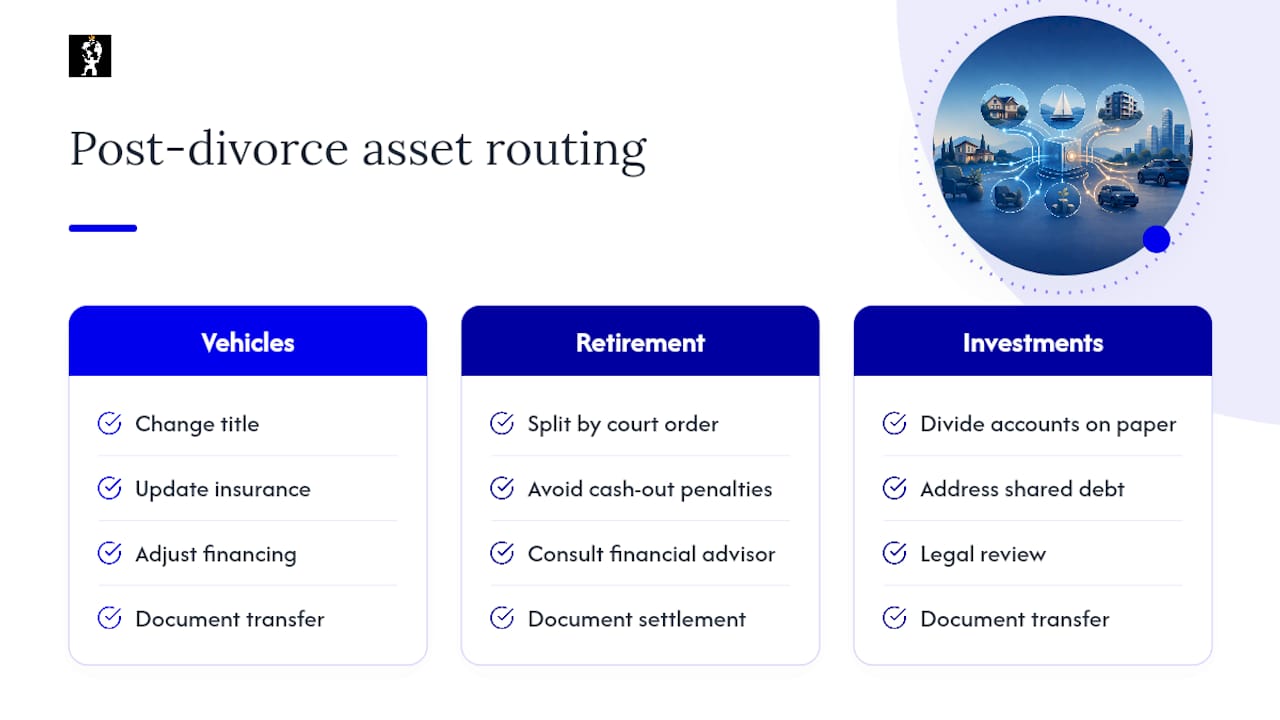
Vehicles registered jointly need a clean transfer of title once ownership is decided, along with an update to insurance and financing if a loan is still attached. Don’t assume a verbal agreement about who keeps the car covers you legally. Get the paperwork changed.
Retirement accounts and pensions are often split through a formal domestic contract or court order rather than a simple withdrawal, and cashing one out early to “settle up” quickly can trigger tax penalties neither of you wants. If retirement assets are part of your settlement, loop in a financial advisor or your lawyer before touching a single account, since the Divorce Act’s provisions on variation show how much these arrangements can shift after the fact if they’re handled loosely.
Investment accounts and any shared debt tied to them deserve the same scrutiny as the house. A clean division on paper now saves both of you from a messier conversation two years down the road.
How Do You Set Up a New Home for Co-Parenting?
Space planning looks different when kids are splitting time between two households. Even a smaller home needs to function as a real second base, not a temporary stopover.
Prioritize a bedroom or defined sleeping space for each child, even in a smaller footprint, over a spare room for guests or a home office. Kids adjust better when they have a consistent, personal space that’s theirs in both homes, not just a shared pullout couch. Keep a duplicate set of daily essentials, toiletries, chargers, a few favorite items, so nothing critical gets forgotten during handoffs.

Coordinate logistics early with the other parent: pickup and drop-off locations, school and activity schedules, and how you’ll handle last-minute changes. A predictable routine matters more to kids than a bigger house does. If your move affects the co-parenting arrangement in any meaningful way, revisit the notice requirements covered earlier before you finalize anything.
Publisher perspective: when hiring help actually pays off
Some moving services build their process around staged moves and transparent itemized and flat-rate pricing because sorting a household alone under emotional strain rarely goes smoothly. Hiring help makes the most sense when kids, mobility limits, a tight timeline, or sheer emotional weight are in the mix. Consults are straightforward: no hidden line items, no surprises after the invoice.
— Natalie
How Atlas Kings Can Help With Your Move
If the sorting and moving feel like more than you can carry alone right now, Some moving services provide a flat-rate, no-surprises way to hand off the physical work while you focus on the decisions that actually need your energy.

Our Small Move service is built for exactly this kind of transition, moving under ten large items for a flat 225 CAD, with no hourly guessing games. If you’re relocating bulky purchases or furniture into a new place, Inhouse Delivery runs 125 CAD and handles the heavy carrying so you don’t have to. For the emotional weight of sorting itself, the Space Reset service at 75 CAD, and the ADHD Reset program offer structured, in-home decluttering support built for exactly the kind of decision fatigue this article has walked through. If you need time before committing to a final housing decision, Itemized Storage and Moving Box Rental let you hold sentimental or high-value items without rushing a call you’re not ready to make. Frequent movers or anyone managing an ongoing household reset can also look at the ATLAS PASS at 312 CAD per year for repeat service discounts.
For sentimental collections like books, a partner resource on storing books properly is worth a look before you box them for storage. And if part of what you need is less about logistics and more about clearing emotional residue from a shared home, Distance House Clearing offers that kind of support alongside the practical work.
Ready for a plan instead of a pile of boxes? Book a consult online and get an itemized quote before anything gets scheduled.
This article is general information, not a substitute for advice from a qualified lawyer. Consult a qualified legal professional about your own circumstances before acting on anything here.
Sources
FAQ
Is It Possible to Start Over at 55 After a Divorce?
Yes. Statistics Canada demographic data shows a meaningful share of Canadians aged 55 and older are divorced or separated, which means rebuilding a household later in life is common, not an exception. The key is treating downsizing as retirement and liquidity planning, not just a moving project.
Is Divorcing at 60 a Good Idea?
That depends entirely on the individual situation, not on age alone. What matters more than the decision itself is the planning behind it: confirming asset division, understanding how it affects retirement income, and building a housing plan that fits a realistic post-divorce budget.
Is It Possible to Be Financially Ruined by a Divorce?
Divorce can seriously strain finances, and Statistics Canada research shows it tends to lower later-life income replacement rates, especially for women. Ruin isn’t inevitable, though. A conservative budget, an emergency reserve, and a clear separation of joint credit accounts go a long way toward avoiding the worst outcomes.
Is It Possible to Live Alone After a Divorce at 50?
Yes, and it’s a common path. Renting first, keeping your footprint modest, and building a cash reserve before committing to a bigger housing decision all make living alone at 50 or later a stable, realistic option rather than a financial risk.
Recommended
Comments