

Professional Basement Removals: Hire a Pro and Save Time
- William Wooldridge

- Aug 10
- 8 min read

Hire a professional basement removals service when you want items relocated, donated, or rehomed safely and efficiently. A booked moving and decluttering crew handles the heavy lifting, coordinates donation drop-offs, and keeps the job insured from start to finish. For a small basement reset, expect to spend a moderate amount and about half a day of your time. Medium jobs usually take a full day, while whole-basement projects can reach a significantly higher cost range and last several days depending on volume and access. Atlaskings offers both itemized and flat-rate pricing, so you know exactly what you’re paying before the crew arrives.
Key Takeaways
Hiring a professional basement removals service is the right call when you have a deadline, heavy items, stairs, or a space that has resisted DIY progress for more than a season.
Point | Details |
Verify insurance first | Request a COI before signing; confirm general liability and mover’s valuation coverage. |
Get an itemized estimate | A written, line-by-line quote lets you compare providers and prevents surprise fees. |
Measure access points | Share stairwell width, ceiling height, and doorway clearance with your provider before service day. |
Coordinate donations early | Confirm which items go to donation centers and request receipts for tax documentation. |
Atlaskings is a ready option | Atlaskings offers itemized and flat-rate pricing, organizer-led service, and 500+ completed moves since 2021. |
Table of Contents
What does “basement removals” actually mean?
In this guide, “basement removals” means a professionally booked service that removes, relocates, rehomes, or donates items stored in your basement. It is not a junk-haul or disposal-only service. The distinction matters because the work involves a professional organizer and a moving crew working together, not a truck that empties a space without a plan.
A typical basement removals job includes:
Site assessment to map the space and identify access challenges
Inventorying and sorting items into keep, donate, sell, or discard categories
Packing and protective wrapping for fragile or valuable pieces
Heavy lifting and stair navigation with proper equipment
Transport to a new location, storage facility, or donation center
Reassembly of furniture at the destination
Donation coordination, including scheduling pickups or drop-offs
Optional short-term storage for items that need a temporary home
Professional decluttering services add structure, zoning, and donation coordination that most DIY attempts lack. Pros break the project into manageable zones and enforce finish points so the space becomes usable again rather than a recurring unfinished task.
This guide does not cover demolition, construction debris removal, or disposal-only services. Those are separate categories with different providers and different scopes.
Who should hire a professional for basement removals?
The short answer: hire a pro when the job has a deadline, a safety risk, or an emotional weight that makes solo progress unlikely.
Decluttering services are most valuable when clutter affects how the home works, when deadlines exist, or when clients simply lack the time to finish on their own. A few specific situations make the case clearly.
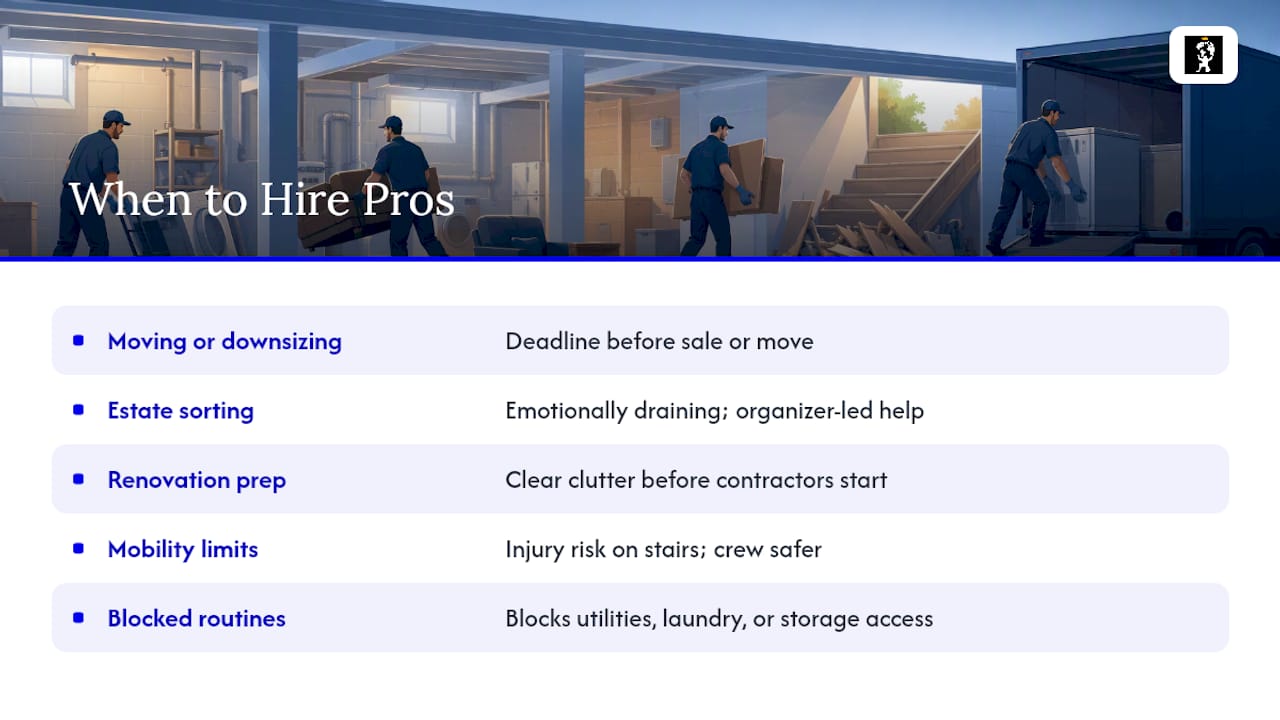
Moving or downsizing. When you need the basement cleared before a sale closes or a moving truck arrives, a professional crew keeps the timeline. There is no room for a half-finished sort that stalls for weeks.
Estate and inheritance situations. Sorting through a loved one’s belongings is emotionally draining. An organizer-led crew provides steady, respectful progress through difficult decisions without judgment.
Renovation prep. Contractors cannot work in a cluttered basement. Clearing the space before a renovation starts prevents costly delays and protects items from construction damage.
Mobility or stair limitations. Carrying boxes up steep basement stairs is a real injury risk. A professional crew with the right equipment handles that safely.
When clutter blocks daily routines. When a packed basement prevents access to utilities, laundry, or storage you actually need, professional help that includes donation and rehoming coordination turns a tidy-up into a proper home reset.
Pro Tip: If your basement is blocking a contractor’s start date or preventing a home sale, a professional removals crew typically pays for itself in time saved and avoided delays.
What a professional basement removals job typically includes
Professional basement removals are hands-on and mix organizing with moving tasks from the first hour. The crew does not simply load a truck. They work through the space methodically, making sure every item has a clear destination.
A standard decluttering and organizing service typically covers item sorting, organizing retained pieces, storage planning, labeling, light cleaning, and preparation for donation or disposal. Here is what you can expect from a full-service basement removals job:
Walkthrough assessment and written plan before work begins
Item-by-item sorting with your input on keep, donate, sell, or discard
Packing, wrapping, and labeling of items being relocated
Moving heavy furniture and appliances via stairs or elevator
Transport to a new address, storage unit, or donation facility
Reassembly at the destination
Donation drop-off scheduling and receipt documentation
Optional itemized short-term storage for items in transition
Always request a Certificate of Insurance (COI) before work begins. A reputable provider carries general liability coverage and mover’s valuation options. If a provider cannot produce a COI on request, that is a firm reason to look elsewhere.
Heavy-appliance disposal, hazardous waste removal, and structural work are almost always billed separately or referred to a specialist. Bulky-item disposal is typically treated as a separate service from standard organizing and moving work. For items that cannot be rehomed, a partner like EasyScrap’s removal services handles disposal logistics outside the organizer-led model.
Pro Tip: Ask your provider upfront which items they will rehome or donate versus which ones require a separate disposal arrangement. Getting that in writing prevents surprise fees on service day.
How much does a basement removal cost, and how long does it take?
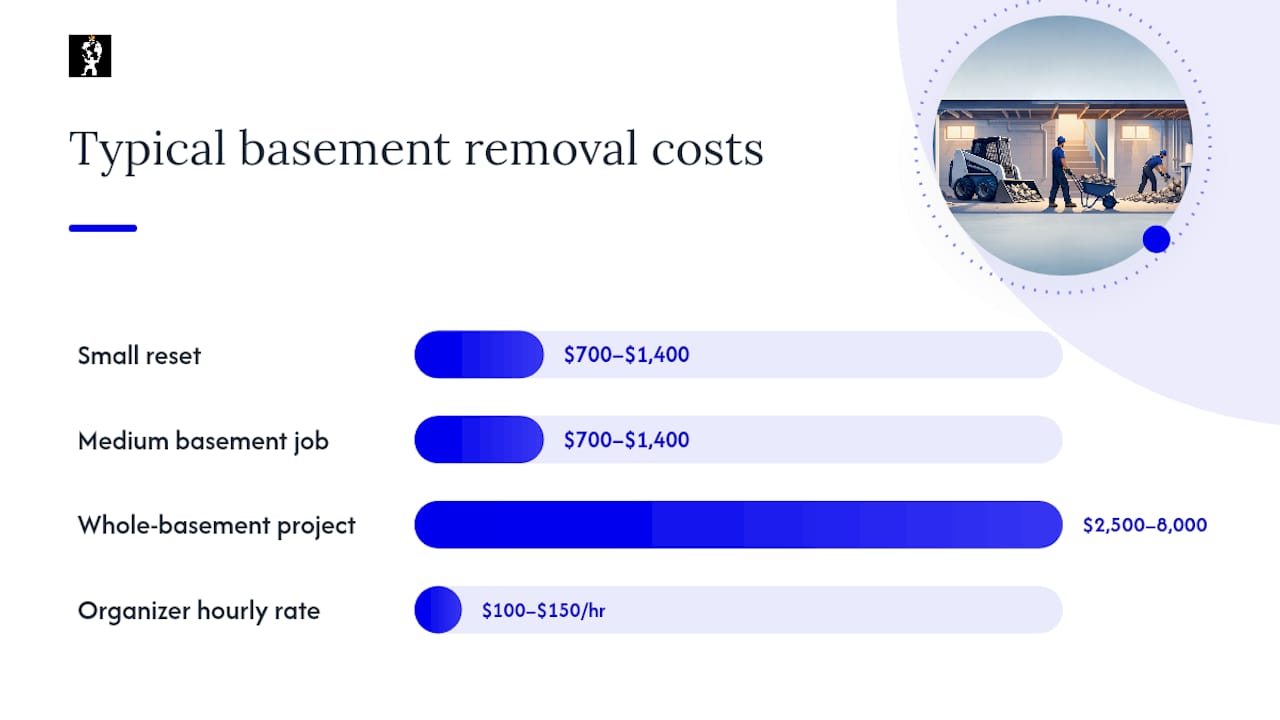
Pricing is typically hourly, flat-rate per job, or a hybrid of both. Professional organizers charge about $100–$150 per hour, and project packages range from approximately $700–$1,400 for small spaces to $2,500–$8,000 for whole-home or large resets. Moving labor is usually billed separately on top of organizing time.
Job Size | Typical Cost Range | Estimated Time |
Small reset (1 room or partial basement) | $700–$1,400 | 2–4 hours |
Medium basement job | $700–$1,400 | Half to full day |
Whole-basement project | $2,500–$8,000 | 1–3 days |
Organizer hourly rate | $100–$150/hr | Per session |
Several factors shift the final number: clutter density, number of stairs, heavy or oversized items, whether items are donated versus disposed of, required crew size, and travel distance. A basement with narrow stairs and a decade of accumulated storage will cost more than an open space with a walkout door.
For timeline planning, book at least one to two weeks out for medium and large jobs. Most providers require a deposit at booking and will confirm an arrival window 24–48 hours before service day.
Pro Tip: Always request an itemized written estimate before confirming. A flat-rate quote is convenient, but an itemized breakdown lets you see exactly what you’re paying for and compare providers fairly. Confirm the cancellation and deposit policy in writing at the same time.
How to prepare your basement before the crew arrives
Good preparation speeds the job and can reduce the total hours billed. Here is a practical checklist to work through the day before service:
Measure large items and access points. Note the width of doorways, stairwell clearance, ceiling height, and any tight turns. Share these measurements with your provider in advance so they bring the right equipment.
Clear pathways. Remove obstacles from the basement floor, stairwell, and route to the front door or loading area.
Secure pets. Keep animals in a separate room or off the property during the job.
Set aside valuables and documents. Move anything irreplaceable, including financial records and jewelry, to a room the crew will not enter.
Label items that must stay. Use colored tape or sticky notes to mark anything the crew should not touch.
Identify donation versus relocation items. If you already know what is going to a new address versus a donation center, mark those groups separately. It saves sorting time on service day.
Plan a staging area. Designate a clear space near the exit where the crew can stage packed boxes before loading.
Reserve the elevator if you live in a building, and confirm parking access for the moving vehicle.
For more guidance on organizing before a crew arrives, these household organization tips cover practical pre-service prep in detail.
What to ask providers and red flags to watch for
The most important questions to ask any basement removals provider cover insurance, written estimates, crew experience, donation handling, and cancellation terms. A provider with nothing to hide answers all of them without hesitation.
Insurance and COI. Ask for a Certificate of Insurance before signing anything. Confirm the policy covers general liability and mover’s valuation for items in transit. A verbal assurance is not enough.
Written estimate. Request a line-by-line breakdown of labor, transport, donation coordination, and any disposal fees. Verbal quotes are a red flag. A written estimate protects both parties.
Crew experience and references. Ask how long the crew has handled basement removals specifically, and request two or three references from similar jobs. Before-and-after photos or case studies are a strong trust signal.
Donation handling policy. Confirm whether the crew coordinates donation drop-offs directly, and whether they provide receipts for tax documentation. For donation pickup and drop-off logistics, clarify which organizations they work with and what items they accept.
Red flags to avoid:
Vague or verbal-only quotes with no written breakdown
Requests for a large cash payment on service day
Refusal or delay in providing a COI
High-pressure tactics to book immediately without a written contract
No clear policy distinguishing donated items from disposed ones
For a broader look at vetting local providers, this guide to professional decluttering services covers evaluation criteria and what good provider communication looks like.
Atlaskings makes basement removals straightforward to book
Atlaskings is the direct, transparent option for homeowners and renters who want a professional basement removals service with no hidden costs. Every job comes with itemized or flat-rate pricing upfront, so you see the full cost before committing. The organizer-led Inhome Refresh service handles sorting, donation coordination, and space planning, while the moving crew manages heavy lifting, stair navigation, and transport.

With over 500 completed moves since 2021, Atlaskings brings proven reliability to every job. Trust signals include full insurance coverage, written estimates, and a family-run team that treats your belongings with care. For items that need a new address rather than a storage unit, the in-home delivery service handles same-city relocation of individual pieces or small loads.
To get started, book your service or request a free estimate directly through the Atlaskings booking page. You will receive a confirmation with your arrival window and a clear outline of what the crew will do on service day.
What organizers see most often in basements
The most common pattern in basement removals is a homeowner who waited longer than they planned. By the time a professional arrives, the space has usually been accumulating for years, and the client’s biggest regret is not calling sooner. Sorting decisions that feel impossible alone tend to move quickly with a neutral, experienced organizer guiding the process.
Two choices consistently save time and money: sorting items into destination groups before the crew arrives, and confirming donation logistics in advance so the truck does not make an extra stop. Asking for an itemized plan at the estimate stage, along with donation receipts for tax purposes, protects you financially and keeps the project moving without surprises.
Sources
The pricing benchmarks, service scope details, and organizer best practices in this article draw from the following sources. Atlaskings service pages are linked directly for booking and service details.
Is Hiring a Professional Organizer Worth the Money? | Family Handyman
Professional Decluttering vs DIY Decluttering: Which Is Right For Your Home? | Total Cleanz
Decluttering Service - Everything to Know Before Hiring | SundayJesus
Home Organization vs. Professional Decluttering Services: Which Approach Works Best? | Kittycatbliss
Recommended
Comments