

What a Certificate of Insurance for Movers Actually Proves


A certificate of insurance for movers is a broker-issued document, usually the standard ACORD 25 form, showing your moving company carries the liability and workers’ compensation coverage your building requires. If a move is on the calendar, your next move is simple: ask the mover’s insurance broker for that ACORD 25, then forward your building’s specific COI requirements to the mover’s operations team, not just their sales line.
Skip this step and you risk a denied entry on move day. Buildings that require a COI generally will not let a crew past the loading dock without one.
Request the broker-issued ACORD 25 directly, not a form typed up by the mover itself.
Send your building’s certificate-holder name, limits, and additional-insured wording in writing.
Confirm written acceptance from the property manager before the truck arrives.
Key Takeaways
A valid moving COI requires a broker-issued ACORD 25 with matching limits, dates, and additional-insured wording, requested at least 7 to 10 business days before move day.
Point | Details |
Confirm the producer field | A broker’s name and phone number must appear; a mover-issued certificate is not valid. |
Match the exact wording | Certificate-holder name and additional-insured language must match your building’s written requirements exactly. |
Build in lead time | Forward requirements to mover operations 7 to 10 business days before the move, since broker turnaround runs 24 to 48 hours. |
Get written acceptance | Confirm the building has approved the COI in writing before move day, not verbally. |
Choose a mover who handles it | Atlaskings requests the broker-issued ACORD 25 for every applicable move and confirms building acceptance before arrival. |
Where to Verify Moving COI Standards
ACORD publishes the industry-standard certificate form used by insurance brokers nationwide.
Columbia Residential’s COI page shows a real institutional submission requirement.
Table of Contents
What Is a Certificate of Insurance for Moving Companies?
A moving COI is a one-page snapshot of the mover’s insurance program, printed on the ACORD 25 form that brokers across the insurance industry use as a shared template. The mover’s insurance broker, called the “producer” on the form, issues it. The mover cannot legally generate its own certificate, which is one reason property managers treat a broker-issued COI as more trustworthy than paperwork from the moving company’s own office.
The certificate typically summarizes four coverage types:
General liability, covering property damage and third-party injury during the move.
Workers’ compensation, covering injury to the movers’ own crew while on your premises.
Auto liability, covering the moving truck and its transit to and from the building.
Cargo insurance, covering the goods themselves while in the truck.
One caution worth repeating: a COI is evidence of coverage, not a contract. It does not extend or alter the policy behind it. If a claim happens, the actual policy language governs, not the summary on the certificate.
Why Do Property Managers Require a COI From Movers?
Buildings require a moving COI because they are the ones holding the risk if something goes wrong in a shared hallway, elevator, or lobby. A scraped wall or a dented elevator door becomes the building’s repair bill unless the mover’s insurance absorbs it first.
Requiring a COI transfers that financial exposure to the mover’s carrier instead of the building’s own policy. It also protects the building’s loss history. A property with a clean claims record keeps its own premiums lower, and one uninsured moving accident can undo years of that.
Repair and legal costs shift to the mover’s insurer, not the building’s.
The building’s own liability policy stays untouched by move-related incidents.
Higher-risk property classes, like commercial office towers or Class A residential buildings, often ask for higher limits and more specific additional-insured wording than a small walk-up would.
Tenants benefit too: a building enforcing COI rules is less likely to have move-day damage disputes drag into their own lease renewal or deposit.
None of this is bureaucratic overreach. It is the same logic behind requiring a certificate from any contractor entering a shared building, whether that is a mover, an electrician, or a landscaping crew.
What Should You Check on a Moving COI (ACORD 25)?
The ACORD 25 form has the same structure regardless of which broker issues it, which makes reviewing one fairly quick once you know where to look. Work through these six fields in order.
Producer. This is the broker’s name, address, and phone number, printed in the upper left. If this field is blank or filled in with the mover’s own company name, the certificate is not broker-issued and should not be accepted.
Insured. Confirm this matches the legal name of the moving company you hired, not a sister company or a subcontractor you were not told about.
Policy types and limits. Check that general liability, workers’ comp, and auto liability all appear, and that each limit meets or exceeds what your building requires.
Policy effective and expiration dates. The move date needs to fall inside this window with room to spare. A policy expiring the week of your move is a real problem.
Certificate holder. This should be your building’s legal name and address exactly as the property manager specified, along with any required additional-insured language naming the building as a protected party.
Description of operations. Look for the move date and building address referenced here, plus any cancellation notice period, often 30 days, that tells the building if coverage lapses early.
Pro Tip: Keep a copy of your building’s exact certificate-holder wording in your phone. Property managers reject more COIs over a mismatched name or address than over an actual coverage gap.
How Do You Get a COI for Your Move?
Getting a valid certificate of insurance for movers is mostly a matter of timing and knowing who to contact.
Get your building’s requirements in writing. Ask the property manager for the exact certificate-holder name, required limits, and additional-insured phrasing. Verbal instructions get lost between departments.
Forward those requirements to the mover’s operations team, not the salesperson who booked your move. Misrouted requests to sales instead of operations are a common cause of last-minute COI failures.
Give the mover 7 to 10 business days before move day. Some institutional landlords, including university housing programs, require submission at least 48 hours ahead at minimum, but 7 to 10 days gives room for corrections.
The mover contacts its broker, who issues the ACORD 25. Broker turnaround is often 24 to 48 hours once they have your building’s exact requirements.
Get written acceptance from the building before move day, not a verbal “looks fine.” An email confirmation is what protects you if there is a dispute at the door.
A few extra safeguards make this process smoother:
Keep every requirement exchange in email so nothing gets attributed to a phone call nobody remembers.
Build in a buffer week if your move date could shift, since a COI tied to the wrong date needs to be reissued.
How Do You Verify a COI Is Genuine?
Property managers reviewing a stack of certificates, and tenants who want to double check their mover, both need the same four verification checks.
Call the producer listed on the certificate. A quick call to the broker’s phone number confirms the policy is active and matches what the certificate states.
Match limits and dates against your building’s sheet. The numbers on the certificate should meet or exceed your minimums, and the move date should sit inside the policy period.
Check the additional-insured wording word for word. Buildings often specify exact phrasing, and a close-but-not-exact match can void the protection they are counting on.
Watch for red flags, including a certificate printed on the mover’s own letterhead, a blank producer field, or expiration dates that do not line up with your move.
ACORD’s standardized template exists partly so that this kind of verification is fast. Because every legitimate certificate follows the same layout, a forged or sloppy one tends to stand out the moment someone checks the producer field and picks up the phone.
What If a Mover Can’t Provide a COI?
Treat the absence of a broker-issued COI as a real disqualifier, not a paperwork technicality. A broker can typically issue a certificate within 24 to 48 hours, so a mover with no path to one is telling you something about how they operate.
Ask directly for the broker’s name and phone number, and call to verify coverage yourself.
Request a specific timeline in writing for when the certificate will arrive.
If the broker cannot produce a valid certificate at all, start looking at other movers.
Only proceed without one if the property manager issues a documented, written temporary waiver, and even then, get it in writing before move day.
Printable Move-Day Checklist for Tenants and Property Managers
Print this or save it to your phone before the truck arrives. Move-day disputes almost always trace back to one missing item on this list.
Written building acceptance of the COI, saved as an email or PDF you can pull up on-site.
A copy of the ACORD 25 itself, digital or printed, with the broker’s name and phone number visible.
Elevator reservation confirmation, if your building requires one for move-in and move-out.
The exact building address and certificate-holder name, matched against what appears on the certificate.
Three contact numbers on hand: the broker, the mover’s operations manager, and your property manager, in case anything needs resolving at the door.
Nothing on this list requires special expertise. It just requires having the right document, from the right person, before the truck backs up to the dock.
How Atlas Kings Handles COIs for Every Move
Atlaskings treats a broker-issued certificate as a standard part of booking a move, not an afterthought handled the week before. Our process is built to remove the guesswork property managers and tenants usually deal with.
We obtain the ACORD 25 directly from our insurance broker for every job that requires one.
We forward the certificate to the property manager or building office and confirm written acceptance before move day.
Our itemized and flat-rate pricing means the COI process is documented alongside the rest of your move, so there is a paper trail if any question comes up later.
Since 2021, we have completed over 500 moves, and COI coordination has become one of the more routine parts of that operational history.
Pro Tip: If your building has a strict submission window, mention it when you book. Flagging it early gives our team time to request the certificate with margin to spare instead of scrambling the week of your move.
Who Typically Requires a COI Before a Move?

Almost any property with shared common areas or a management office will ask for one, but the strictness varies by building type. Apartment buildings and condo boards are the most common source of COI requirements, largely because elevators, hallways, and lobbies are shared liability zones that the board’s insurance has to protect.
HOAs in townhome and single-family communities request COIs less uniformly, but many with shared driveways, gates, or common landscaping still enforce the rule, especially for larger moves involving multiple trucks. Office buildings tend to be the strictest of all, frequently requiring higher limits and specific additional-insured language because commercial leases carry more liability exposure than residential ones.
Universities are a distinct case. Campus housing offices often publish formal COI submission guidelines with hard cutoffs, sometimes as little as 48 hours before a move, which makes early planning more important than in a typical apartment building. Corporate campuses and coworking spaces have started adopting similar rules as commercial leasing has become more liability-conscious generally.
If you are unsure whether your building falls into a strict category, ask the property manager directly rather than assuming. A quiet building today can tighten its policy after a single bad incident, and you do not want to discover that change on move day.
What Coverage Limits Do Buildings Typically Require?
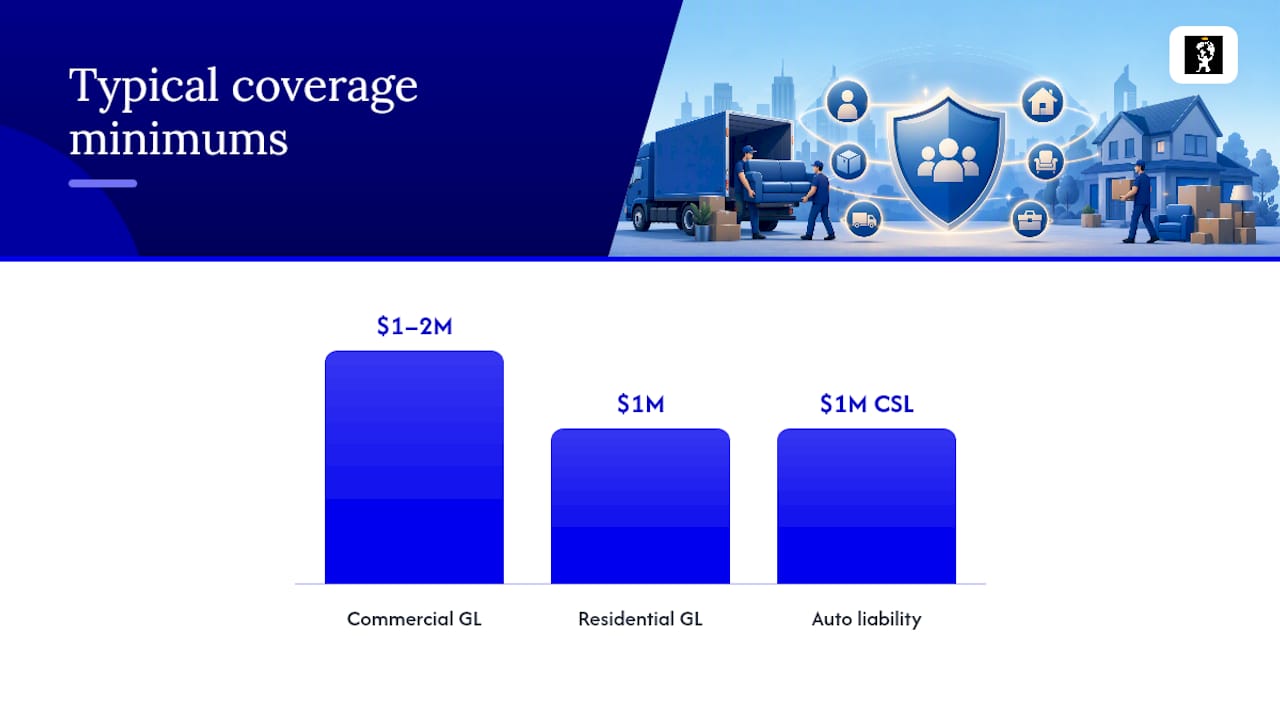
Coverage minimums vary by property type, but a pattern shows up across most COI requirement sheets. Commercial office moves commonly specify general liability limits between $1,000,000 and $2,000,000, workers’ compensation at statutory limits set by the mover’s home state, and auto liability often requested around $1,000,000 combined single limit.
Residential buildings tend to sit at the lower end of that same range, though upscale or Class A residential properties frequently mirror commercial requirements almost exactly. A high-rise condo with a marble lobby and a doorman is far more likely to demand $2,000,000 in general liability than a modest six-unit walk-up.
Beyond the core numbers, buildings often add special requirements that catch first-time movers off guard:
Naming the property management company as an additional insured, not just the building’s ownership entity.
A 30-day cancellation notice, meaning the mover’s insurer has to notify the building if the policy lapses early.
Waiver of subrogation clauses in some commercial leases, which prevent the mover’s insurer from later suing the building after paying a claim.
None of these are unusual asks. Higher-risk property classes requesting more detailed insurance language is standard practice, not a sign that a particular building is being difficult.
COI vs. Insurance Policy: What’s the Difference for Movers?
A certificate of insurance and an insurance policy are not the same document, and confusing the two causes real problems. The policy is the full legal contract between the mover and its insurance carrier, often dozens of pages long, spelling out exactly what is covered, what is excluded, and under what conditions a claim gets paid.
The COI is a one-page summary of that policy, generated by the broker to give a third party, your building, quick proof that coverage exists. It lists the policy numbers, the coverage types, and the limits, but it does not reproduce the policy’s fine print.
This distinction matters most when a claim actually happens. If a mover damages a hallway wall, the building’s recovery depends on the actual policy terms, not on what the certificate summarized. A COI can show that general liability coverage exists at a $1,000,000 limit, but exclusions buried in the policy itself could still limit what gets paid for a specific type of damage.
Because a COI does not extend or alter coverage, it should never be treated as a stand-in for reading the policy when a large or unusual move is involved. For a routine residential move, the certificate is generally sufficient assurance. For a high-value commercial relocation, it is worth asking the broker directly whether any exclusions apply to the specific type of property being moved.
How Do You Read Coverage Limits and Exclusions on a Moving COI?
Reading a COI correctly means understanding that a stated limit is a ceiling, not a guarantee that every dollar of damage gets covered. A $1,000,000 general liability limit means the policy pays out up to that amount for a covered claim, but it says nothing about what counts as “covered” in the first place.
Exclusions live in the policy, not the certificate, which is exactly why the COI alone cannot answer every question. Common exclusions in moving-industry general liability policies include damage to items the mover was specifically warned were fragile but handled without extra precautions, and certain types of high-value items like fine art or jewelry that require separate valuation coverage.
Cargo insurance, which covers goods while in transit inside the truck, often carries its own per-item or aggregate limit separate from the general liability figure. A mover might show $1,000,000 in general liability but only $50,000 in cargo coverage, which matters enormously if you are moving a home full of high-value furniture rather than a studio apartment’s worth of boxes.
Workers’ compensation limits are typically set by state statute rather than negotiated, so there is less to interpret there. Auto liability limits matter most for moves involving highway transit between cities, where an accident risk is higher than a short in-town move.
The practical takeaway is straightforward: match the coverage type to your specific move. A cross-country move with high-value goods warrants a closer look at cargo limits, while a local studio move rarely needs that level of scrutiny.
What Are the Legal Implications of a Moving COI?
A COI carries legal weight because it is often referenced directly in the move-related agreement between the building and the tenant, and sometimes in the lease itself. Many leases include a clause requiring tenants to use only movers who can provide acceptable proof of insurance, which means failing to secure one is not just an inconvenience. It can be a lease violation.
For property managers, accepting a COI and later discovering it was fraudulent, or issued by the mover rather than a broker, creates real exposure. If a claim arises and the “certificate” turns out to be worthless because no actual broker relationship existed, the building may find itself without the risk transfer it thought it had secured. This is why verifying the producer field and calling the broker directly is not just good practice. It is a legal safeguard.
Movers, for their part, face contractual consequences for failing to maintain the coverage represented on a COI. Most moving contracts include language requiring the mover to notify the client if a policy lapses, and a mover operating without valid coverage after representing otherwise on a certificate can face claims for breach of contract on top of whatever damage occurred.
None of this requires a lawyer to navigate correctly. It just requires taking the verification step seriously rather than treating a COI as a formality to check off a list.
What Kinds of Claims Does a Moving COI Actually Cover?
The real value of a COI shows up when something goes wrong, and the range of scenarios it can cover is broader than most people expect before their first move.
A common scenario involves a moving crew scraping paint or denting drywall while carrying a couch through a hallway. General liability coverage is designed for exactly this kind of incident, covering repair costs the building would otherwise absorb itself.
Worker injuries are another frequent claim type. If a mover strains their back or falls on a wet loading dock, workers’ compensation coverage handles their medical costs, protecting the building from a personal injury claim tied to an incident on its property.
Cargo claims arise when belongings are damaged in transit, a dropped television or a water-damaged mattress during a rainy move. This is where the separate cargo insurance limit matters, since general liability typically does not cover damage to the goods being transported.
Auto liability claims are less common in local moves but become relevant for multi-city relocations, covering accidents involving the moving truck itself while en route.
A well-structured COI touches all four of these categories, which is exactly why property managers ask for evidence across the full policy suite rather than accepting proof of just one coverage type.
What Insurance Terms Should You Know Before Hiring a Mover?
A handful of terms show up repeatedly on moving COIs, and knowing them makes the whole document far less intimidating.
General liability is the broadest coverage type, protecting against property damage and third-party bodily injury caused by the mover’s operations. This is the coverage that pays for a scratched floor or a broken banister.
Workers’ compensation covers medical costs and lost wages for the mover’s own employees if they are injured on the job, including while working inside your home or building. This protects you from being pulled into a personal injury claim from someone else’s employee.
Cargo insurance covers the belongings themselves while they are in the mover’s truck or care, separate from damage to the building or injury to workers. This is the coverage that matters most if you are moving valuable furniture or electronics.
Auto liability covers the moving vehicle in the event of an accident during transit, relevant mainly for longer, multi-city moves rather than local ones.
Additional insured is a status granted to a third party, usually the building or property manager, that extends certain protections of the mover’s policy to that party’s benefit, generally without giving them any control over the policy itself.
Certificate holder is simply the party the COI is being issued to, listed by name and address on the form.
Knowing these six terms is enough to read almost any moving COI intelligently, without needing a background in insurance to make sense of the document in front of you.
What Most Advice on Moving Insurance Gets Wrong
Most guidance on moving insurance treats the COI as a legal artifact to be filed away and forgotten once the move is booked. That misses the point. The certificate only does its job if someone actually reads it, checks the producer field, and confirms the wording matches what the building asked for. A COI sitting unopened in an inbox protects nobody.
The bigger gap is timing. Property managers and tenants alike tend to treat the certificate as a last-minute formality, requested days before the move instead of weeks. That is backward. A broker can turn around an ACORD 25 quickly once given the right requirements, but building review, corrections, and written acceptance all take time that a rushed timeline does not allow.
If there is one habit worth prioritizing above the rest, it is this: put the building’s exact requirements in writing and route them to the mover’s operations team the moment a move date is set. Every other step, verification, follow-up, escalation, gets easier once that single piece of communication happens early and correctly.
Book a Move That Handles Its Own Paperwork
Atlaskings builds COI coordination into every move instead of treating it as an add-on request you have to chase down separately. If you have read this far, you already know that the real risk is not the insurance itself. It is the last-minute scramble when a broker takes too long or a certificate gets sent to the wrong department.

We request the broker-issued ACORD 25 as a standard part of booking, forward it to your building, and confirm written acceptance before your move date arrives, all under itemized and flat-rate pricing so there are no surprise charges layered on top. Whether you need a full local or multi-city move, help with a single bulky item, or in-home delivery that requires the same building sign-off, we handle the certificate the same way every time. If your building has a strict submission window or unusual additional-insured wording, book online and flag it during scheduling so our team has time to request the certificate well ahead of your move date.
Frequently Asked Questions
What is a certificate of insurance for movers?
It is a one-page ACORD 25 document, issued by the moving company’s insurance broker, that summarizes the general liability, workers’ compensation, auto, and cargo coverage the mover carries for your move.
Who issues a mover’s COI, the mover or the broker?
The broker issues it. A certificate printed on the mover’s own letterhead without a broker’s producer information listed should not be accepted as valid proof of insurance.
How long does it take to get a COI for movers?
Once the mover’s operations team has your building’s exact requirements, the broker typically issues the certificate within 24 to 48 hours. Building review and written acceptance can take longer, so starting 7 to 10 business days ahead is safer.
What if my building rejects the mover’s COI?
Compare the certificate against your building’s written requirements field by field, limits, dates, certificate-holder name, and additional-insured wording. A mismatch in any one of those is usually the reason for rejection, and it is often fixable with a corrected certificate from the same broker.
Does a COI mean the mover is fully insured for everything?
No. The certificate summarizes coverage that exists, but it does not extend coverage or override exclusions written into the actual policy. For high-value or unusual moves, ask the broker directly about any exclusions that might apply.
Can I move without a COI if my building requires one?
Only with a documented, written temporary waiver from the property manager. Without that waiver, buildings that require a COI can and often will deny building access on move day.
Sources
Recommended
Comments