

Canada's 2026 Furniture Assembly Prices: Itemized Ranges & Fees

Furniture assembly cost typically runs $50 to $550 per item, or $40 to $100 per hour, depending on size and complexity. Most providers use one of three pricing models: a flat per-item rate, an hourly rate, or a per-visit minimum that covers a service call regardless of job size. Large, wall-mounted, or multi-person pieces push costs toward the higher end, so a single dresser rarely costs the same as a full closet system.
TL;DR:
Most furniture assembly costs range from $50 to $550 depending on size, complexity, and whether the job requires one or two technicians.
Booking multiple items in one visit usually reduces the per-piece cost, especially if the technician does not need to return for separate appointments.
Wall anchoring, wall-mounting, and accessory installation significantly increase job cost and should be clarified upfront.
Retailer assembly services often have fixed prices for specific items, but may charge extra for add-ons like disposal or extra mounting.
Clear, itemized quotes that disclose pricing structure, minimum fees, and travel costs prevent unexpected charges and are key to fair pricing.
Table of Contents
Average Furniture Assembly Prices and What Those Numbers Mean
Nationally, Thumbtack reports assembly costs land between $102 and $221, with most people paying around $148 for a standard job. That figure covers a mix of pricing structures, which is exactly why two quotes for what sounds like the same job can look wildly different on paper.
HomeAdvisor puts the average closer to $150 per piece, with small items landing near the low end of that range and larger furniture pushing costs up. The gap between the two figures usually comes down to whether you’re being billed per item, per hour, or under a flat per-visit minimum.
Here’s how that plays out in practice:
Scenario | Pricing model | Typical total |
One small item (nightstand, chair) | Flat per-item or minimum fee | $50 to $150 |
Two to three medium items (desk, bookshelf, dresser) | Per-item with volume discount | $150 to $350 |
One large item (bed frame, wardrobe, sectional sofa) | Hourly or flat large-item rate | $50 to $550 |
Booking multiple pieces in one visit almost always lowers the per-item cost, since the technician is already on-site and tools are already out.
What Actually Drives the Price of Your Assembly Job
Cost isn’t just about the item itself. It’s about how hard that item is to build, move, and secure once it’s built.
Size and complexity: A flat-pack bookshelf takes 20 minutes; a modular wardrobe system with sliding doors can take three hours and a second technician.
Number of items: Booking three pieces together typically costs less per item than booking them separately, since the technician’s time on-site drops with each additional piece.
Site access: Narrow hallways, walk-up units, and multiple flights of stairs add labor time that shows up on your invoice.
Wall-mounting and anchoring: Finding studs and installing proper anchors for a TV unit or floating shelf is a specialized task, and it raises price because it raises risk if done wrong.
Scheduling and travel: Rush bookings, weekend slots, and homes outside a provider’s core service area often carry minimum fees or travel surcharges even for small jobs.
Pro Tip: Ask upfront whether wall anchoring is included in the base quote or billed separately. It’s one of the most common places a “simple” job turns into a bigger invoice.
How Much Does Assembly Cost by Furniture Type?
Per-item pricing varies more by category than most people expect. A desk with cable management and drawer glides is a different job than a basic bookcase, even though both look like “one piece of furniture” on a quote sheet.
Furniture type | Typical price range | Notes |
Chair (dining or office) | $50 to $100 | Rarely needs two people |
Bookcase or shelving unit | $70 to $150 | Price rises with height and shelf count |
Desk | $50 to $150 | Cable routing and hutches add time |
Dresser | $70 to $450 | Drawer glides and mirrors add labor |
Bed frame | $100 to $350 | Platform beds with slats cost more than basic frames |
Wardrobe or closet system | $50 to $550 | Often requires two technicians |
Sofa or sectional | $150 to $450 | Modular sectionals with multiple pieces cost more |
Aggregated industry ranges put small items at $50 to $150, medium items at $70 to $450, and extra-large or modular pieces from $350 up to $1,000, according to cost data compiled by HomeGuide. Once an item requires two people to lift or stabilize safely, expect the quote to shift from a single-tech flat rate to a two-person hourly rate.
Retailer Assembly Services vs. Local Providers
Retailer-branded assembly, like IKEA’s partnership with Taskrabbit, gives you a predictable starting price you can book at checkout for specific catalog items. It’s convenient, especially if you’re buying and assembling in one transaction.
That convenience comes with trade-offs:
Scheduling windows are often less flexible than booking a local provider directly.
Add-ons like wall mounting or disposal of packaging may cost extra, even when the base price looks all-in.
Retailer flat rates typically only cover items from that retailer’s own catalog, not mixed furniture from multiple sources.
Before comparing a retailer quote to a local pro, ask both what’s actually included. A lower headline number that excludes anchoring or hauling away boxes isn’t necessarily the better deal.
DIY vs. Hiring a Pro: A Quick Decision Guide
Calculate your time cost. If assembly takes you four hours and a pro charges $60 an hour for two hours of work, the math often favors hiring, especially on a weekend you’d rather not spend with an Allen key.
Weigh safety and warranty risk. Heavy items and anything requiring wall anchoring carry real injury and damage risk. A botched DIY installation can void a manufacturer warranty.
Check the complexity threshold. Multiple items, modular systems, or tight-access spaces (tiny condo hallways, narrow stairwells) are where professional assembly consistently pays for itself.
Getting an Accurate Quote: What to Ask Before You Book
A vague quote is a warning sign, not a bargain. Give providers the model number, box count, and delivery address details, along with whether stairs or elevators are involved and when you need the work done.
Then ask directly:
What’s the pricing structure: flat per-item, hourly, or per-visit minimum?
Is there a travel fee or minimum charge for small jobs?
How many hours and how many technicians does this job typically need?
Is the provider insured, and is the work covered by any guarantee?
Refusal to itemize costs, unusually large upfront deposits, or estimates that skip travel and minimum fees entirely are red flags worth walking away from.
Atlas Kings’ Approach to Transparent Assembly Pricing
We built Atlaskings around one frustration we kept hearing from clients: quotes that ballooned after the work started. Since 2021, we’ve completed more than 500 moves and delivery jobs as a family-run operation, and every one of them runs on itemized or flat-rate pricing decided before we show up, not after.
A typical assembly-related invoice from us breaks out clearly:
Assembly labor by item or by hour, quoted upfront
Any applicable travel fee, disclosed before booking
Disassembly charges, when a move requires taking furniture apart first
Disposal fees, only when you actually need packaging or old furniture hauled away
Pro Tip: If you’re combining a move with assembly, ask whether disassembly is billed separately from reassembly at the destination. It’s one of the most common surprise fees in moving-related assembly jobs.
Our Take: The Real Cost Question Isn’t the Number, It’s the Structure
Most pricing guides fixate on the wrong question. Readers want to know “how much,” but the number that matters more is “how is this priced.” A $150 flat rate and a $150 estimate under an hourly model with a two-hour minimum can end in very different final invoices once travel time and complexity enter the picture.
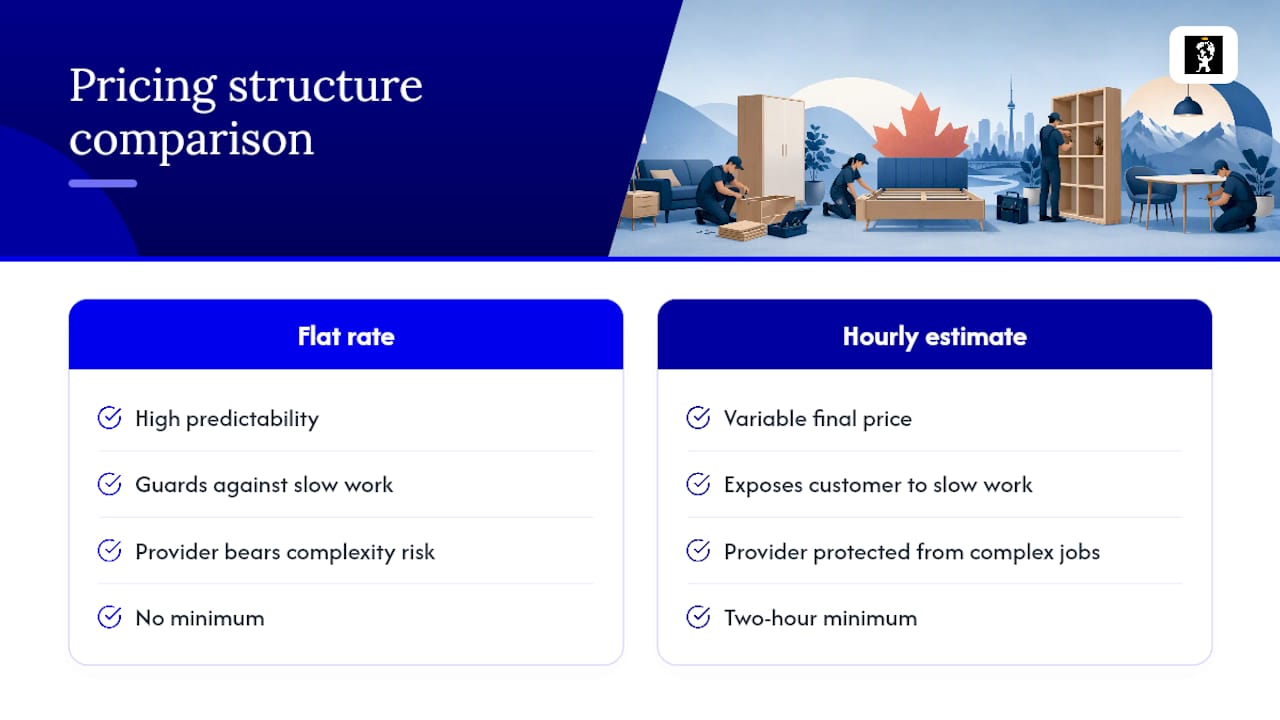
The conventional advice, get three quotes and pick the middle one, misses that quotes aren’t apples to apples unless the pricing structure is disclosed upfront. A flat per-item rate protects you from an assembler working slowly. An hourly rate protects the provider from unpredictable furniture designs. Neither is inherently better, but you need to know which one you’re agreeing to before the technician arrives.
What should come first isn’t the lowest number on a screen. It’s whether the provider will name their structure, their minimum, and their add-ons before you book. That’s the actual signal of a service worth trusting with your furniture and your schedule.
— Natalie
Book Assembly With a Price You Can See Upfront
Some assembly services offer itemized or flat-rate pricing set before arrival to avoid price adjustments after the work begins. Some providers can handle delivery and assembly under the same pricing structure for customer convenience.

Booking typically starts with a walkthrough to assess items, access details, and special requirements, followed by a confirmation of crew size, estimated hours, and any travel fees before scheduling. Combine it with our in-home delivery service if you’re assembling newly delivered pieces the same day.
Ready to see what your job actually costs? Get a quote through our assembly service page and book a time that works for your schedule.
Sources
Recommended
Comments