

Atlas Kings' Checklist to Verify a Flat Rate Furniture Delivery Quote


Flat-rate furniture delivery is a fixed price covering a stated set of services, such as pickup, transport, and placement, up to defined limits on weight, size, or access. It usually pays off for heavy or bulky items and small grouped deliveries, where weight-based pricing would climb fast. Before you book, ask exactly what that flat number includes.
TL;DR:
Flat-rate furniture delivery typically covers pickup, transport, and basic placement within a defined limit of weight, size, or access, offering predictability for heavy or bulky items.
Service tiers range from threshold drop-off to full in-home placement and assembly, with higher tiers significantly increasing the final cost due to additional labor.
Hidden fees often arise from oversize items, weight or piece limits, access issues, or disassembly requirements, making it crucial to measure access points beforehand.
Comparing quotes requires clear understanding of what each includes, such as assembly or multiple stops, and accurate measurements or photos to prevent unexpected charges.
Transparent pricing providers, like Atlas Kings, offer detailed, itemized quotes alongside flat rates, reducing surprises and ensuring clear service expectations before the crew arrives.
Table of Contents
What Flat-Rate Furniture Delivery Actually Covers
A flat fee is really a package deal. Instead of paying by the hour or by the pound, you’re paying one number for a defined bundle of labor and transport, and that bundle is the entire point. Providers set that price by estimating item count, distance, and the labor a job typically takes, then bake in a margin so unexpected delays don’t eat their profit.
This is a sharp contrast to hourly billing, where a slow elevator or a tricky staircase quietly adds dollars to your invoice, or dimensional pricing, where a large but light dresser gets charged like it weighs far more than it does.
Providers like flat-rate pricing for a simple reason: it turns a messy quote into a fast yes or no for the customer, and it lets dispatch schedule crews without guessing how long a job runs long. A typical flat-rate furniture package includes:
A defined pickup location and delivery address
Transport between those two points
Basic carry to an agreed drop point (often the threshold or first room)
A stated limit on weight, item count, or truck time
Furniture Flat-Rate vs. Parcel Flat-Rate: Don’t Confuse Them
Search “flat rate delivery meaning” and you’ll get a mix of two very different things. Parcel carriers sell flat-rate boxes: pack it in, and the price is fixed regardless of weight, as long as it fits the box and stays under the carrier’s weight limit, often between 50 and 70 pounds. That’s a shipping product, not a moving service.
Furniture movers sell something structurally different: a flat rate tied to service level, not box dimensions. Two examples make the split clear:
Parcel flat-rate: A 40 pound lamp shipped in a carrier’s flat-rate box costs the same as a 60 pound box of the same size, but a 300 pound sectional simply won’t fit the program at all.
Mover flat-rate: A 300 pound sectional gets a fixed price that already accounts for two movers, a truck, and carry-in labor, something no parcel carrier offers.
Carriers also vary in how they handle these programs, with different box sizes and zone rules. None of that logic applies once you’re hiring people to lift a couch.
What’s Usually Included, Tier by Tier
Furniture delivery fees almost always break into tiers, and knowing the tier names helps you read a quote correctly. Here’s the typical progression, from bare-bones to full service:
Threshold delivery. The crew brings the item to your door or building lobby. You handle the rest.
Room-of-choice delivery. The item goes to a specific room you designate, not just the door.
In-home placement. Movers position the piece where you want it, unwrap it, and often haul away the packaging.
White-glove or full-service delivery. Assembly, placement, and debris removal are all bundled in, and this is where labor time drives the biggest jump in cost.
Service level is often the single biggest hidden factor in what a flat rate actually costs, because assembly and in-home placement demand far more time on site than a curbside drop. Ask which tier a quoted price matches before you compare it against a competitor’s number, because two “flat rates” for the same couch can represent two entirely different jobs.
Fine Print That Can Turn a Flat Rate Into a Bigger Bill
Flat-rate quotes come with conditions, and the conditions are where surprise charges hide. Most providers set a general or conditional flat rate tied to weight or price thresholds, and furniture movers apply the same logic to item count and size.
Watch for these common triggers:
Weight or piece caps. Ask the exact number, not just “we handle heavy items.”
Oversize surcharges. Very large or unusually heavy items such as sectionals, safes, and pianos often fall outside the standard rate entirely.
Access fees. Stairs beyond a set number of flights, narrow hallways, or an elevator that requires a booked reservation window can all add a line item.
Disassembly and reassembly. If a piece has to come apart to fit through a doorway, confirm whether that’s included or billed separately.
Cancellation and failed-delivery fees. Many providers charge a fee if a crew arrives and can’t complete delivery because of an access issue nobody flagged in advance.
Pro Tip: Measure your tightest access point, whether that’s a stairwell corner or an elevator door, before you book. Providers routinely charge access or failed-delivery fees when a crew shows up and the item simply doesn’t fit, and that measurement takes five minutes with a tape measure.
When Flat-Rate Delivery Actually Saves You Money
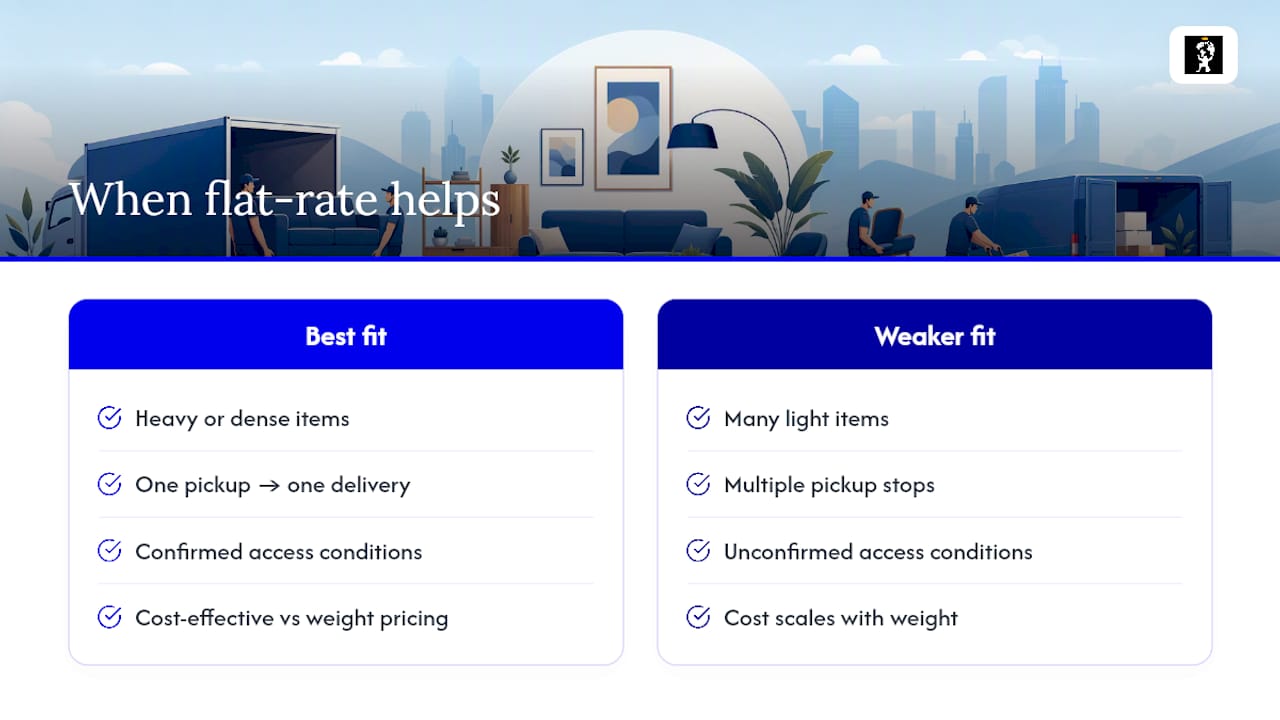
Flat-rate pricing shines for heavy or dense items moving from one pickup point to one delivery point with clear, known access. Think a single sofa, a washer and dryer set, or a small grouped delivery of three or four large pieces. Flat rates are most cost-effective for exactly this kind of load, since weight-based pricing would otherwise scale quickly with every extra pound.
Flat-rate pricing is a weaker fit when you have many light items, multiple pickup stops, or access conditions you haven’t confirmed yet. A single heavy item delivery typically books within a same-day to 48-hour window once measurements are confirmed; small multi-item moves usually run on a scheduled window of a few days out.
Consumers frequently assume “flat rate” means “cheap.” It doesn’t. It means predictable, and predictability is worth paying for when the job carries real risk of extra labor or access surprises.
How to Compare Flat-Rate Quotes Without Getting Burned
Comparing two flat-rate quotes side by side only works if you know they’re pricing the same job. Run through this checklist before you sign anything:
Ask what’s included, item by item. Does the price cover room-of-choice delivery? Assembly? Packaging removal? Get a yes or no on each, not a vague “we handle everything.”
Ask about weight and piece limits. Get the exact number in pounds or item count, and confirm what happens if your item exceeds it.
Measure your access points. Doorway widths, stairwell dimensions, and elevator interior size all matter. Write these down before you call.
Photograph the item and the path. A photo of the staircase or hallway lets a provider confirm the quote is accurate instead of guessing over the phone.
Read the limiting language closely. Phrases like “standard delivery” or “ground floor only” are conditions, not filler. Ask what triggers an upcharge.
Request written confirmation. A verbal quote isn’t a commitment. Get the tier, the inclusions, and the limits in an email or text before delivery day.
Pro Tip: If a provider hesitates to put the flat-rate scope in writing, treat that as a signal. A transparent flat rate should be specific enough to print and hand to the crew on delivery day.
Atlas Kings’ Approach to Transparent Pricing
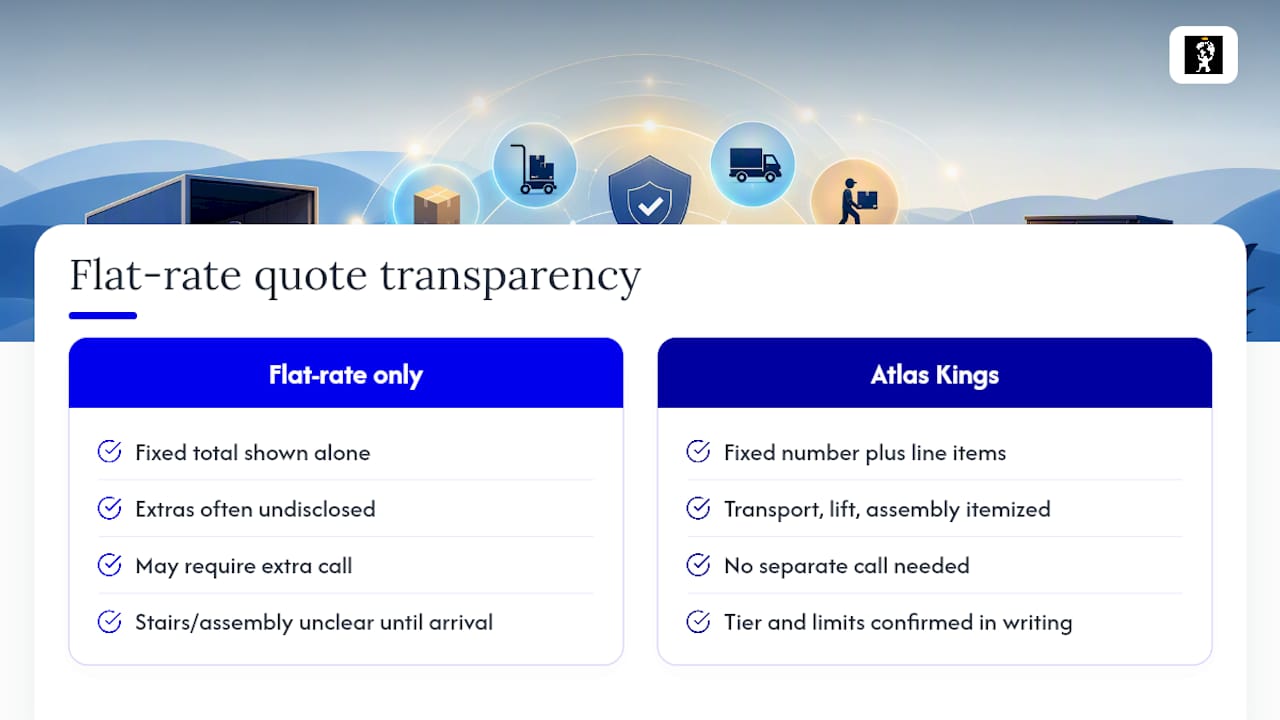
The company has experience with flat-rate and itemized pricing on the same job, so a customer can see both the fixed number and what built it. That structure exists precisely to close the gaps described above: no separate, unstated tier for assembly, no mystery access fee.
In practice, that means confirming dimensions and photos of tight stairwells or hallways before dispatch, and defining service tiers, threshold versus in-home delivery, in the quote itself. If you’re vetting another provider, use that same measurement checklist. A provider who can’t answer those questions clearly probably can’t price the job accurately either.
Price Isn’t the Whole Story
The lowest quote on your list is often missing a service you’ll need once the crew arrives, whether that’s assembly, stair access, or packaging removal, and those gaps get expensive fast once you’re negotiating on delivery day. A transparent quote that costs a bit more up front usually saves both time and money on jobs with real risk: stairs, tight hallways, or assembly.
A cheap, bare-bones quote is genuinely fine when the job is simple: threshold delivery, no stairs, a light or single item. Match the price to the risk, not the other way around.
— Natalie
Get a Transparent Flat-Rate Quote From Atlas Kings
Atlaskings is built around the exact transparency problem this article covers: knowing what your flat rate buys before the truck shows up. The Inhouse Delivery service combines flat-rate and itemized pricing on the same quote, so you see the fixed number alongside the line items behind it, transport, lift needs for oversized pieces, and assembly, instead of discovering them after the crew arrives.
That means no separate call to find out whether stairs cost extra and no guessing whether assembly is bundled in. If your delivery involves a heavy sectional, an appliance, or a small group of large items with clear access, request a quote through Atlas Kings’ Inhouse Delivery page and get the tier, inclusions, and limits confirmed in writing before you commit to a delivery date.
Where This Information Comes From
Carrier and logistics explainers from EasyPost, Shopify, and Pitney Bowes informed the pricing mechanics above. For local delivery specifics, visit Atlas Kings.
Sources
Recommended
Comments