

Cut Your Ontario Hydro Bill: 23.5% Rebate Plus $35 to $75 Credit


Apply for OESP, OER, or EAP if your household qualifies, and shift big electricity loads like laundry and EV charging to off-peak hours. Together, these two moves cover most of what’s achievable: government credits can knock $35 to $75 off a monthly bill, while off-peak shifting and small retrofits chip away at the rest. Start with the Ontario Energy Board’s bill calculator to see where you actually stand before changing anything.
TL;DR:
Most households can maximize savings by applying for multiple programs like OESP, OER, and EAP, as eligibility overlaps and they offer different benefits.
Shifting heavy electricity loads such as laundry and EV charging to off-peak hours, especially weekends and evenings, significantly reduces energy costs under Time-of-Use pricing.
Ensuring bill details are reviewed, including usage patterns, rebate lines, and rate breakdowns, can reveal specific habits and appliances that drive high costs.
Upfront actions like switching to LED bulbs and reducing thermostat settings can add immediate savings, making behavior changes more effective.
Table of Contents
Which Ontario Programs Actually Lower Your Hydro Bill?
Four government programs do the heavy lifting for Ontario households, and they work differently enough that most people should check all four rather than assume they only qualify for one.
The Ontario Electricity Support Program (OESP) is the one most renters and homeowners on a tight budget should check first. It provides a monthly on-bill credit to eligible low-income households, and the credit typically runs $35 to $75 per month depending on household size and income. You apply once, and the credit applies automatically to future bills.
The Ontario Electricity Rebate (OER) doesn’t require an application at all. As of November 1, 2025, it applies a 23.5% rebate on the pre-tax subtotal of most residential electricity bills. If you’re a residential customer in Ontario, you’re almost certainly already getting it. Check your bill; the line item usually appears near the bottom, above HST.
The Energy Affordability Program (EAP) goes further than a credit. It sends accredited contractors to install free upgrades, LED bulbs, low-flow showerheads, thermostat adjustments, and minor insulation fixes, and eligible households typically save $100 to $750 a year depending on which measures get installed.
The Low-Income Energy Assistance Program (LEAP) exists for a different problem: unpaid bills. If you’re behind on payments and facing disconnection, LEAP provides emergency grants through local intake agencies rather than an ongoing monthly credit.
A few notes worth flagging:
Eligibility and exact credit tiers vary slightly by utility, since distributors like Hydro One administer OESP locally.
OER shows up automatically; you don’t need to apply.
EAP and OESP both require an application, and you can pursue both at once.
LEAP is for arrears specifically, not routine bill reduction.
What Can You Do This Week to Cut Usage?
Government credits handle one side of the equation. What you actually use handles the other, and Ontario’s Time-of-Use pricing means when you use electricity matters almost as much as how much you use.
Shift heavy loads to off-peak hours. Laundry, dishwashers, and EV charging are the biggest discretionary loads in most homes. Off-peak shifting is one of the most effective levers available because weekends and holidays are off-peak all day under Time-of-Use pricing.
Kill phantom load. Game consoles, cable boxes, and phone chargers left plugged in draw power around the clock. A smart power strip (roughly $20 to $40) cuts power to idle devices automatically.
Switch to LED bulbs. They cost more upfront but use a fraction of the electricity of incandescent bulbs and typically pay for themselves within a year.
Adjust your thermostat by a few degrees. Lowering it in winter or raising it in summer by even 2 to 3 degrees adds up over a billing cycle.
Wash clothes in cold water and batch tasks. Running fewer, fuller loads beats several small ones.
Pull your usage data. Most utilities offer Green Button data downloads, which show exactly which hours and appliances are driving your costs instead of guessing.
Pro Tip: Run your dishwasher and laundry after 7 p.m. on weekdays, or anytime on weekends, since Ontario treats weekends and holidays as off-peak around the clock.
Should You Switch Your Electricity Price Plan?
Ontario gives you three pricing structures, and picking the wrong one can quietly cost you more than sticking with the default.
Time-of-Use (TOU) charges different rates depending on the hour: cheapest overnight and on weekends, most expensive on weekday afternoons and early evenings. Ultra-Low Overnight (ULO) pushes that further, offering a very low overnight rate in exchange for a higher on-peak rate during the day. Tiered pricing charges one flat rate up to a monthly threshold, then a higher rate beyond it, regardless of time of day.
The OEB is blunt about this: benefits depend entirely on your household’s usage pattern, so run your own numbers through the bill calculator before switching.
A rough guide:
ULO tends to help households that reliably shift laundry, dishwashing, and EV charging to overnight hours.
ULO can backfire for households that run air conditioning or major appliances during the day, since the trade-off is a steeper on-peak rate.
Tiered suits households with steady daytime usage who don’t want to think about timing at all.
One procedural detail matters: if your utility receives your plan election less than 10 business days before your billing cycle starts, the switch may not take effect until the following cycle. Check the effective date printed on your next bill to confirm it went through.
How Do You Apply for Credits and Avoid Scams?
Applying for OESP or EAP takes a few steps, and the same steps double as your defense against fraud.
Apply directly through ontarioelectricitysupport.ca for OESP, or contact your local intake agency for EAP and LEAP.
Gather your utility account number, the account holder’s name, and proof of household income or size before you start.
Expect credits to appear on your bill within one to two billing cycles; if they don’t, call your utility directly to confirm processing.
Roughly 65% of Ontario households currently shift some usage to off-peak hours to reduce costs, according to OEB guidance, but far fewer take the extra step of applying for available credits. Neither the government nor your utility will ever charge a fee to apply for OESP, OER, or EAP. If someone calls asking for payment or your banking information to “process” a rebate, hang up.
What Kind of Savings Should You Expect?
The math looks different for every household, but a few sourced examples give you a realistic range.
A household using 700 kWh a month sees roughly $36 shaved off through the 23.5% OER rebate alone, before any other program applies.
An OESP-eligible household adds another $35 to $75 monthly credit on top of that.
EAP’s free upgrades add $100 to $750 in annual savings, depending on which measures your home needs.
Stack OER and OESP together and a qualifying household could realistically see a significant amount knocked off a single month’s bill, before behavior changes even enter the picture. Your actual number depends on usage, household size, and which programs you qualify for, so treat these as directional, not guaranteed.
How Home Prep Makes Energy Upgrades Work Better
Free EAP upgrades and heat pump retrofits only perform as well as the space they’re installed in. A cluttered basement blocks contractor access to your furnace or water heater. Furniture pushed against vents chokes airflow before the air even reaches the thermostat.

Clearing that path before a contractor visit is one of the cheapest steps you can take before locking in an energy rebate. If you’re weighing whether an assessment is worth the cost, it helps to know what a home energy audit typically runs in Ontario before booking one. For bigger jobs, like moving a fridge to access coils, or hauling out furniture ahead of insulation work, hiring help beats risking a strained back or a scratched floor.
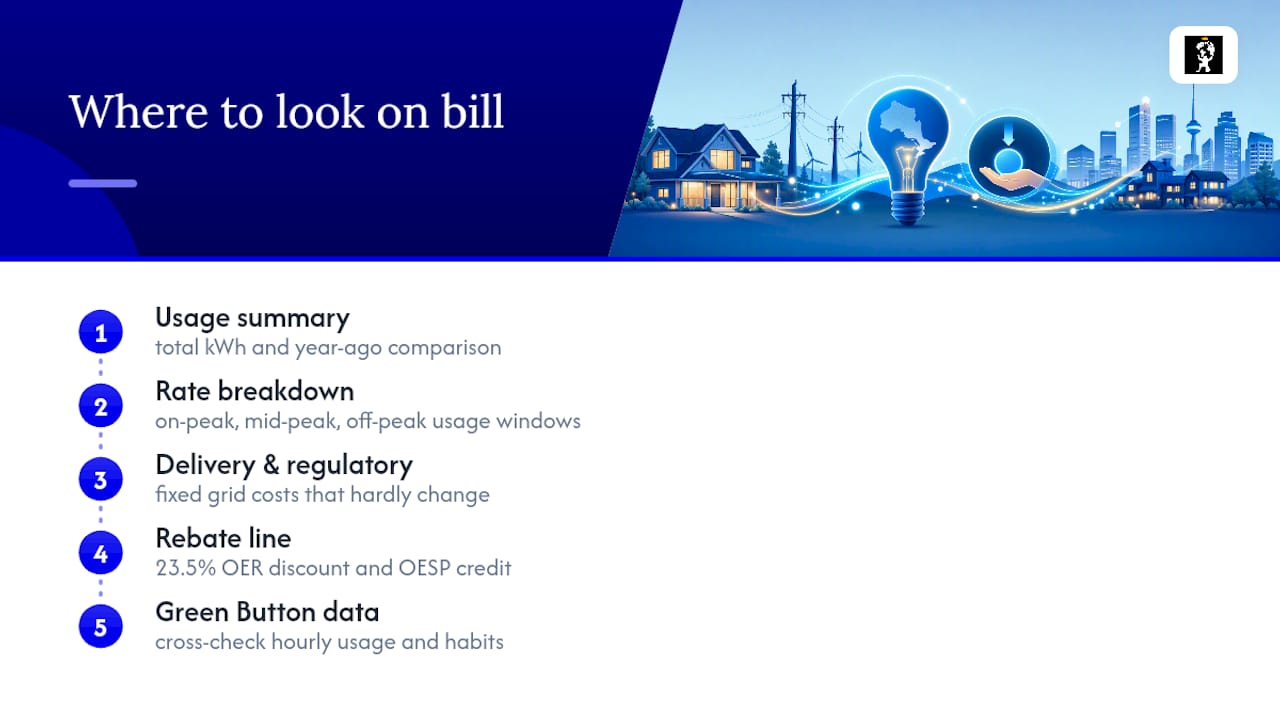
How to Read Your Hydro Bill for Hidden Savings
Most Ontario hydro bills follow the same layout, and once you know where to look, the bill itself tells you exactly where your money is going.
Start with the usage summary, usually near the top, showing total kWh consumed for the billing period compared to the same month last year. A sudden jump often points to a specific culprit, a space heater, a new appliance, or a heat pump running inefficiently.
Below that sits the rate breakdown, showing how much electricity you used during on-peak, mid-peak, and off-peak windows if you’re on Time-of-Use pricing. This is the single most useful section for spotting behavior changes. If most of your usage clusters in the expensive afternoon window, that’s your target.
The delivery and regulatory charges section covers fixed costs tied to maintaining the grid; these don’t change much no matter how little you use, which is why extremely low usage sometimes still produces a bill that feels disproportionately high.
Finally, look for the rebate line, where the 23.5% OER discount appears, and any OESP credit if you’re enrolled. If you don’t see either and think you should, that’s your cue to call your utility.
Cross-reference this against your Green Button usage data if your utility offers it. Together, the bill and the usage history show you not just how much you’re spending, but exactly which hours and habits are driving the number up.
Does Switching Electricity Providers Save You Money?
Ontario’s electricity market works differently than provinces with full retail competition. Your local distributor, Hydro One or a municipal utility depending on where you live, delivers the power and bills you for it regardless of who generates it. You can’t shop around for a cheaper distributor the way you might compare cell phone carriers.
What you can choose, in most cases, is a retailer contract for the commodity portion of your bill, or you can stick with the regulated rate set by the OEB. Regulated rates (TOU, ULO, or Tiered) are set by the province and reviewed regularly, which means no salesperson, no fixed-term contract, and no early termination fees.
Retailer contracts sometimes promise rate stability, but they’ve also drawn complaints over the years for locking customers into rates above the regulated price once market conditions shift. Before signing anything with a door-to-door or phone retailer, compare their offered rate directly against your current regulated rate using your last few bills. If a retailer can’t clearly show your savings in writing, that’s a warning sign.
For most homeowners and renters, the more reliable path to lower costs isn’t switching providers. It’s making sure you’re on the right regulated price plan for your usage pattern, and layering government credits on top.
Do Solar Panels and Net Metering Make Sense in Ontario?
Net metering lets homeowners with solar panels send excess electricity back to the grid and receive credit against future bills, rather than being paid cash for it. Ontario’s net metering rules, overseen by the OEB, allow eligible customers to bank credits generated during sunny months and draw them down during darker winter stretches.
The economics depend heavily on your roof orientation, local sun exposure, and how much of your usage happens during daylight hours, since credits offset consumption rather than generate income. A south-facing roof with minimal shading in a region like Niagara or Hamilton performs noticeably better than a shaded, north-facing roof in the same city.
Ontario’s net metering program doesn’t pay out unused credit balances in cash at the end of the year in most cases; it typically carries forward or resets, so oversizing a solar system rarely makes financial sense. The better strategy is sizing panels to cover a realistic share of daytime usage, then letting net metering handle the gap between sunny and cloudy days.
Solar isn’t a fit for every household, particularly renters or condo owners without roof access, but for detached homeowners with a clear southern exposure, it’s worth requesting a formal quote and comparing the payback period against your current annual electricity spend before committing.
How Should You Adjust Hydro Habits by Season?
Ontario’s climate swings hard between seasons, and your electricity habits should swing with it.
Winter is when heating dominates the bill. Space heaters are convenient but expensive to run for hours at a time; a programmable thermostat set a few degrees lower overnight, combined with sealing drafts around windows and doors, does more for your bill than any single appliance swap. Block heaters for cars pull surprising amounts of power if left plugged in all night; a timer that runs it for two hours before you leave uses far less than one running from midnight to 7 a.m.
Summer flips the problem to air conditioning, which is exactly the load that collides hardest with on-peak TOU pricing on hot weekday afternoons. Pre-cooling your home in the morning off-peak window, then letting it drift a couple degrees warmer during the expensive afternoon hours, can meaningfully cut your on-peak draw without sacrificing comfort.
Spring and fall are the cheapest seasons by default since heating and cooling loads both drop. That makes them the ideal window to schedule any retrofit work, insulation upgrades, thermostat installs, so you’re set up before the next extreme season hits.
What Other Retrofit Help Exists Beyond Government Programs?
Government programs cover a meaningful chunk of retrofit costs, but they don’t cover everything, and several other resources fill the gaps.
Some municipalities in the Niagara and Hamilton regions run local energy efficiency incentive pilots that stack on top of provincial programs; check your municipal website directly, since these come and go with funding cycles. Utility-specific conservation programs, run separately from OESP or EAP, sometimes offer rebates on smart thermostats or high-efficiency appliances. If you’re considering a heat pump specifically, it’s worth reading up on available heat pump rebates for Ontario homeowners before budgeting for the full retail cost.
Financing programs through some municipalities also let homeowners spread retrofit costs over property tax installments rather than paying upfront, which matters for anyone doing a larger insulation or window replacement project. And if a retrofit means replacing an old, inefficient appliance, checking appliance recycling costs in Ontario ahead of time avoids a surprise fee when the old unit needs to go.
This Week’s Priority Checklist
Check your eligibility for OESP and EAP today, run your usage through the OEB’s bill calculator before touching your price plan, and move one heavy load, laundry or EV charging, to off-peak this week. If the application feels confusing, call a local intake agency; that’s what they’re there for.
— Natalie
Let Atlas Kings Handle the Heavy Lifting on Your Energy Upgrade
A practical partner for the physical side of an energy retrofit handles tasks like clearing the basement before the contractor arrives, moving the old fridge out once the new efficient one is delivered, and getting furniture off the vents HVAC technicians need to reach.

Our Space Reset service declutters a room before insulation or duct work begins, so contractors aren’t tripping over boxes on day one. Need a new appliance delivered and the old one hauled away the same afternoon? Inhouse Delivery covers that in one visit with flat-rate pricing and no hidden fees. And if a retrofit means a small move, shifting a few large items to make room for new equipment, our Small Move service handles under 10 items without the cost of a full moving crew.
Ready to prep your space for an efficiency upgrade? Book online and get a flat-rate quote before your contractor’s first visit.
Sources
FAQ
Who Is Eligible for the Ontario Hydro Bill Relief Program?
Eligibility for OESP is based on household income and size, and you apply directly through ontarioelectricitysupport.ca; households facing arrears instead of ongoing high bills should look at LEAP through a local intake agency.
What Is the Cheapest Time to Do Laundry in Ontario?
Weekends and holidays are off-peak all day under Time-of-Use pricing, and on weekdays the cheapest window is typically overnight, so running laundry then costs the least.
What Is the Simple Trick to Cut Your Electric Bill?
Shift your biggest loads, laundry, dishwasher, EV charging, to off-peak hours and unplug idle electronics or use a smart power strip to eliminate phantom draw; both cost nothing and produce a visible difference within one billing cycle.
What Runs Up Your Electric Bill the Most?
Heating and cooling drive the largest share of most Ontario bills, followed by running major appliances like dryers, dishwashers, or EV chargers during expensive on-peak afternoon hours instead of off-peak windows.
Recommended
Comments