

Rain Garden Installation Cost: A Homeowner's Guide

A professionally installed rain garden typically runs $4–$22 per square foot, with most residential projects landing around $8/sq ft. Costs for rain gardens vary by size and whether you DIY or hire a contractor. Small projects cost less when done yourself, while professional installation costs more before any rebates. Municipal reimbursement programs can reduce professional costs depending on the city.
Three factors drive most of the cost variation:
Soil and drainage conditions — clay soil or a high water table often requires an underdrain system, adding significant labor and materials
Labor — professional installation typically accounts for 40–60% of the total quote
Plant density and selection — mature shrubs and native trees cost far more per plant than plugs or bare-root perennials
Key Takeaways
Professional rain garden installation costs $4–$22 per square foot nationally, with most residential projects averaging around $8/sq ft installed and $2–$5/sq ft for DIY materials only.
Point | Details |
Installed cost range | Expect $4–$22/sq ft professionally installed; DIY materials run $2–$5/sq ft for small projects. |
Biggest cost driver | Soil type determines whether you need an underdrain — run a percolation test before budgeting. |
Rebates reduce net cost | Programs like Philadelphia Rain Check and Howard County reimbursement require pre-approval before installation. |
Get itemized quotes | Normalize bids to per-sq-ft installed and confirm excavation, soil, and underdrain are all included. |
Atlaskings support | Atlaskings provides itemized delivery of soil and mulch and lawn refresh services to support installation and upkeep. |
Table of Contents
What does rain garden installation cost, line by line?
Understanding each cost component helps you read a contractor quote without guessing. Most quotes bundle some items and separate others, so knowing the typical per-item ranges lets you spot where a bid might be light or inflated.
Labor and soil preparation consistently make up the largest share of a professional quote. The Vermont Rain Garden Manual includes a cost-and-labor matrix confirming that excavation and soil amendment together often represent more than half of total installed cost on residential projects.
Watch for quotes that omit the underdrain line entirely. On sites with clay or compacted soil, that omission can mean a garden that pools water for days and eventually fails.
What makes your project land high or low on the cost range?
Size is the most obvious driver, but it is rarely the most important one. Soil type and site complexity routinely push a straightforward project into a higher cost tier.
Ponding depth and excavation volume — a garden designed for 6-inch ponding depth requires twice the excavation of a 3-inch design, directly multiplying labor and disposal costs
Soil infiltration rate — sandy loam drains well and rarely needs an underdrain; clay or compacted fill soil often does, and percolation testing is the only reliable way to know before you dig
Slope and access — a steep grade requires a berm on the downhill side, sometimes with compacted fill or stone; tight side-yard access adds equipment and hand-labor time
Plant selection — a 100 sq ft garden planted with native plugs at $1 each costs a fraction of the same area planted with 3-gallon shrubs at $18–$35 each
Regional labor rates — coastal and mountain markets typically add 10–20% to base costs compared to Midwest or rural rates
Permit and engineering requirements — some municipalities require a licensed engineer to stamp a design if the garden exceeds a certain size or is within a regulated setback
Pro Tip: Run a simple percolation test before calling contractors. Dig a 12-inch hole, fill it with water, let it drain, refill it, and time how long the second fill takes to drain. If it takes more than 36 hours, budget for an underdrain from the start.
Should you DIY or hire a contractor?
Small, simple gardens on well-draining soil are genuinely good DIY candidates. Complex drainage situations, proximity to a foundation, or any need for permits typically call for professional design and installation.
University of Kentucky Extension data puts DIY material costs at $2–$5 per square foot for a small residential project. Professional installation runs $10–$13/sq ft in many markets, with the national average around $8/sq ft across all project sizes.
When to hire a professional:
Percolation test shows drainage slower than 36 hours
The garden will sit within 10 feet of your foundation or a septic system
Your municipality requires a permit or engineered design
The site has a slope greater than 12% or unknown buried utilities
You have no experience with grading or drainage work
Hidden DIY costs are real and often underestimated. Equipment rental for a mini-excavator runs $150–$400 per day. Hauling excavated soil costs $100–$400. Replacement plants after a failed first season add another $50–$200. A DIY project that requires a second attempt can easily exceed the cost of hiring a contractor the first time.
Pro Tip: Ask any contractor for two versions of their quote: one itemized by line, one as a lump sum. The gap between them tells you how much room exists to negotiate or scope down.
How do you size a rain garden and estimate your budget?
The standard sizing formula used by extension programs across the country is straightforward:
Garden area = (Runoff area × Runoff coefficient × Design storm depth) ÷ Ponding depth
The EPA’s rain garden guidance and state extension manuals both reference this approach, with the Vermont Rain Garden Manual providing detailed sizing equations and recommended ponding depths of 3–12 inches for residential installations.
Worked Example 1 — Small roof downspout:
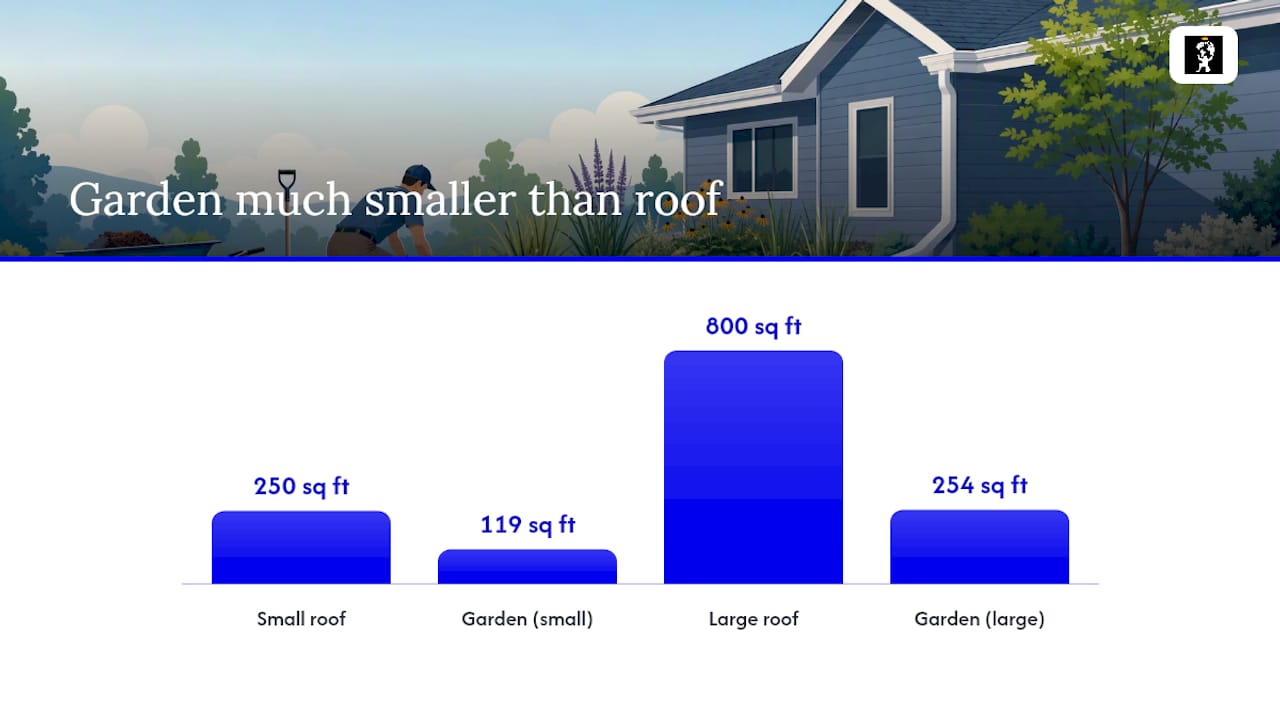
Measure the roof area draining to one downspout: 10 ft × 25 ft = 250 sq ft
Apply a runoff coefficient for a shingled roof: 0.95
Design storm depth: 2 inches (0.167 ft)
Ponding depth: 4 inches (0.333 ft)
Garden area = (250 × 0.95 × 0.167) ÷ 0.333 = 119 sq ft
At $8/sq ft installed: ~$950 professional or $2–$5/sq ft DIY: ~$240–$595 materials
Worked Example 2 — Larger roof, deeper ponding:
Roof area: 20 ft × 40 ft = 800 sq ft; coefficient: 0.95
Design storm: 2 inches (0.167 ft); ponding depth: 6 inches (0.5 ft)
Garden area = (800 × 0.95 × 0.167) ÷ 0.5 = 254 sq ft
At $8/sq ft installed: ~$2,030 professional or DIY materials: ~$510–$1,270
Quick measurement tips:
Use your county’s GIS parcel map to measure roof footprint without climbing up
Your local cooperative extension office can review your sizing math for free
A simple percolation check (described above) takes 30 minutes and can save you thousands
Note: University of Delaware extension guidance recommends sizing the rain garden at roughly 10–20% of the contributing drainage area as a practical rule of thumb when a full calculation is not feasible.
How rebates and reimbursement programs lower your net cost
Many U.S. cities and counties offer per-square-foot reimbursements or fixed-cap grants for residential rain gardens. Program rules vary significantly, and pre-approval is almost always required before you break ground.
Philadelphia Rain Check Program
The Philadelphia Water Department runs a Rain Check program that has offered reimbursements of up to $2,500 for qualifying residential stormwater installations, including rain gardens. Homeowners must apply before installation, use an approved contractor or follow approved design standards, and pass a post-installation inspection. The program is designed to reduce combined sewer overflow events in the city.
Howard County, Maryland
Howard County operates a rain garden reimbursement program through its stormwater management office. Eligible homeowners can receive per-square-foot reimbursements up to a program cap. Like Philadelphia, the county requires pre-approval, adherence to approved plant lists, and a final inspection before funds are released.
Key rule across nearly all municipal programs: Reimbursement is never guaranteed until the municipality confirms eligibility, completes the post-install inspection, and approves the final paperwork. Never count on rebate funds to cover upfront contractor costs.
How to find programs in your area:
Search “[your city or county] + stormwater rebate” or “rain garden reimbursement”
Check your state’s department of environmental quality or natural resources website
Contact your local cooperative extension office — they often maintain updated lists of local programs
Review the EPA’s stormwater resources for links to regional programs
Documents typically required for a rebate application:
Site plan or sketch showing garden location relative to structures
Contractor quote or materials list (for DIY applications)
Pre-approval confirmation from the municipality
Post-installation photos and inspection sign-off
What does the installation timeline look like, and what will maintenance cost?
Most residential rain gardens take 1–3 days of active installation work once materials are on site. The first two years require more attention than the garden will need long-term.
Typical project milestones:
Week 1–2: Site visit, soil percolation test, design finalization
Day 1 of install: Utility marking (call 811), layout staking, excavation
Day 2: Soil mix placement, overflow pipe installation, edging
Day 3 (if needed): Planting, mulching, final grading check
Months 1–6: Weekly watering during dry spells; hand-weeding while plants establish
Year 1–2: Two establishment checks; replace any plants that did not survive
Annual maintenance after establishment is modest. Weeding, light pruning, and a mulch top-up once per year typically run $25–$150 depending on garden size and plant density. Texas Water Resources Institute notes that rain gardens are among the lower-maintenance stormwater options available to homeowners, particularly when planted with well-chosen native species.
Denser plantings with native perennials tend to suppress weeds naturally after the second year, reducing the time and cost of upkeep compared to sparse plantings that leave bare soil exposed.
Permits, setbacks, and red flags that can add cost or create real risk
Before you dig, a few checks can prevent expensive problems or outright project failure.
Standard setbacks and permit triggers:
Most extension manuals recommend keeping rain gardens at least 10 feet from any building foundation; the Vermont Rain Garden Manual cites 10–30 ft guidelines depending on soil type and slope
Septic systems and drain fields require larger buffers — typically 50–100 feet
Gardens larger than a certain threshold (often 500 sq ft or more) may trigger local stormwater permit requirements
Grading that redirects water onto a neighbor’s property can create legal liability
Call 811 before you dig. This is not optional. DIG SAFE / 811 is the national utility notification system; calling it at least three business days before excavation is required by law in every U.S. state.
Red flags that require a professional assessment:
Percolation test shows water standing for more than 36 hours
The proposed garden location is uphill of or adjacent to your foundation
You find unexpected buried debris, pipes, or hardpan during test digging
The site is within a regulated floodplain or wetland buffer
A septic system or drain field is anywhere nearby
Pro Tip: If you are in a municipality with a rebate program, confirm permit requirements with the stormwater office at the same time you apply for pre-approval. Some programs handle permit coordination as part of the application process.
How to get and compare contractor quotes
Request itemized quotes from at least two or three contractors. A single lump-sum number tells you almost nothing about whether the work is scoped correctly.
Must-ask items for every quote:
Does the quote include a soil percolation test or site drainage assessment?
What is the soil mix specification (sand/compost ratio, filter bed depth)?
What is the plant list, species names, and container size?
Is underdrain or French drain included, and under what conditions would it be added?
How is overflow routed, and what pipe size and outlet type are specified?
Are excavation, haul-away, and disposal included or separate?
Who handles permit applications, and is that fee included?
What is the warranty on plants and labor, and for how long?
How to compare bids fairly:
Convert every quote to a per-square-foot installed cost by dividing the total by the garden area
Confirm whether excavation and soil import are included in each bid
Check whether the plant counts and species match across quotes
Verify that overflow routing and any underdrain work appear in all bids
Ask each contractor how they handle a percolation failure discovered during excavation
Red flags in contractor bids:
A one-line lump sum with no materials breakdown
No mention of a site visit or percolation assessment
A bid significantly lower than others that omits underdrain and haul-away
Vague plant descriptions (“native plants” with no species list or container size)
No warranty language at all
When professional installation makes the most sense
Direct recommendation: when site complexity, drainage risk, or time constraints are real factors, professional installation reduces the likelihood of costly rework and protects your property.
Atlaskings works with homeowners on site preparation, material delivery, and follow-up maintenance as part of our lifestyle services. Our itemized pricing model means you see exactly what each component costs before any work begins — no bundled surprises.
A typical scenario we encounter: a homeowner in a suburban neighborhood with a downspout draining toward the house selects a garden location that looks reasonable on the surface. A professional site assessment reveals the soil is compacted clay fill from original construction, percolation fails at 48 hours, and the proposed location is 8 feet from the foundation. Redirecting the downspout, relocating the garden, and adding an underdrain adds cost upfront. It prevents foundation moisture infiltration that would have cost far more to remediate later.
Services that support a smooth installation:
Site preparation and grading assessment
Delivery of soil, mulch, and plant materials
Seasonal lawn refresh and post-install maintenance checks
Itemized estimates with no hidden fees
An editorial perspective on rain garden costs
The most common mistake homeowners make when budgeting for a rain garden is treating the per-square-foot range as a flat number rather than a range with real conditions attached. The $4 end of the range exists. So does the $22 end. They describe completely different projects on completely different sites.
What the typical cost guide underplays is the percolation test. It costs almost nothing to run yourself, takes 30 minutes, and determines whether your project is a $600 DIY afternoon or a $4,000 engineered installation. Skipping it is the single most reliable way to end up with a garden that pools water for a week after every rain and eventually needs to be rebuilt.
The rebate programs are also more valuable than most homeowners realize, but they require patience. Philadelphia’s Rain Check program and Howard County’s reimbursement both require pre-approval. That means the sequence is: test your soil, design your garden, apply for pre-approval, get your approval confirmed, then hire your contractor. Homeowners who reverse that order and install first rarely receive reimbursement.
Finally, the DIY vs. professional question is less about skill than about site conditions. A homeowner with no landscaping experience can successfully install a rain garden on sandy loam soil with good slope and clear drainage. A professional landscaper cannot reliably install a rain garden on a clay site near a foundation without a drainage assessment first. The soil is the variable that matters most.
Atlaskings can help you get your rain garden project started
Handling the logistics of a rain garden project — sourcing and delivering soil amendments, mulch, and plant materials, coordinating site prep, or managing seasonal upkeep — is where many homeowners lose time and budget. Atlaskings offers reliable in-home delivery of bulk materials and a lawn refresh service that supports both pre-installation prep and post-install maintenance.

Our itemized pricing means you see the cost of each service before we arrive. No bundled fees, no surprises on the final invoice. Whether you need a one-time soil and mulch delivery or ongoing seasonal maintenance after your garden is established, we build the scope around what your project actually needs. Request an itemized estimate or book a virtual consult at Atlaskings to get a clear picture of what support would cost for your specific project.
Sources
These resources provide technical sizing guidance, plant lists, cost calculators, and local rebate information directly from extension programs and government agencies.
Recommended
Comments