

Is Moving to Welland the Right Call for Your Family?
- William Wooldridge

- 4 hours ago
- 11 min read

Welland fits families, first-time buyers, and remote or hybrid workers who want more house for less money without giving up canal-front parks and a real sense of community. Housing costs sit 3 to 11 percent below the Ontario average, which offsets the tradeoff of a longer commute if your job pulls you toward Toronto. If your work stays local or hybrid, the math favors Welland immediately.
TL;DR:
Welland’s housing costs are 3 to 11 percent below Ontario averages, making it a cost-effective choice for families and remote workers.
Commuting to Toronto is lengthy and complex, so Welland suits hybrid or local jobs but is less practical for full-time Toronto downtown employment.
Neighborhoods vary from new suburban North Welland to waterfront Dain City, with choices driven by lifestyle preferences such as schools, recreation, or walkability.
The housing market is diverse, offering everything from historic downtown homes to newer subdivisions, with first-time buyers often finding entry-level options here.
Crime levels are higher than Ontario averages, but safety varies significantly by neighborhood, making local neighborhood visits essential before moving.
Table of Contents
What to Know Before Moving to Welland: Population and Livability Snapshot
Welland carries a livability score of 71 out of 100, a number driven mostly by affordability and amenities rather than any single standout feature. That score puts it in solid, unremarkable territory: not a hidden gem, not a compromise, just a genuinely workable place to build a life.
The affordability gap is the number that matters most for anyone weighing a move from the Greater Toronto Area. Housing and everyday costs in Welland run 3 to 11 percent below the Ontario average, and that gap widens sharply when you compare it against GTA benchmarks specifically. A family selling a semi-detached home in Mississauga or Oakville can often buy a comparable or larger property in Welland and still bank the difference.
Location explains a lot of this value. Welland sits centrally in the Niagara Region, with many parts of the city reaching St. Catharines and Niagara Falls in under 30 minutes by car. You get small-city pricing with regional-city access, which is a rarer combination than it sounds.
The commute story is more mixed. Welland works well if your job is anywhere in Niagara or if you work hybrid. It works far less well if your employer expects you in downtown Toronto five days a week, since that drive is long and typically requires multi-leg travel rather than a straightforward highway run. Factor that reality in before you commit to a lease or a mortgage.
Which Neighborhoods in Welland Fit Your Lifestyle Best?
Welland’s neighborhoods split along fairly clear lines, and picking the right one has more to do with your daily routine than your budget alone. Local property guides group the city into a handful of distinct pockets, each with its own personality.
North Welland leans newer and suburban, with subdivisions built for families who want driveways, backyards, and proximity to schools. West Welland tends to be a bit more established, with a mix of housing ages and easier access to shopping corridors. If you want walkability and small-town character over new construction, West Welland usually delivers more of it per dollar.
Dain City and Merritt Island sit closest to the water and trade some convenience for lifestyle. These areas hug the Welland Recreational Canal, so residents get direct access to trails, rowing events, and waterfront green space, but you’ll drive a little farther for big-box shopping. East Welland is a practical middle ground, often more affordable, with straightforward access to Highway 406.

Downtown Welland offers the most walkable, historic core, with older housing stock and a slower pace. It suits buyers who value character over square footage.
None of these areas is objectively “best.” The right one depends on whether you’re optimizing for school access, canal recreation, commute time, or price per square foot.
What Does the Housing Market Look Like in Welland?
Welland’s housing stock is genuinely mixed, which is part of what makes it appealing to a wide range of buyers. You’ll find postwar bungalows, 1970s and ‘80s subdivisions, newer builds in North Welland, and older character homes downtown, often within a few minutes’ drive of each other.
Local relocation guides consistently describe Welland as a value-driven Niagara option, and that reputation holds up against neighboring markets like St. Catharines or Niagara-on-the-Lake, where comparable homes routinely cost more. First-time buyers priced out of the GTA often find their first realistic entry point here, particularly for semi-detached homes and older bungalows that need light updating.
Renting is a smaller, tighter market than buying. Purpose-built rentals exist but move quickly, and much of the rental stock is basement apartments or secondary units in single-family homes. If you’re not ready to buy immediately, budget extra time for the rental search and consider a short-term lease while you scope out neighborhoods in person.
One practical note for anyone comparing across regions: sale prices vary meaningfully street to street depending on canal proximity, lot size, and school catchment, so a citywide average tells you less than walking a specific block will.
How Much Does It Cost to Live in Welland?
Housing is the single biggest lever in your cost of living, and Welland pulls that lever in your favor. With overall costs running 3 to 11 percent below the Ontario average, the savings show up most in your mortgage or rent payment, not in groceries or gas, which track closer to provincial norms.
Build your budget around a few practical categories:
Housing: the biggest line item and the biggest source of savings versus the GTA or St. Catharines.
Utilities: comparable to other mid-size Ontario cities; older homes may run higher heating costs in winter.
Transportation: expect to own a car; budget for gas and insurance even if you also use transit occasionally.
Property taxes: factor these into your monthly budget before you set a maximum home price, not after.
Pro Tip: Run your numbers through a moving cost calculator before you set your home-buying budget. Movers, deposits, and setup costs add up fast, and it’s easier to plan around them than to discover them mid-move.
The households that do best financially in Welland are the ones who redirect their housing savings toward things that actually improve daily life: a shorter loan term, a home renovation, or simply a bigger cushion in savings.
Can You Commute From Welland, or Should You Work Locally?
Highway 406 is Welland’s main artery, connecting the city north to the QEW and giving reasonably quick access to St. Catharines, Niagara Falls, and the broader Niagara Region. If your work is anywhere in that corridor, the drive is manageable and often faster than a comparable GTA commute.
Public transit is more limited. Niagara Region Transit connects Welland to neighboring municipalities, but service frequency and coverage don’t match what you’d get in a larger city, so plan around a car for daily errands and most work trips.
The bigger gap is GO Transit. Welland doesn’t have direct GO rail access, and getting to Toronto typically means driving to a GO station in another municipality or relying on a long, multi-leg trip that can eat two or more hours each way. That reality rules out Welland for anyone who needs a daily downtown Toronto office job without a hybrid arrangement.
If your employer offers even two or three remote days a week, the math changes completely. You get Welland’s lower housing costs on the days you’re home, and you absorb the long commute only occasionally. That’s the calculation most successful Welland transplants are quietly making already.
Are the Schools and Healthcare in Welland Good Enough for Families?
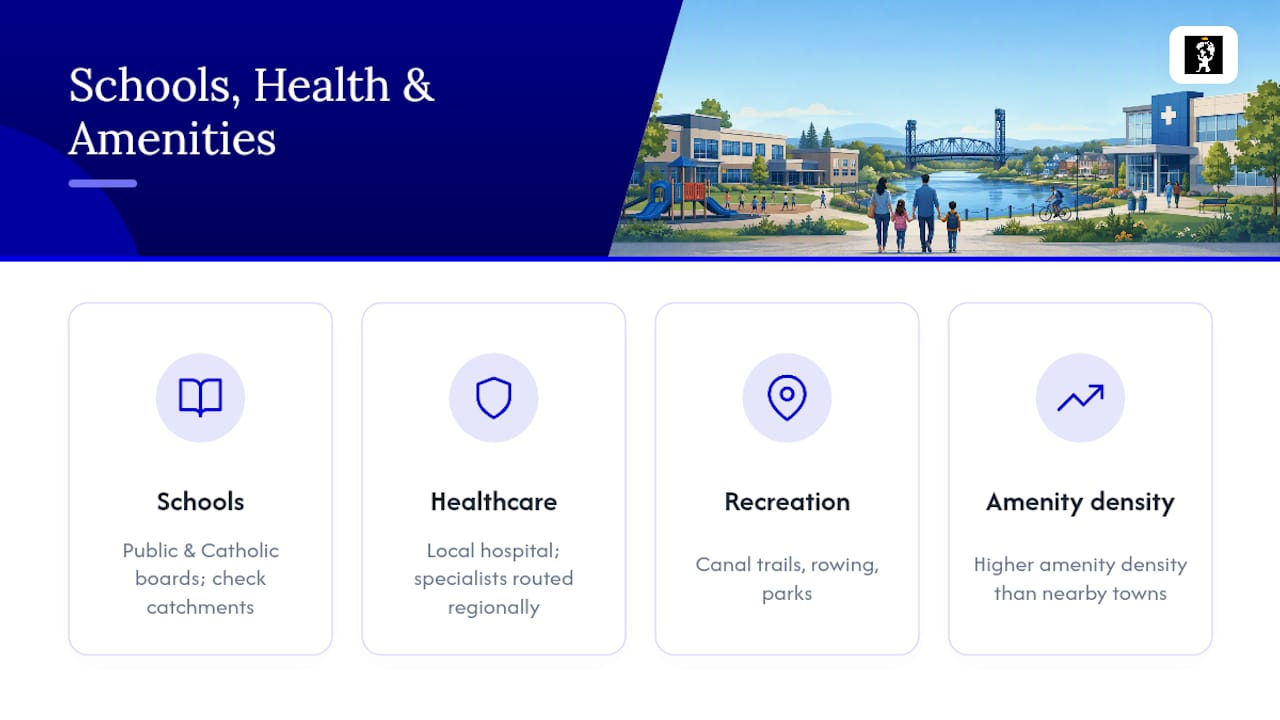
Welland runs schools under both the public and Catholic boards serving Niagara, with elementary and secondary options spread across North Welland, West Welland, and the east side of the city. Families relocating with kids should check catchment boundaries block by block, since school assignment can shift which street within a neighborhood makes sense to buy on.
Healthcare access centers on Niagara Health’s local hospital presence, with specialist and acute care often routed through larger Niagara facilities in St. Catharines or Niagara Falls. For routine care, walk-in clinics and family doctors are available locally, though like much of Ontario, finding a family physician taking new patients can take patience.
Community amenities round out the picture. The Welland Recreational Canal anchors much of daily life, with trails, rowing facilities, and canal-side parks that double as informal community gathering spots. Add a public library system, recreation centers with pools and fitness programs, and a downtown core slowly filling back in with local shops, and you get a city with more community infrastructure than its size might suggest.
For families weighing Welland against other Niagara towns, the amenity density here tends to beat smaller municipalities nearby, even if it doesn’t match a city the size of Hamilton or London.
What Should Your Welland Moving Checklist Look Like?
A move to Welland runs smoother when you sequence it instead of tackling everything at once. Here’s a realistic timeline:
8 weeks out: research neighborhoods in person, not just online, and confirm school catchments if you have kids.
6 weeks out: book your mover and get an itemized quote in writing, not a rough verbal estimate.
4 weeks out: transfer or set up utilities, including hydro, water, and internet, since some Niagara providers require lead time.
2 weeks out: update your address with Service Ontario, your bank, and Canada Post, and confirm parking or loading access at both properties.
Moving week: confirm arrival windows and decide in advance if you need temporary storage for items that won’t fit your new place immediately.
Storage is worth planning for even if you don’t think you’ll need it. Local storage options exist within Welland for anyone closing on a new home before their old one sells, or downsizing and needing a buffer. Reading up on movers and packers costs ahead of time also helps you spot a fair quote versus one that’s padded with vague line items.
Who Should You Call for Moving Help in Welland?
Finding the right mover matters more once you’re outside the GTA, where fewer companies compete for your business and reputation carries more weight. Start by asking whether a company offers itemized pricing or a flat rate, since the difference determines whether your final bill matches your quote.
A few questions to ask any mover before booking:
Do they serve Welland specifically, or is it a stretch route for them?
Is the quote itemized, and does it include fuel, labor, and materials separately?
Can they handle a small move (under 10 items) without charging full-service rates?
Do they offer in-home delivery for large furniture or marketplace purchases separately from a full move?
Atlas Kings operates as a verified local moving and storage service across the Niagara Region, including Welland, with pricing structured to avoid the vague estimates that make budgeting difficult. Whether you need a full multi-city move, a small move of a handful of items, or just in-home delivery for a couch you bought secondhand, matching the service to the actual job saves money you’d otherwise waste on a one-size-fits-all quote. Reading a guide on finding moving help before you call anyone gives you the vocabulary to ask sharper questions and spot vague answers.
What Is the Job Market Like in Welland?
Welland’s economy leans on manufacturing, healthcare, retail, and a growing services sector, with Niagara College’s Welland campus adding a steady stream of students and staff to the local economy. It’s not a boomtown, and it doesn’t try to be. It’s a city where local employment is realistic without being flashy.
The bigger opportunity is remote and hybrid work. Because housing costs run below the Ontario average while internet infrastructure keeps pace with the rest of the province, Welland has quietly become a landing spot for workers who kept a Toronto-area salary but no longer need to live near a Toronto-area office. That combination, a provincial paycheck with Niagara-level housing costs, is arguably the strongest economic argument for the move.
Local job seekers should look toward Niagara Region job boards and the healthcare and education sectors first, since both tend to have the steadiest hiring volume in the city.
What Do People Actually Do for Fun in Welland?
The Welland Recreational Canal is the city’s defining feature, and it shapes recreation more than any single park or facility could. Rowing events, canal-side walking and biking trails, and waterfront green space give Welland a lifestyle identity that punches above its size.
Beyond the canal, the city runs a full slate of community recreation centers, sports leagues, and seasonal festivals that draw families out of their houses on weekends. Downtown Welland has been slowly rebuilding its retail and restaurant footprint, giving residents more reason to spend an evening there instead of driving to St. Catharines or Niagara Falls.
For families specifically, the mix of parks, canal access, and community programming means you’re rarely more than a short drive from something to do, even without the tourist-heavy attractions that define nearby Niagara Falls.
Is Welland Safe? What Do the Crime Numbers Show?
Safety is one area where Welland’s numbers deserve a straight answer rather than a soft one. Some regional crime comparisons show Welland running higher than the Ontario average, and that’s worth knowing before you commit rather than discovering after you’ve moved in.
That said, crime statistics at the city level rarely tell you what a specific street or neighborhood feels like day to day. The gap between North Welland and parts of downtown, for instance, can be significant, which is exactly why local relocation experts recommend walking a neighborhood in person, at different times of day, before signing anything. A citywide average can mask real block-by-block variation, and that variation matters more to your daily experience than the headline number does.
If safety is a top priority, treat it the same way you’d treat schools: narrow your search to specific streets and pockets rather than judging the whole city by one statistic.
What Is the Weather Like in Welland Throughout the Year?
Welland sits firmly in the Niagara microclimate, which means winters tend to run slightly milder than much of inland Ontario, thanks to the moderating effect of Lake Erie and Lake Ontario nearby. That doesn’t mean mild by any national standard. You’ll still get snow, ice, and stretches of gray, damp cold from December through February.
Summers run warm and often humid, with the lake effect adding moisture to the air rather than cutting the heat. Spring and fall are the sweet spots, and they’re also when the canal trails and parks see the heaviest local traffic.
Practically, this means budgeting for both a real winter coat and a decent air conditioner, and it means timing your move to avoid the worst of a January freeze if you have any flexibility. Late spring or early fall tends to be the easiest window for moving trucks, driveway access, and general logistics.
Author’s View: The One Rule That Should Guide Your Decision
Welland rewards families and first-time buyers who prioritize routine over headline price. The households who thrive here checked commute reality, school catchment, and street-level upkeep before signing anything. The ones who regret it moved for the number on the listing alone. If Welland’s math works for your daily life, not just your down payment, look into local moving support early and start your search with a mover who prices transparently from day one.
— Natalie
How Atlas Kings Makes Your Welland Move Easier
Atlas Kings is the local alternative to juggling three different companies for your move, your furniture delivery, and your decluttering before you pack. We’ve completed over 500 moves since 2021, and every one of them ran on itemized or flat-rate pricing, so you know your total before the truck shows up, not after.

Whether you need a full local or multi-city move, a small move of a handful of large items, in-home delivery for something you bought online, or our ADHD Reset service to declutter before you pack a single box, we build the service around your actual situation instead of forcing you into a package that doesn’t fit. That’s the difference between a quote that holds and one that grows once the truck is loaded.
Ready to see what your Welland move actually costs? Book your move online and get an itemized quote built around what you’re really moving, or explore our in-home delivery service if you just need one piece handled right.
Sources
Recommended
Comments