

Homeowners: Moving Furniture Upstairs Safely and When to Hire Pros

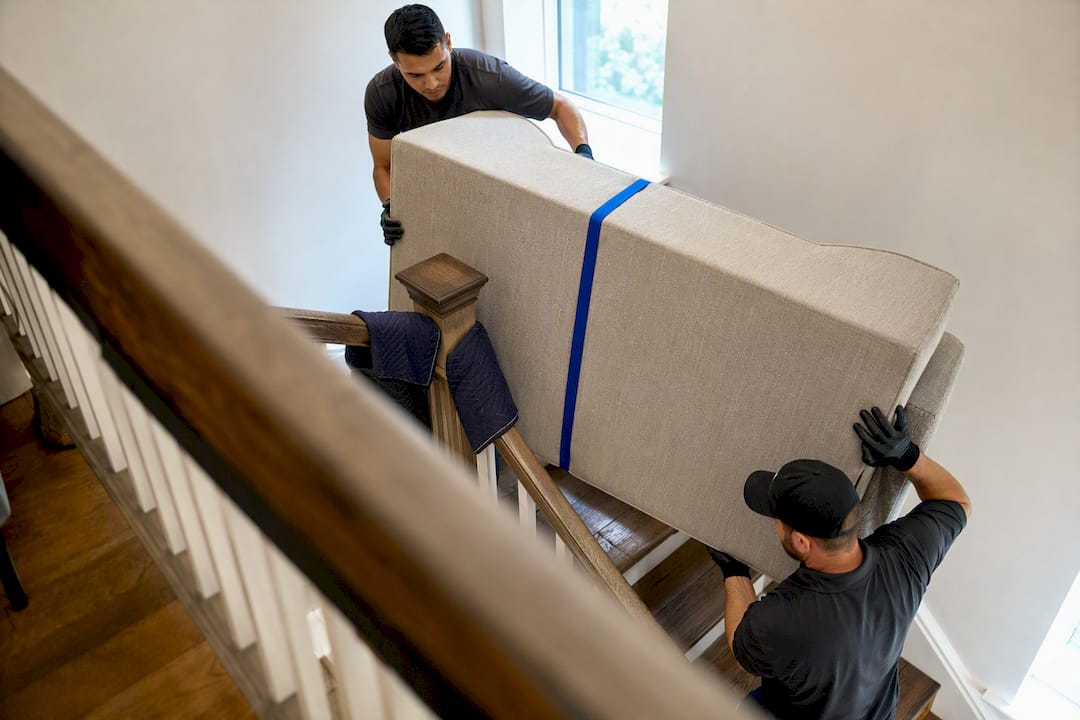
Match your method to the item’s weight and shape before you lift anything: two people with moving straps handle most furniture under a moderate weight, a stair-climbing dolly suits heavier items within a typical range. Anything heavier or oddly shaped usually calls for professional movers. Measure your stairway and the item first, strip off anything detachable, and follow one non-negotiable rule: if it jams on a landing or turn, stop and reassess instead of forcing it.
TL;DR:
Items heavier than 150 pounds or with awkward shapes typically require professional movers equipped with specialized gear, especially on spiral or narrow stairs.
Measuring stair width, landing depth, headroom, and item diagonal clearance is essential to prevent jams and damage during the move.
Using the appropriate tools, such as straps and stair-climbing dollies, extends the safe handling range but demands careful assessment of stair geometry.
Disassembly of furniture and removal of trim or doors can significantly reduce bulk and facilitate smoother transitions through tight turns.
Rushing or skipping the planning stage increases the risk of accidents, making safety and accurate measurement non-negotiable for a safe move.
Table of Contents
Pre-Move Checklist: Measure, Empty, Protect, Assign Roles
A rushed upstairs move usually fails for the same reason every time: nobody measured anything before lifting. Fix that before your hands touch the furniture.
Start with the furniture itself. Measure height, width, and depth, then measure diagonally from corner to corner. That diagonal number is what actually has to clear a turn on the stairs, not the flat width.
Checklist before you lift:
Measure the item’s height, width, depth, and diagonal corner-to-corner span.
Measure stair width, landing depth, and headroom at the tightest turn.
Remove cushions, drawers, glass shelves, and any legs that unbolt.
Pad banisters, corners, and door frames with moving blankets.
Lay down a stair runner or grip mat if your steps are hardwood or tile.
Turn on hallway and stairwell lights, including at the top landing.
Assign one move leader who calls directions and one spotter watching clearance.
Padding the route matters more than people expect. A dented banister or a gouged doorframe is one of the most common outcomes of an unprotected DIY move, and covering stairs and corners before you start prevents most of it.
Roles matter as much as muscle. One person calls every move, one person watches the tightest clearance point, and everyone else follows the count instead of freelancing their own pace.
Pro Tip: Do a dry run first. Walk the empty path from truck to bedroom, timing how many turns and doorframes you’ll actually clear, before you’re holding 180 pounds of sofa.
How Do You Map the Route Before Moving Furniture Upstairs?
Measure four things before you commit to a stair carry: clear stair width, landing depth, headroom above each tread, and diagonal clearance through every turn.
Measure clear stair width wall to wall, not banister to banister, since the banister itself eats into usable space.
Measure landing depth at the top and any mid-flight landing. A landing shorter than your item’s length forces an awkward pivot mid-carry.
Check headroom above each tread, especially where a ceiling slopes or a light fixture hangs low.
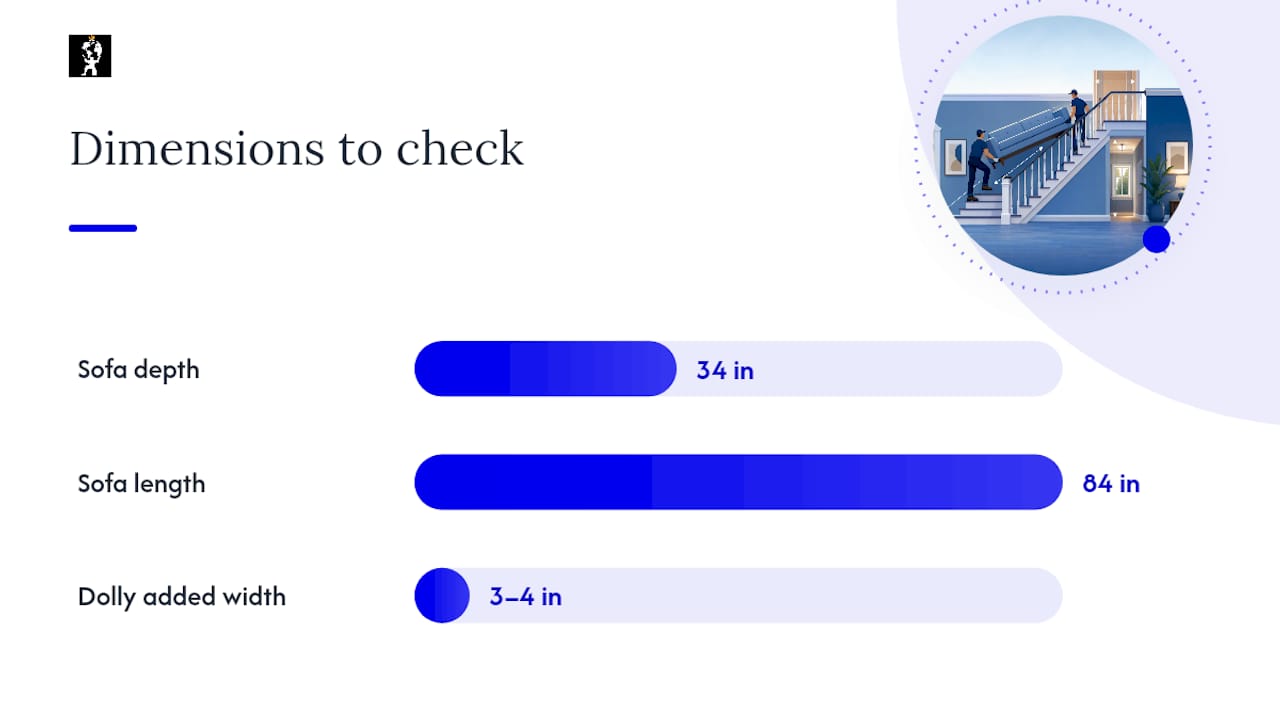
Calculate diagonal clearance at every turn by adding your item’s width and depth, then comparing that sum to the diagonal space available at the corner. A sofa that’s 34 inches deep and 84 inches long needs a surprising amount of turning room, and this is where most “it won’t fit” moments happen.
Add equipment width to your item’s dimensions if you’re using a dolly. A stair-climbing dolly typically adds 3 to 4 inches to the total footprint, which can turn a tight-but-doable turn into a genuine jam.
Access constraints trip people up more often than raw weight does. A 200-pound dresser that’s short and square can be far easier to carry than a 120-pound sofa with an awkward L-shaped frame, simply because the sofa’s shape fights the stairwell’s geometry.
If the numbers don’t work, you have two fallback options before calling it impossible: temporarily remove a door or trim piece for a few extra inches, or check whether a side entrance or window access changes the equation entirely.
Tools That Help: Straps, Dollies, Blankets, and Rental Guidance
The right tool changes what’s possible on a stair carry, but each one comes with a tradeoff worth knowing before you rent or buy.
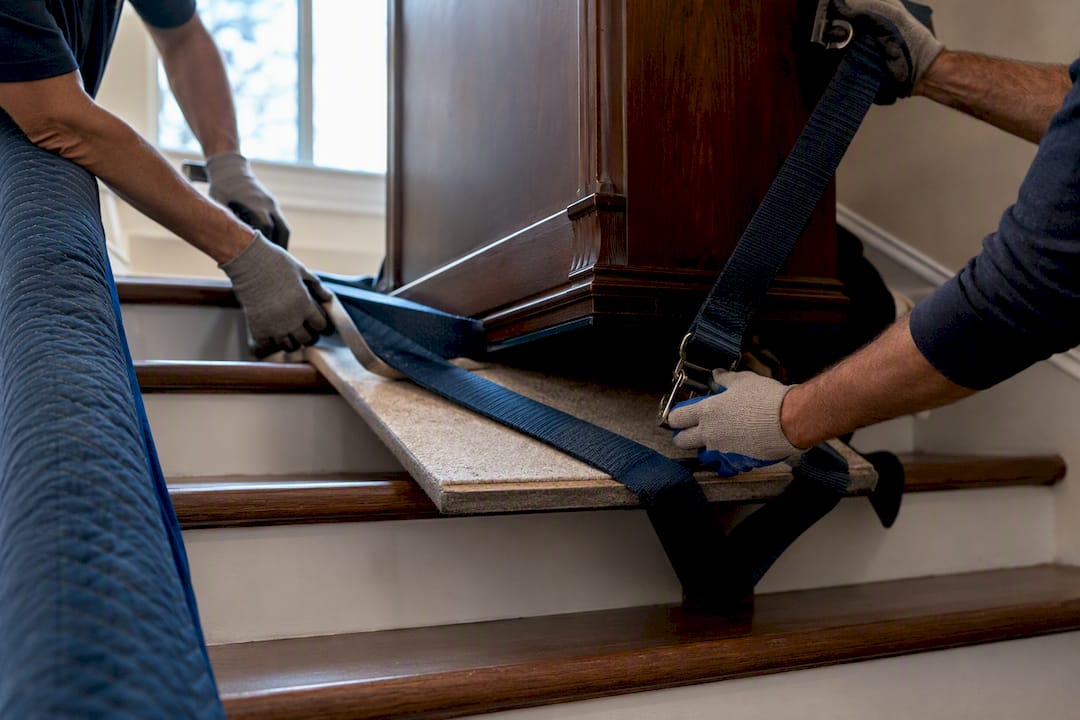
Forearm or shoulder straps shift the load from your back to your legs, which lets two people carry weight neither could manage with bare hands. They work best on sofas, mattresses, and dressers in the 100 to 150 pound range.
Stair-climbing dollies use a triangular wheel design to walk down each tread with the load balanced. They’re built for the 150 to 400 pound range but need fairly even, wide stair geometry to work safely.
Appliance dollies with a ratchet strap suit fridges, washers, and other boxy, top-heavy items. A hand truck used correctly is one of the most common tools for both stairs and flat ground.
Moving blankets and stretch wrap protect upholstery and finished wood from scuffs against banisters and walls.
Furniture sliders help on flat sections before and after the stairs, not on the stairs themselves.
Stair edge guards, work gloves, and closed-toe shoes with grip round out the basics that prevent slips.
Two people with straps can safely handle most household furniture under about 150 pounds, while anything from 150 to 400 pounds is where a stair-climbing dolly earns its rental fee.
Rental counters will hand you a stair-climbing dolly without asking about your stairway’s width, so measure first. Whatever you rent, strap the load down before moving it, and never roll a dolly over a raised threshold without a ramp. That single habit prevents most tipping accidents.
Step-by-Step Techniques for Carrying Furniture up Stairs
Once the route is measured and padded, the carry itself comes down to positioning, pacing, and communication.
Set the high-low carry. The person at the bottom lifts and steadies from a lower position; the person at the top guides and stabilizes from above.
Put the stronger carrier downhill. Gravity pulls most of the load onto whoever is below, so the stronger person always takes the downhill end while the uphill carrier steers.
Call a spoken count before every step. “One, two, lift” or a simple “step” on each tread keeps both carriers moving together instead of one person stepping early.
Move one tread at a time and pause fully on landings. Rushing a flight is where ankles roll and grips slip.
For hand trucks, add a spotter. One person tilts and steps the hand truck up each stair while a spotter watches the top edge and calls clearance.
Strap the load to the hand truck before starting, since an unsecured item can shift mid-climb and throw off the whole carry.
If it jams, stop completely. Set the item down on the nearest stable tread or landing, reassess the angle, and decide whether partial disassembly or a professional crew is the better call.
Downhill moves deserve extra respect. Momentum builds fast on a descending stair carry, and maintaining full stops between treads is what keeps that momentum from turning into a fall.
Pro Tip: Practice the count on flat ground first. If your team can’t lift and step together in the hallway, they won’t manage it on a stair carry either.
Disassembly and Fit Strategies That Reduce Bulk
Sometimes the fastest fix for a piece that won’t clear a turn isn’t more muscle. It’s fewer parts.
Remove legs, drawers, cushions, and glass shelving first. These come off most furniture without tools and immediately cut both weight and profile.
Take doors off cabinets and hutches if they swing wide enough to catch a banister.
Save full frame teardown for complex pieces. Bed frames with hidden hardware or modular sectionals sometimes need a proper look at how they were assembled, which our guide to furniture disassembly for moving walks through in more detail.
Pull an interior door temporarily if a sofa or dresser is an inch or two too wide for a doorway. A standard interior door is usually simple to lift off its hinges and rehang once the move is done.
Trim removal buys clearance too, but only pull baseboard or door casing if you’re confident about reinstalling it. A pried-off trim piece that cracks becomes its own repair job.
When Should You Hire Professional Movers Instead?
Weight is the first threshold, but shape and value matter just as much. Under roughly 150 pounds, two people with straps can usually manage a stair carry safely. Between 150 and 400 pounds, a stair-climbing dolly plus an extra spotter is often enough. Above that range, or with awkward shapes that won’t sit flat on a dolly, professional movers are the safer call.
Pianos, gun safes, and marble-top tables combine extreme weight with off-center balance, which is exactly the combination that causes serious injuries on stairs.
Anything over 300 to 400 pounds generally exceeds what two people with straps or a rented dolly can control safely through turns and landings.
Ask about pricing structure when you call. Movers typically quote either itemized (charged per item or per hour) or flat-rate pricing, and knowing which one you’re getting avoids surprise fees on move day.
Ask whether hoisting is an option. For pieces too large or heavy for any stair carry, professional crews can sometimes lift furniture through an upper-floor window or balcony instead of forcing it up the stairs.
A dresser that’s borderline manageable but expensive or sentimental is worth the same caution as one that’s simply too heavy. Our piano moving checklist covers thresholds for that specific case in more detail.
What Atlas Kings Has Learned From 500+ Upstairs Moves
Natalie, who writes on furniture handling for Atlas Kings, has covered everything from how to move a couch to appliance-specific stair jobs.
Atlas Kings has completed more than 500 moves since 2021, and stairs come up on a large share of them. That volume means a crew arriving at your door has already seen the failure points: the turn that looks fine on paper but isn’t, the sofa frame that needs one bolt removed to clear a landing, the fridge that needs a ramp instead of a threshold roll.
On an upstairs job, an Atlas Kings crew measures the stairway before touching the item, pads banisters and corners, disassembles what needs to come apart, and uses hoisting through a window when a stair carry genuinely isn’t safe. Pricing runs itemized or flat-rate, decided upfront so there’s no surprise invoice after the truck pulls away.
Moving Sofas, Pianos, and Mattresses up Stairs
Every tricky piece has its own failure point, and knowing it in advance changes how you approach the carry.
Sofas are usually a shape problem more than a weight problem. Stand the sofa on end if the stairwell allows it. This shrinks the profile that has to clear each turn. Detach any removable legs and feet first, then use the high-low carry with the taller end leading upstairs.
Pianos combine extreme weight with a center of gravity that shifts as you tilt the instrument. Upright pianos can sometimes go up a straight, wide staircase with a piano board and enough hands, but any turn, landing, or spiral stair pushes this firmly into hire-a-pro territory. Grand pianos almost always need specialized equipment and crew experience.
Mattresses are light but unwieldy. Bag the mattress to protect it and give it a stiffer, easier-to-grip surface, then carry it vertically with one person leading and one following, tilting slightly to clear low ceilings at the top of the stairs. Box springs behave the same way but crack more easily if bent, so keep them as flat as the stairwell allows.
How Do You Get Furniture Around Tight Corners and Landings?
Landings are where most stalled moves happen, because that’s exactly where you have to change the angle of a large object in a confined space.
Approach a landing turn by leading with the narrowest edge of the piece, not the widest. If your sofa’s arm is narrower than its back, angle the arm through the turn first and pivot around it.
Use the landing itself as a staging point. Set the item down flat, fully supported, before attempting the pivot, rather than trying to rotate it while both carriers are still holding full weight. This single pause is often the difference between a controlled turn and a scraped wall.
For tight inside corners, tilting the furniture toward the open side of the stairwell, away from the wall, usually creates a few extra inches of working room. If your sofa still won’t fit through a doorway or corner even after these adjustments, our guide on sofas stuck at the doorway covers the next steps, including when trim or door removal actually helps versus when it’s wasted effort.
Never force a turn by wedging one end and yanking the other. That’s how frames crack and how fingers get pinched between furniture and wall.
Moving Furniture up Spiral or Very Narrow Stairs
Standard techniques break down fast on unusual stairs, and spiral staircases are the clearest example. A stair-climbing dolly needs consistent, even tread geometry to function, which makes it counterproductive on spiral or winding stairs where each step has a different depth and angle.
On a spiral staircase, plan on carrying by hand with straps, moving slower than usual, and treating every single step as its own decision point. The high-low carry mechanics still apply, but pauses need to happen more often since the turning radius changes with every tread instead of just at landings.
Very narrow stairs, common in older homes, create a different problem: there’s often no room for two carriers to stand side by side. In that case, one person may need to lead from above using a strap while the second carrier feeds the item up from below, communicating by voice rather than visual cues.
For both spiral and unusually narrow stairs, hoisting through a window becomes a realistic option well before the weight thresholds that would trigger it on a standard staircase. If your stairway falls into either category, that’s the moment to call in professional movers rather than testing the limits of a DIY carry.
Editorial Perspective: Safety and Planning Beat Speed Every Time
Every shortcut on a stair move trades a few saved minutes for a much larger risk. Stairs amplify consequences that flat-ground moves simply don’t have: a slip becomes a fall, a scrape becomes a cracked frame. The costliest mistakes I see are rushing the measurement step and skipping the stop-and-reassess moment when something jams. Schedule the heaviest items for the morning, when your team is fresh and patient, not the last push before dark.
— Natalie
Move It Yourself, or Let Atlas Kings Handle the Stairs
Straps and a rented dolly solve plenty of upstairs moves, but the math changes fast once you’re staring down a heavy sectional, a piano, or a stairwell with tight landings. A professional moving crew measures the route, pads every corner, disassembles what needs to come apart, and handles hoisting when a stair carry isn’t the safer option.

Booking a job gets you an itemized or flat-rate quote upfront, so there’s no guessing what the invoice will say afterward. For a full move or a single large-item delivery, our transport service covers local and multi-city jobs, while in-home delivery fits readers who just need one heavy piece carried upstairs and placed correctly. If your item is heavy enough that hoisting through a window is genuinely the safer route, our lift service page details how that works. Check availability and get a quote through our booking page before you commit to a solo stair carry you might regret halfway up the flight.
Sources
FAQ
How do you move a 300-pound safe upstairs?
A safe in this weight range generally exceeds what two people with straps or a rented dolly can control safely through turns and landings, so hiring professional movers with proper equipment or hoisting capability is the safer route.
Can I move my couch upstairs by myself?
If the couch weighs under about 150 pounds and the stairway is straight with enough turning clearance, two people using forearm or shoulder straps can typically manage it using a high-low carry with the stronger person downhill.
Is rearranging furniture a sign of ADHD?
Some people associate the urge to rearrange furniture with restlessness or a need for novelty, which can show up with ADHD, but rearranging alone isn’t a diagnostic sign of anything on its own.
How do you lift furniture upstairs without hurting your back?
Use straps to shift the load to your legs rather than your back, keep the stronger carrier on the downhill end, and move one tread at a time with a spoken count so both carriers stay coordinated.
When should I rent a stair-climbing dolly instead of carrying by hand?
A stair-climbing dolly works best for items in the 150 to 400 pound range on stairs with even, consistent tread depth, but it adds several inches of width and performs poorly on spiral or very narrow stairs.
Recommended
Comments