

Moving Cost Calculator Ontario: Your 2026 Budget Guide


A moving cost calculator Ontario families rely on is defined as a digital estimation tool that combines home size, distance, labor rates, and optional services to produce a clear budget forecast before moving day. These calculators use regional pricing data specific to Ontario, so the numbers reflect what local movers actually charge rather than national averages. For Niagara Falls residents planning a local or long-distance relocation, getting an accurate estimate upfront prevents the budget surprises that derail so many moves. The core variables are home size, crew size, hourly rate, and distance, and understanding each one gives you real control over your moving budget.
How does a moving cost calculator Ontario work for local moves?
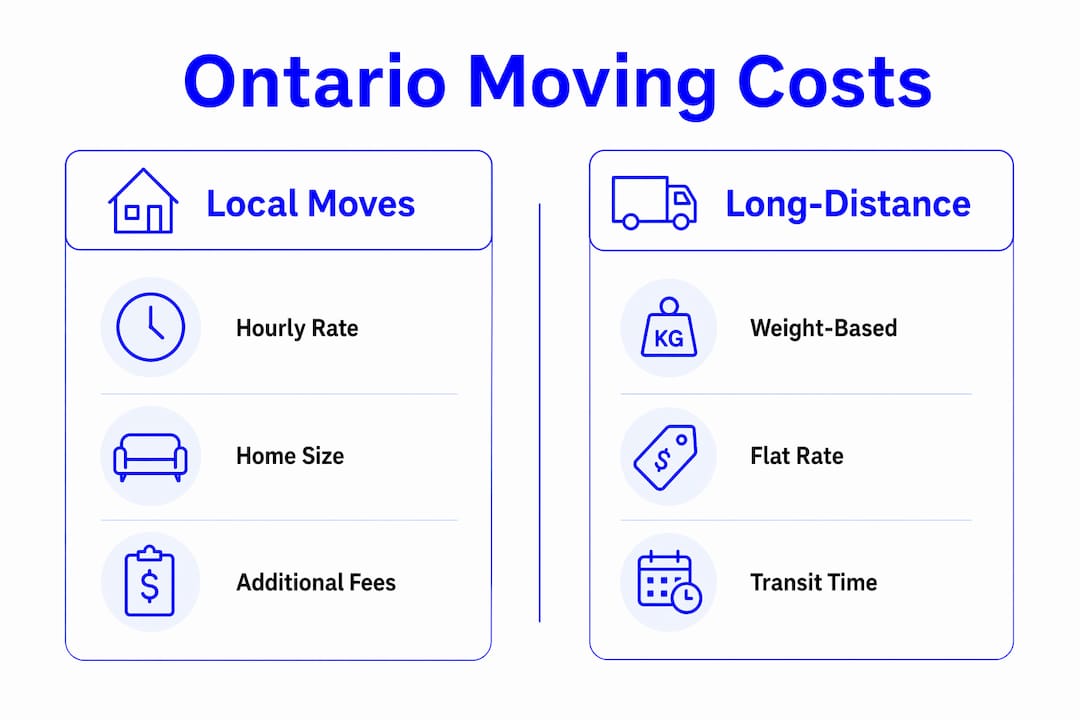
Local moves in Ontario are priced by the hour, not by weight. Professional rates for 2 movers and a truck run from C$120 to C$160 per hour, plus 13% HST on the final bill. That hourly rate covers the crew and the truck together, so you are not paying separate line items for each.
Home size drives the total hours more than any other single factor. A studio or one-bedroom typically takes 3–4 hours to move, while a three or four-bedroom home requires 7–10 hours. Multiply those hours by the hourly rate, and you get the core labor cost before any add-ons.

The table below shows typical cost ranges for local Ontario moves before HST:
Home size | Estimated hours | Estimated cost (before HST) |
Studio / 1 bedroom | 3–4 hours | C$360–C$640 |
2 bedroom | 5–6 hours | C$600–C$960 |
3 bedroom | 7–9 hours | C$840–C$1,440 |
4+ bedroom | 9–10+ hours | C$1,080–C$1,600+ |
Most Ontario movers enforce a minimum billable duration of 2–3 hours and bill travel time at the same hourly labor rate. Travel time runs the clock from the moment the crew leaves their depot to when they return. For a Niagara Falls move, that depot-to-origin leg can add one to two full billable hours before a single box is loaded.
Additional fees stack on top of the base rate. Stairs, long carries from a parking spot to your door, and heavy items like appliances all trigger surcharges. The average 2-bedroom local move lands between C$1,250 and C$2,500 after these extras are included.
Pro Tip: Ask every mover for a written breakdown that separates the base hourly rate, travel time, and any surcharges. A low headline rate with uncapped travel billing often costs more than a slightly higher flat rate.
What makes long-distance moving costs different in Ontario?
Long-distance moves shift from hourly billing to weight or volume-based pricing. The crew no longer charges by the clock. Instead, the mover weighs your shipment or calculates cubic footage and multiplies that by a per-unit rate tied to distance.
Full-service cross-country moves for a 2-bedroom home cost C$8,000 to C$12,000. Portable container options run C$4,000 to C$7,500, and self-pack freight services cost C$2,500 to C$5,000. The price gap between these three options is large enough to change your entire moving budget.
Here is how the three main service levels compare:
Service type | Pricing model | Typical 2-bed cost | Who handles packing |
Full-service movers | Weight + distance | C$8,000–C$12,000 | Mover |
Portable container | Volume + distance | C$4,000–C$7,500 | You |
Self-pack freight | Weight + distance | C$2,500–C$5,000 | You |
Flat-rate pricing for long-distance moves is safer for budget-conscious families because it locks in the final price based on a pre-move inventory. Hourly billing for local moves risks exceeding your budget if the move takes longer due to obstacles. For cross-province relocations, a flat rate removes that uncertainty entirely.
Transit time also affects cost. Long-distance moves often require temporary storage if your new home is not ready on arrival day. Storage fees add to the total, and families planning moves from Niagara Falls to Toronto or Ottawa should factor in at least one to two nights of potential storage costs.
What additional factors affect your Ontario relocation cost estimate?
Packing services, specialty items, seasonal timing, and insurance all push the final number above the base estimate. Each one is a real cost driver, not a minor footnote.
Full-service packing adds 20–40% to the base moving cost. Partial packing, where the crew only handles fragile items, costs less but still adds a meaningful amount. If you pack yourself, you eliminate this charge entirely, though you take on the time and risk.
Specialty items carry their own surcharges. Pianos, hot tubs, gun safes, and large appliances require extra crew members or specialized equipment. Check the large item moving options available in your area before assuming a standard crew can handle these pieces.
Seasonal timing changes the price significantly:
Peak season (may through september): Surcharges of 15–25% above base rates apply. Demand is highest, and movers book up weeks in advance.
Off-peak season (october through april): Rates drop, availability improves, and movers are more flexible on scheduling.
End of month and weekends: These slots fill first at any time of year. Mid-week, mid-month moves consistently cost less.
Holidays: Moving around long weekends in may or july adds a premium on top of the peak season rate.
Insurance is the most overlooked line item. Basic coverage is free but limited. Full value protection costs about 3% of the declared value of your belongings and covers market replacement costs. For a household with C$50,000 in declared goods, that is C$1,500 added to the bill. It is worth it for fragile or high-value items.
Pro Tip: Declare the actual replacement value of your belongings, not a low number to save on insurance. If a mover damages a C$3,000 television and you declared C$500, you absorb the difference.
How do you budget your move and verify Ontario moving estimates?
A moving cost estimator gives you a planning baseline, not a binding contract. The estimate tells you the likely range. The written quote from a licensed mover tells you the actual price.
Use these steps to build a reliable moving budget:
Get at least three written quotes. Phone estimates are not binding. An in-home or video survey produces a far more accurate number.
Confirm the minimum hours policy. Most Ontario movers charge a 2 or 3-hour minimum. A short move that takes 90 minutes still costs you 2–3 hours of labor.
Ask about travel time billing. Confirm whether travel from the depot is billed at the full hourly rate or a reduced rate.
Check for hidden add-on costs upfront. Stairs, elevator waits, long carries, and parking fees are standard surcharges that low base quotes often exclude.
Time your move strategically. Booking in october through april, on a Tuesday or Wednesday, mid-month, saves money without sacrificing service quality.
The moving company prices guide for Ontario breaks down current 2026 rates in detail and helps you cross-check any quote you receive. Use your calculator estimate as a ceiling, not a floor. If a mover quotes significantly below your estimate, ask what is excluded before signing anything.
Pro Tip: Add a 15% buffer to your calculator estimate to cover unexpected charges. Moves almost always take slightly longer or involve one surprise fee. Building that buffer in from the start keeps your budget intact.
Key Takeaways
An accurate Ontario moving budget requires combining a digital cost estimate with written quotes, seasonal timing, and a clear understanding of add-on fees.
Point | Details |
Local moves are hourly | Ontario rates run C$120–C$160 per hour for 2 movers plus a truck, before 13% HST. |
Long-distance uses weight pricing | Cross-province moves cost C$2,500–C$12,000 depending on service level and load size. |
Add-ons raise costs by 20–40% | Packing, stairs, specialty items, and insurance upgrades all stack on top of the base rate. |
Peak season adds 15–25% | Moving between may and september costs more. Off-peak months offer real savings. |
Calculator estimates need a buffer | Add 15% to any digital estimate to account for travel time, minimums, and surcharges. |
What I’ve learned from watching families use moving cost calculators
Moving cost calculators are genuinely useful, but most families treat the output as a final price rather than a starting point. That misunderstanding is where budgets break down.
The calculators I trust most are the ones that ask for specific inputs: number of bedrooms, floor level, distance, packing preference, and specialty items. Generic calculators that only ask for city and home size produce numbers that are too broad to plan around. A Niagara Falls family moving a three-bedroom home with a piano and a hot tub has a very different cost profile than a family moving the same size home with standard furniture.
The charges that consistently surprise people are travel time billing and the minimum hours policy. A move that physically takes two hours still costs three hours of labor if the mover enforces a three-hour minimum. Add the depot-to-origin travel leg, and that “two-hour move” costs four to five hours of billed time. No calculator I have seen automatically accounts for the specific depot location of the mover you hire.
My honest recommendation: use a calculator to set your budget range, then call two or three movers for written quotes before committing to anything. The gap between a calculator estimate and a real quote is usually small when you input accurate data. When the gap is large, it almost always means the calculator missed a surcharge that the mover will not.
Families who combine calculator research with direct mover communication consistently report fewer billing surprises. The calculator gives you the vocabulary to ask the right questions. The written quote gives you the protection.
— Natalie
Atlaskings makes your Ontario move straightforward
Planning a move in Niagara Falls or anywhere across Ontario is easier when you have transparent pricing from the start. Atlaskings is a family-run moving service that has completed over 500 moves since 2021, with itemized and flat-rate pricing that shows you exactly what you are paying for before moving day.

Whether you need reliable transport services for a local move or specialized lifting for heavy items, Atlaskings provides written quotes with no hidden fees. You can also explore lifting and specialty moving for pianos, appliances, and oversized furniture. Contact Atlaskings directly to get a personalized estimate that reflects your actual household, not a generic average.
FAQ
What does a moving cost calculator include?
A moving cost calculator estimates labor, truck fees, travel time, packing services, and applicable taxes based on your home size and distance. The output is a planning range, not a binding quote.
How much does a local move in Ontario cost?
Local moves in Ontario typically cost C$1,250 to C$2,500 for a 2-bedroom home, including the standard hourly rate and 13% HST.
Is flat-rate or hourly pricing better for Ontario moves?
Flat-rate pricing is better for long-distance moves because it locks in the final cost based on inventory. Hourly billing works for short local moves but carries the risk of overruns if the job takes longer than expected.
When is the cheapest time to move in Ontario?
Moving between october and april, mid-week and mid-month, consistently produces the lowest quotes. Peak season surcharges of 15–25% apply from may through september.
Does moving insurance add a lot to the total cost?
Basic coverage is free but limited. Full value protection costs about 3% of your declared goods value, which is a meaningful addition for households with high-value or fragile items.
Recommended
Comments