

Moving Company Prices in Ontario: 2026 Guide

Moving company prices are defined by two primary variables: the distance of your move and the size of your shipment. Local moves under 50 miles average $1,200–$1,400, while a 1,000-mile long-distance move runs $4,500–$5,450, and cross-country moves reach $8,200 or more for a 2–3 bedroom home. In Ontario, where metro areas like Toronto sit alongside smaller cities and rural routes, these national benchmarks apply with regional adjustments. Understanding the pricing structure before you request quotes gives you real negotiating power and helps you avoid the most common budget surprises.
How do moving companies price local moves and what affects hourly rates?
Local moving services prices follow a straightforward formula: crew size multiplied by hourly rate multiplied by total hours worked. National hourly rates run $100–$200 for a two-to-three-person crew in 2026, with high-demand metro markets like New York City and San Francisco pushing rates to $230 per hour. Toronto and the Greater Toronto Area fall within this higher-cost range, so families planning a local move in Ontario should budget accordingly.
Labor accounts for 60–70% of local move costs. That means the hourly rate is the single biggest lever you can pull when comparing quotes. A difference of $30 per hour sounds small, but across a six-hour move with a three-person crew, that gap adds up to $180 before any add-ons.

Most local movers enforce a minimum booking of two to four hours. This minimum applies even if your move takes less time. A studio apartment move that takes 90 minutes still gets billed at the two-hour floor, so factor that into your total when comparing local moving company prices near you.
Common add-ons that inflate local quotes include:
Stair carries: $50–$200 per flight, depending on the number of floors
Long carries: $75–$150 when the truck cannot park close to the entrance
Elevator reservations: Building-required bookings that add time and sometimes fees
Fuel surcharges: Often excluded from the base hourly rate
Packing materials: Charged separately unless bundled into a flat-rate package
Pro Tip: Ask every mover to list all potential add-ons in writing before you sign. The lowest hourly rate often becomes the most expensive option once stair fees, fuel charges, and minimums are applied.
What pricing models and factors influence long-distance moving costs?
Long-distance moves shift away from hourly billing entirely. Carriers price these moves based on shipment weight and distance, with the average 2–3 bedroom home weighing approximately 7,500 lbs. That weight, combined with your mileage, determines your base rate before any surcharges are added.
Fuel surcharges add 5–12% on top of base costs for long-distance moves. On a $5,000 base quote, that means an additional $250–$600 that many families do not anticipate. Always ask for the fuel surcharge percentage in writing before accepting any long-distance estimate.
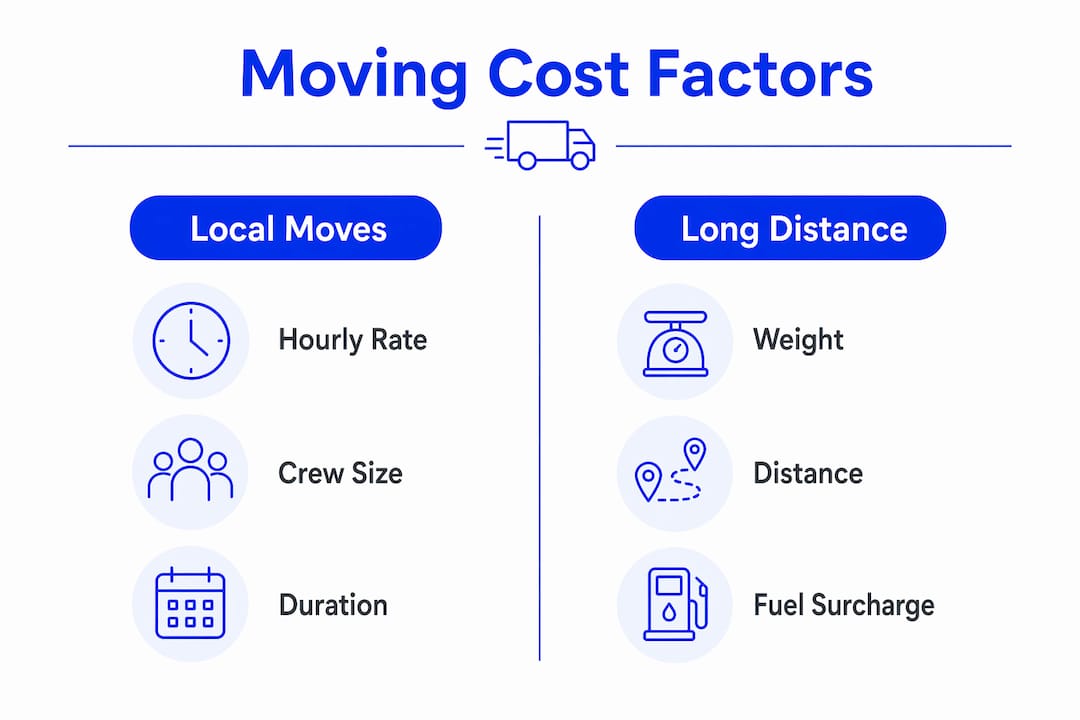
Here is a quick reference for typical long-distance cost ranges in 2026:
Move Distance | Home Size | Estimated Cost |
Under 50 miles | 2–3 bedrooms | $1,200–$1,400 |
1,000 miles | 2–3 bedrooms | $4,500–$5,450 |
Cross-country | 2–3 bedrooms | $8,200+ |
Timing has an outsized impact on long-distance moving services prices. Moving companies function like airlines with dynamic pricing: 68% of annual interstate moves happen between july and august, driving prices 30–40% above winter lows. January and february offer the best rates, with savings reaching up to 38% compared to peak season.
Key factors that affect your long-distance quote:
Shipment weight: Heavier loads cost more; decluttering before your move directly reduces your bill
Distance and route: Some routes cost more because carriers need to reposition trucks after delivery
Access at origin and destination: Narrow streets or no-parking zones trigger shuttle fees
Delivery window: Flexible delivery dates often cost less than guaranteed single-day delivery
Insurance valuation: Full-value protection adds cost but protects high-value items
Pro Tip: Booking a mid-week move in january or february can reduce your total cost by 20–40% compared to a saturday move in july. That savings on a $5,000 move equals $1,000–$2,000 back in your pocket.
What are common additional fees and hidden charges in moving pricing?
The average mover spends about 22% more than their original quote once all fees and add-ons are counted. That gap between the initial number and the final invoice is the most frustrating part of the moving experience for most families. Knowing what to look for closes that gap before it opens.
Here are the most common additional charges to verify in any quote:
Stair carry fees: Charged per flight, typically $50–$200 each. A three-story walkup adds $150–$600 before a single box is loaded.
Long carry fees: Apply when the truck parks more than 75 feet from your door. Expect $75–$150 per occurrence.
Shuttle service: Required when a full-size moving truck cannot access your street. Shuttle fees range from $150–$400 depending on the market.
Specialty item handling: Pianos, gun safes, hot tubs, and pool tables require extra equipment and labor. These items are almost always quoted separately.
Packing services: Full packing services add $300–$1,200 depending on home size. Partial packing for fragile items costs less but still adds to your total.
Storage-in-transit: If your new home is not ready on move-in day, short-term storage fees apply daily or weekly.
Mover gratuity: Tips are customary and separate from your quote. Industry practice is $20–$50 per mover for a standard move.
Reading every line item in your quote protects you from the 22% overage that catches most families off guard. If a quote does not list these items, ask the company to add them or provide a written statement that they do not apply to your move.
How can you evaluate and compare moving company quotes effectively?
Moving companies use four primary quote types: hourly with minimums, flat rate, weight plus distance, and truck size plus per-minute labor. Each structure suits a different move profile. Hourly quotes work well for small local moves with predictable timelines. Flat-rate quotes protect you on larger moves where the scope is clear. Weight-plus-distance quotes apply to long-distance moves. Truck-size-plus-per-minute billing is less common but appears with some regional carriers.
Binding estimates are the most important protection you can request. A binding estimate locks your price based on the agreed scope of work. A non-binding estimate can increase after delivery, sometimes significantly. Always request a binding estimate for any move over $2,000.
Quotes are often complex bundles of base rates, minimums, and add-ons. Comparing two quotes by their headline number alone is misleading. A $900 quote with a four-hour minimum, stair fees, and a fuel surcharge can easily exceed a $1,100 flat-rate quote that includes everything.
Use this checklist when reviewing any moving company quote:
Does the quote specify a binding or non-binding estimate?
Are stair fees, long carry fees, and fuel surcharges listed separately?
What is the minimum charge, and does it apply to your move?
Is packing included or billed separately?
What is the cancellation or rescheduling policy?
Does the quote include full-value protection or only released-value coverage?
Pro Tip: Collect at least three written estimates and compare them line by line, not just by total. Bring a lower competing quote to your preferred mover and ask if they will match the structure, not just the price.
How do regional and seasonal factors influence moving service costs?
Regional pricing differences in Ontario and across North America are larger than most families expect. West Coast and Northeast markets run 30–60% more expensive than Midwest and Southern states. Moving from California costs 62% more than the national average, while lower-cost states like Mississippi run 41% below it. Ontario sits in a mid-to-high cost range, with Toronto-area rates closer to Northeast benchmarks than to Midwest averages.
Seasonal timing creates equally large swings. July and august are peak months, with prices 30–40% above winter lows. Moving in january or february saves up to 38% compared to peak season. October through december also offers reduced rates because demand drops after the summer rush.
Season | Demand Level | Price Impact |
January–March | Low | Up to 38% savings vs. peak |
April–June | Rising | Near-average rates |
July–August | Peak | 30–40% above average |
October–December | Low | Meaningful savings available |
Practical steps to use regional and seasonal data:
Schedule your move for a tuesday, wednesday, or thursday to save 10–20% versus weekends
Avoid end-of-month dates, when leases turn over and demand spikes
If your timeline is flexible, target january or february for the lowest rates
For Ontario-specific routes, ask carriers about repositioning surcharges on less-traveled corridors
Key Takeaways
Transparent, binding estimates and off-peak timing are the two most effective tools for controlling your total moving cost.
Point | Details |
Local moves bill hourly | Expect $100–$200 per hour for 2–3 movers, with a 2–4 hour minimum in most markets. |
Long-distance pricing uses weight and distance | A 2–3 bedroom home averages 7,500 lbs; fuel surcharges add 5–12% on top of base rates. |
Hidden fees add roughly 22% to final bills | Always request a written list of all potential add-ons before signing any agreement. |
Binding estimates protect your budget | Lock your price with a binding estimate on any move over $2,000 to avoid post-delivery increases. |
Off-peak timing delivers real savings | Moving in january or february saves up to 38% compared to peak summer rates. |
What I’ve learned about moving prices after planning hundreds of moves
Most families focus entirely on the headline quote number. That instinct is understandable but costly. The structure of a quote matters far more than the total it shows on day one.
The single most consistent pattern I’ve seen is this: the mover with the lowest hourly rate almost never delivers the lowest final bill. Stair fees, fuel surcharges, and minimum-hour rules quietly close the gap. A flat-rate quote from a transparent provider often beats an hourly quote by $300–$500 on a standard three-bedroom move, even when the flat rate looks higher at first glance.
Timing is the other lever that most families leave on the table. A july move is not just inconvenient. It is genuinely 30–40% more expensive than the same move in february. If your lease or closing date gives you any flexibility at all, shifting your move by even six to eight weeks can save a family of four more than $1,500 on a long-distance move.
My honest advice: collect three written estimates, ask each mover to itemize every potential fee, and request a binding estimate in writing. Then check whether your move date falls in a peak window and ask what the rate looks like two weeks earlier or later. Those two steps alone will put you ahead of most people who call for quotes.
— Natalie
Atlaskings offers clear pricing for Ontario moves
Planning a move in Ontario means navigating hourly rates, add-on fees, and seasonal price swings all at once. Atlaskings takes a different approach: itemized and flat-rate pricing with no hidden costs, so you know your total before the truck arrives.

Atlaskings has completed over 500 moves since 2021, serving families across Ontario with reliable local transport and in-home delivery options. Whether you need labor-only support or a full-service move, the pricing is transparent and confirmed in writing before your move date. You can also rent moving boxes directly through Atlaskings to keep supply costs predictable. For a personalized quote that reflects your actual move, visit the Atlaskings services page and book online in minutes.
FAQ
What is the average cost of a local move in Ontario?
A local move under 50 miles averages $1,200–$1,400 for a 2–3 bedroom home in 2026. Hourly rates for a two-to-three-person crew run $100–$200 nationally, with Toronto-area rates at the higher end of that range.
How are long-distance moving company prices calculated?
Long-distance moves are priced by shipment weight and distance, not by the hour. Fuel surcharges of 5–12% are added on top of the base rate, so always request the surcharge percentage in writing.
What hidden fees should I watch for in moving quotes?
The most common extras are stair carry fees ($50–$200 per flight), long carry fees ($75–$150), packing services ($300–$1,200), and fuel surcharges. The average mover pays about 22% more than their original quote once all fees are counted.
When is the cheapest time to hire a moving company?
January and february offer the lowest rates, with savings up to 38% compared to peak summer pricing. Mid-week moves also save 10–20% versus weekend bookings.
What is a binding estimate and why does it matter?
A binding estimate locks your moving price based on the agreed scope of work, protecting you from post-delivery increases. Any move over $2,000 warrants a binding estimate to avoid unexpected charges on delivery day.
Recommended
Comments