

Lawn Care Calendar for Niagara Falls, Ontario: Month by Month

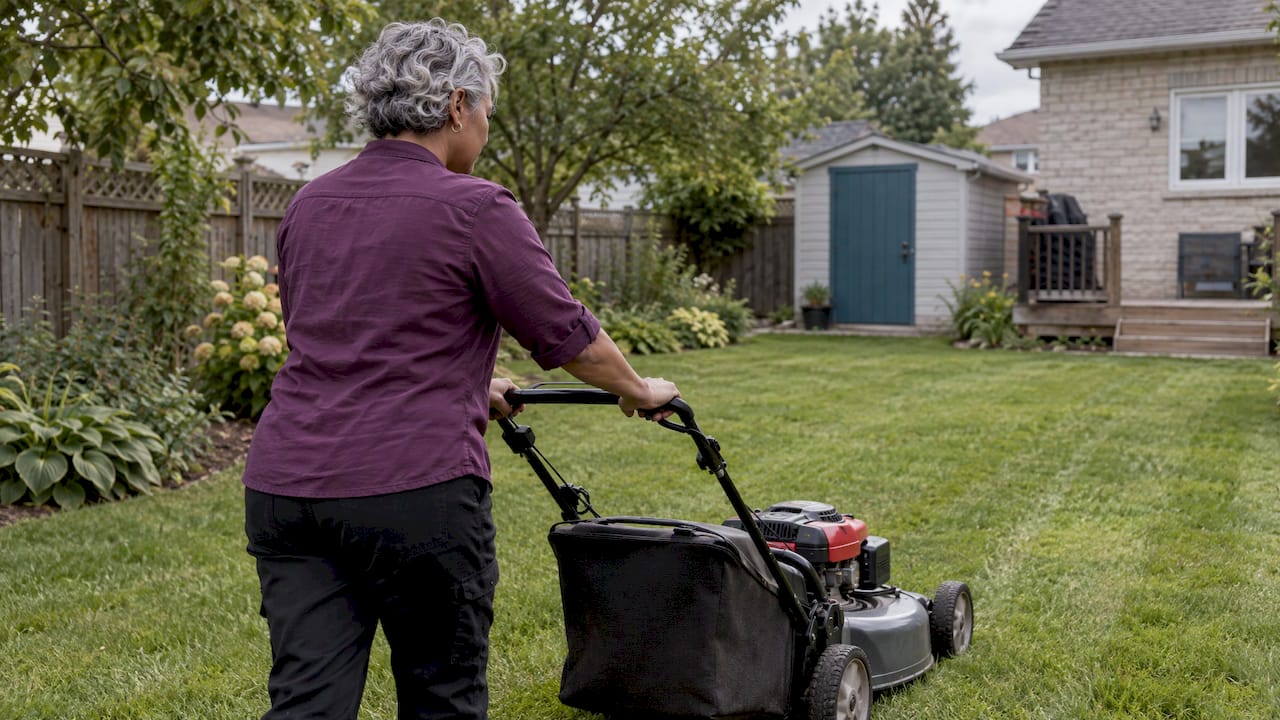
A Niagara Falls lawn does most of its important work in two windows: a short spring restart and a longer push from mid-August to late October. Mowing, watering and weed control fill the months in between. Follow the order below and your lawn heads into winter with deep roots and thick cover. If you would rather hand a seasonal visit to someone local, our Lawn Refresh is a 65 CAD one-off booking.
TL;DR
Spring (March to May): clear debris and salt damage, spot-seed bare patches, and start mowing high, at about 3 inches.
Summer (June to August): water about 1 inch a week in the morning, keep the mower high, and let the lawn rest in hot, dry spells.
Early fall (mid-August to mid-September) is the best time to aerate, overseed and fertilize.
Late fall (mid- to late October): apply a second fertilizer when growth stops but the grass is still green, and mulch or remove leaves before snow.
Ontario’s published guidance is the backbone of this calendar. Local weather decides the exact week, so adjust by a week or two.
Table of Contents
How to use this calendar in Niagara Falls
The Ontario Ministry of Agriculture, Food and Rural Affairs (OMAFRA) publishes the lawn guidance this calendar relies on. Its lawn maintenance page lays out a seasonal table that ties fertilizing to soil-test results. A soil test is a lab analysis of a soil sample that shows the phosphorus and potassium levels in your yard. If your lawn has never been tested, that is a good first job for spring.
Niagara has a longer growing season than much of Ontario because of the lake. Still, the dates below are windows, not appointments. A warm April means an earlier first mow. A dry August means more watering and a later overseed. Treat each date as a range and let the grass tell you: if it is growing, you are in season.
A few terms used throughout:
Core aeration pulls small plugs of soil from the lawn so air, water and seed reach the roots.
Overseeding means spreading grass seed over an existing lawn to thicken it.
Thatch is the layer of dead stems and roots between the soil and the green blades. Too much of it blocks water and shelters disease.
Topdressing means spreading a thin layer of compost or soil over the lawn.
The year at a glance
Season | Window | Main jobs |
Early spring | March to April | Rake debris, check for salt damage, flush salt, spot-seed bare patches |
Spring | May | First mows at about 3 inches, light feeding, hand-pull weeds |
Late spring | June | Aerate if the lawn is compacted, watch watering |
Summer | July to early August | Mow high, water in the morning, let the lawn rest in heat |
Early fall | Mid-August to mid-September | Aerate, overseed, first fall fertilizer |
Mid fall | September to October | Keep mowing, keep new seed moist, chop leaves |
Late fall | Mid- to late October | Second fertilizer, last mows, clear or mulch leaves |
Winter | November to February | Limit foot traffic, careful snow and ice management |
Early spring: March and April
Winter leaves a mess, and in Niagara Falls that often includes road salt. The City of Windsor’s natural lawn care guide recommends this order for March and April: remove debris, inspect for salt-damaged and bare patches, aerate, and water deeply to flush salt from the soil. Windsor is a different Ontario city, but the freeze-thaw and salting cycle is much the same along Niagara roadsides and driveways.
Here is how to work through it:
Walk the lawn once the soil is no longer soggy. Walking on saturated turf compacts it. Wait until the ground firms up.
Rake out debris, matted leaves and dead grass. This lets sunlight and air reach the crowns of the grass.
Mark bare and salt-burned strips. These are usually along the driveway, the sidewalk and the street edge.
Water those strips deeply. A deep soak helps push salt below the root zone.
Spot-seed the damage. Loosen the surface, sprinkle seed, press it in and keep it damp.
Hold off on heavy feeding. The Health Canada page on maintaining a lawn notes that a lower fertilizer rate is generally used in spring and early summer than in early and late fall. The big feeding belongs in autumn.
May: the first mows
The first mow of the year should be a high one. The City of Windsor’s lawn care calendar advises mowing at 8 cm (3 inches) once the lawn reaches about 11 cm. It also suggests spreading a thin 5 mm layer of compost or slow-release fertilizer and pulling weeds by hand.
The one-third rule keeps mowing from stressing the lawn: never cut off more than a third of the blade height in one pass. In May the grass grows fast, so you may need to mow every five to seven days. A taller lawn grows deeper roots, shades the soil and holds moisture. It also leaves less room for weed seeds to sprout.
Ontario’s lawn maintenance table covers early spring (May), late spring (June) and summer (July). It says summer fertilizer should go on only if the lawn is irrigated. That is a useful check: if you do not water in July, skip the summer feeding.
Spring seeding
Spring seeding works for patches, but fall is better for whole-lawn thickening. If you seed in May, plan to water carefully through June and July. Spring seedlings compete with crabgrass, so a seeded patch that dries out will lose to weeds.
June: aeration and watching the weather
Ontario’s lawn maintenance guidance places aeration in late spring (June) and again in late summer (August), and advises doing it during good growth so the lawn recovers quickly. The lawn renovation page adds that a lawn with heavy foot traffic benefits from aerating twice, in spring and early fall, and that soil should be adequately moist because dry soil limits how deeply the coring tines go.
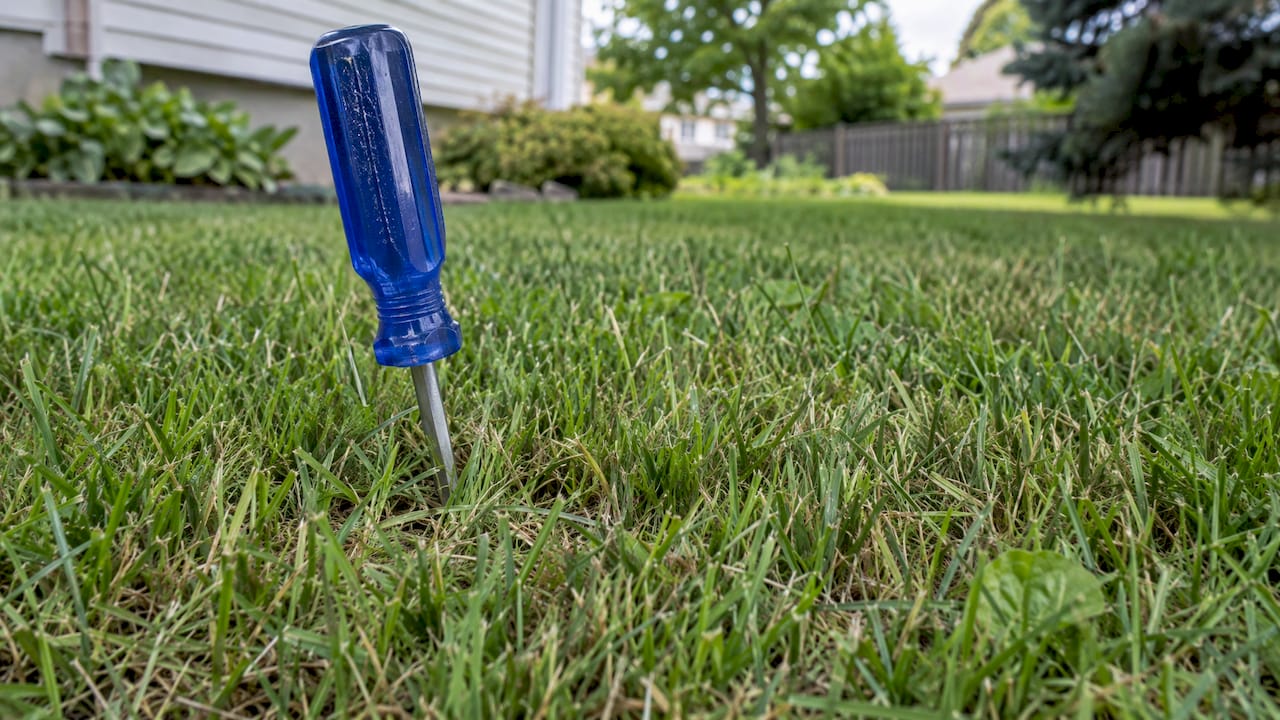
A simple test: push a screwdriver into the soil. If it will not go in more than a couple of inches, the soil is dry or compacted. Water, wait a day, and try again before you aerate.
Landscape Ontario’s guide to a healthy lawn says to aerate before topdressing or fertilizing. The order matters, because the holes carry the benefit down to the roots.
Summer: July and early August
Summer is about restraint. Your goals are to keep the grass alive, not to push growth.
Watering
The City of Niagara Falls says healthy lawns need 2.5 cm (1 inch) of water weekly and recommends watering in the morning to reduce evaporation. That inch includes rain. Set an empty tuna can on the lawn while the sprinkler runs, and stop when it holds about an inch. A deep weekly soak is better than a daily sprinkle, because shallow watering keeps roots near the surface.
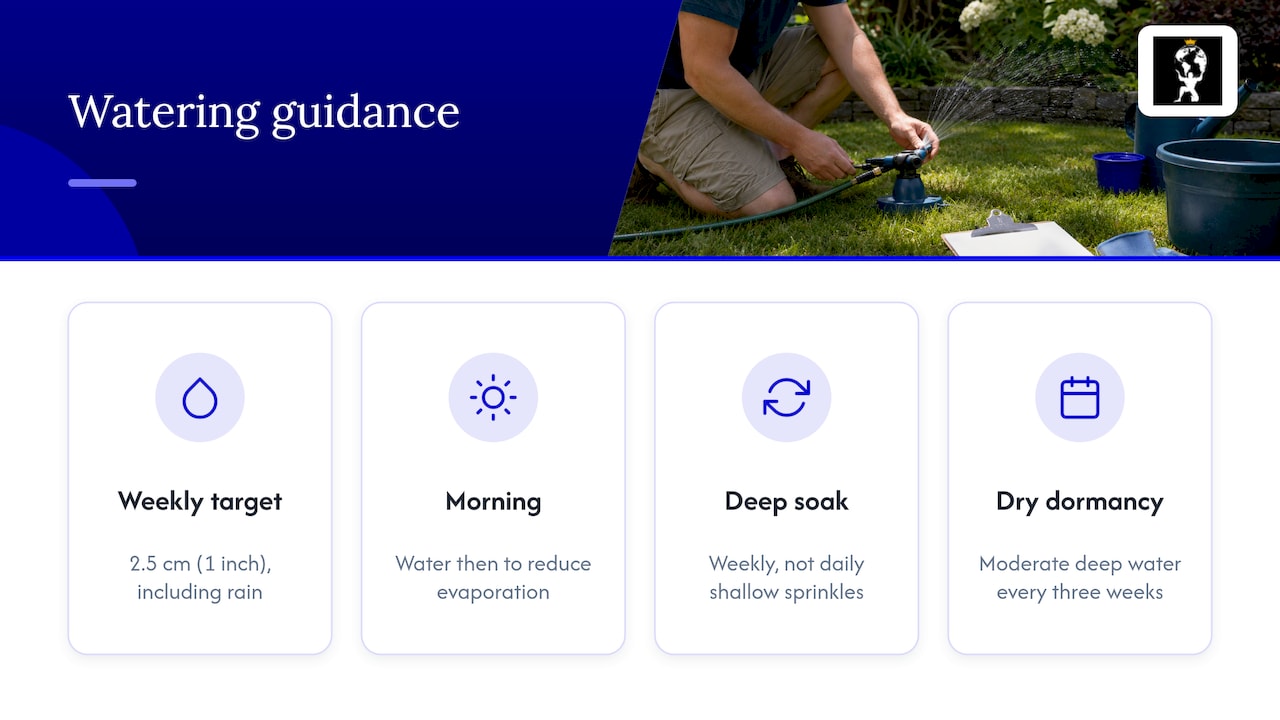
In long, hot, dry spells, the City of Windsor’s calendar describes letting the lawn go dormant. A dormant lawn turns brown but is not dead, and it can survive with a moderate deep watering about every three weeks. Cool fall rain brings it back.
Mowing
Keep the blades at 3 inches. Never scalp the lawn in July. Leave the clippings on the grass when they are short, since they return nutrients to the soil. Skip mowing in the heat of the afternoon.
Weeds
Pull weeds by hand while the soil is damp, root and all. The Windsor calendar recommends hand-pulling, and a thick, tall lawn is the best long-term defence. In August, the Windsor natural lawn care guide suggests applying corn gluten meal in the middle to late part of the month. That is a natural product that limits weed seed germination.
Early fall: mid-August to mid-September
This is the most valuable stretch of the lawn year. OMAFRA’s lawn winter preparation page names mid-August to mid-September as the ideal time to overseed, and recommends core aerating in that same window for thatch control and better seed-to-soil contact. Health Canada also says aeration is best done in late summer, followed by topdressing or overseeding, and that overseeding is best in late summer to early fall.
Why fall? Warm soil, cooling air and more reliable rain suit germination, and the summer weeds are fading. New grass also needs several weeks to root before the ground freezes, so do not wait until October.
The fall sequence
Mow, then aerate. Cut the lawn a little shorter than usual, then core aerate when the soil is moist.
Spread seed. OMAFRA gives seeding rates of 2 to 4 kg per 100 m² for perennial ryegrass, 1 to 3 kg for fine fescue and 2 to 3 kg for tall fescue. Check the bag, since seed mixes vary. The lawn maintenance page notes that overseeding an existing lawn uses double the new-lawn rate.
Topdress lightly. A thin layer of compost helps seed stay moist and in contact with soil.
Fertilize. OMAFRA’s early fall feeding is at 0.5 kg of nitrogen per 100 m². Match the product to your soil test where you can.
Water lightly and often until the seed sprouts. Then return to deeper, less frequent watering.
Thatch matters because, as OMAFRA notes, it harbours snow mould and increases winter injury. Dealing with it in this window protects the lawn through the coming months.
September and October: keep it going
Keep mowing as long as the grass grows, and cut high. More frequent mowing in spring and fall is normal, since both seasons bring fast growth. As the season winds down, raise the mowing height slightly. OMAFRA says this helps roots grow deeper and insulates the crown of the plant.
When leaves start to fall, do not let them sit in a thick mat. The Windsor natural lawn care guide recommends chopping fallen leaves with the mower and leaving about 0.5 cm of the pieces on the lawn for overwinter protection. OMAFRA says leaves can be mulched up to 15 cm deep without harm, but they should be removed or mulched before the snow arrives. Anything beyond a light layer should go to the curb or the compost.
Late fall: mid- to late October
The second fertilizer is the one many homeowners forget. OMAFRA says to apply it when turf has stopped growing but is still green, usually mid- to late October, at the same 0.5 kg of nitrogen per 100 m². The Windsor guide calls the fall fertilizer the year’s most critical root-building application. Grass keeps storing energy in its roots after the top has stopped growing, so this feed pays off the following spring.
Then put the garden hose, mower and spreader away in an orderly way. A tidy end-of-season routine makes the first spring weekend faster.
Winter: November to February
The lawn is dormant, so the job is protection:
Keep foot traffic off frozen or snowy grass as much as you can.
Do not pile snow in tall mounds on the lawn. Compacted snow melts slowly and invites snow mould.
If you use ice melt near the lawn edge, use as little as you can. Salt shows up as brown strips in March.
If the lawn is a stretch of your property that you do not use much, consider whether part of it could be something other than turf. Our guide to sustainable landscaping ideas for Ontario homes covers options that need less mowing, and the rain garden maintenance routine shows a year-round schedule for a low spot that holds water.
A realistic plan for a busy household
Most families do not have time for twelve separate lawn tasks. Here is the short version that covers what matters most:
April: clear debris, flush salt, spot-seed.
May to August: mow high and water 1 inch a week in the morning.
Mid-August to mid-September: aerate, overseed, fertilize. This is the single most important weekend of the year.
Mid- to late October: fertilize again and deal with leaves.
If you only do those four, you will already be ahead of most lawns on the street.
Perspective: what we see as a household services team
Lawns are one of the jobs families put off, usually because the rest of the house is asking for attention first. We are a family-run team, and our work is built around taking logistics off a busy household’s plate, whether that is a move, a delivery, assembly or a reset of a cluttered space. What we have learned since we began in 2021, with over 500 moves behind us, is that people want to know what a job costs before it starts. That is why we use itemized and flat-rate pricing: you see the figure first, and there are no hidden fees. We treat lawn work the same way. Our Lawn Refresh is a flat 65 CAD one-off booking, so a seasonal visit does not become an open-ended expense. The calendar above is the plan. Fall is the window that matters most, and it falls in the same weeks as back-to-school and the end of many leases and moves. When the schedule is full, a booked visit is easier to keep than a weekend you hope to find. Natalie
Book a lawn visit in Niagara Falls
Our Lawn Refresh is a one-off service at 65 CAD, booked online, and it suits the seasonal jobs in this calendar when your own weekend is already full. If you want the whole household to run more smoothly, the ATLAS PASS is 312 CAD per year. You can see all our services, including Lawn Refresh, on our booking page, or read the Lawn Refresh details first.

We are based at 4635 Queen St Unit D, Niagara Falls, and we also serve Welland, Fort Erie, Grimsby, Lincoln, Hamilton, Brantford, London and Sarnia. If you are planning a move this season too, our 6 to 8 week plan for families moving to Niagara Falls fits neatly around the lawn schedule, and the winter moving guide is useful if your move lands in the cold months.
FAQ
When should I start mowing in Niagara Falls?
Start when the grass has grown to about 11 cm (4.5 inches), which is usually in April or early May depending on the spring. The first cut should leave the lawn at about 3 inches, per the City of Windsor’s Ontario lawn calendar. Never remove more than one-third of the blade height at once.
What is the best month to overseed?
OMAFRA identifies mid-August to mid-September as the ideal time to overseed in Ontario. Aerate first so the seed reaches the soil, and keep it moist until it sprouts. Spring seeding is possible for patches, but it needs careful watering through the summer.
How much should I water my lawn?
The City of Niagara Falls says healthy lawns need about 2.5 cm (1 inch) of water each week, ideally given in the morning. Rain counts toward that inch. In a long dry spell, the lawn can go dormant, and fall rain will green it up again.
When should I fertilize?
OMAFRA recommends early fall (mid-August to mid-September) and late fall (usually mid- to late October), each at 0.5 kg of nitrogen per 100 m². Spring and early summer feedings are generally lighter. A soil test tells you which nutrients your lawn actually needs.
What should I do with fallen leaves?
Mulch them with the mower so only small pieces remain, or remove them before snowfall. OMAFRA says up to 15 cm can be mulched without harm. A thick, wet mat of whole leaves left over winter can smother the grass.
Sources
Recommended
Comments