

Insurance for Moving: What Every Family Needs to Know


For most long-distance moves or any household with high-value items, getting coverage beyond the default carrier’s liability is worth the cost. If you’re moving locally with low-value goods, you may be fine relying on your existing homeowners or renters policy. But before you sign anything, do two things right now: call your insurance agent to confirm whether your policy covers items in transit or storage, and ask your mover to walk you through their valuation options in writing.
Here are four steps you can complete today:
Walk through your home and list every item worth more than $200, noting the replacement cost.
Photograph high-value pieces (electronics, art, jewelry, antiques) from multiple angles.
Record serial numbers for electronics and appliances.
Pull out receipts or appraisals for anything you’d struggle to replace out of pocket.
These steps take under an hour and can be the difference between a paid claim and a denied one.
Table of Contents
What does insurance for moving actually cover?
Moving insurance is the informal term most families use, but the industry distinguishes between two distinct concepts: valuation and insurance. Valuation is the liability your mover accepts under federal or contractual rules. Insurance is a separate financial product, either from a private insurer or added to an existing homeowners policy. Understanding which one you’re buying matters because the payout math is completely different.
Released Value Protection
Released Value Protection is the default option for interstate moves and costs you nothing. The catch: it pays only $0.60 per pound per article. A 50-pound sofa gets you $30 if it’s destroyed. A 1-pound tablet worth $500 gets you $0.60. For most households, this coverage is nearly meaningless for anything electronic, fragile, or valuable relative to its weight.
Full Value Protection
Full Value Protection requires the mover to repair the damaged item, replace it with a comparable item, or offer a cash settlement at current market value. Federal rules set Full Value as the automatic default for interstate moves: if you don’t select Released Value in writing, your shipment is covered under Full Value. Pricing typically runs about 1%–2% of the declared value of your shipment, though the exact settlement method (repair, replace, or cash) and exclusions vary by mover. Always request the written plan details before you sign, as specific terms and costs vary by mover.

Third-party private moving insurance
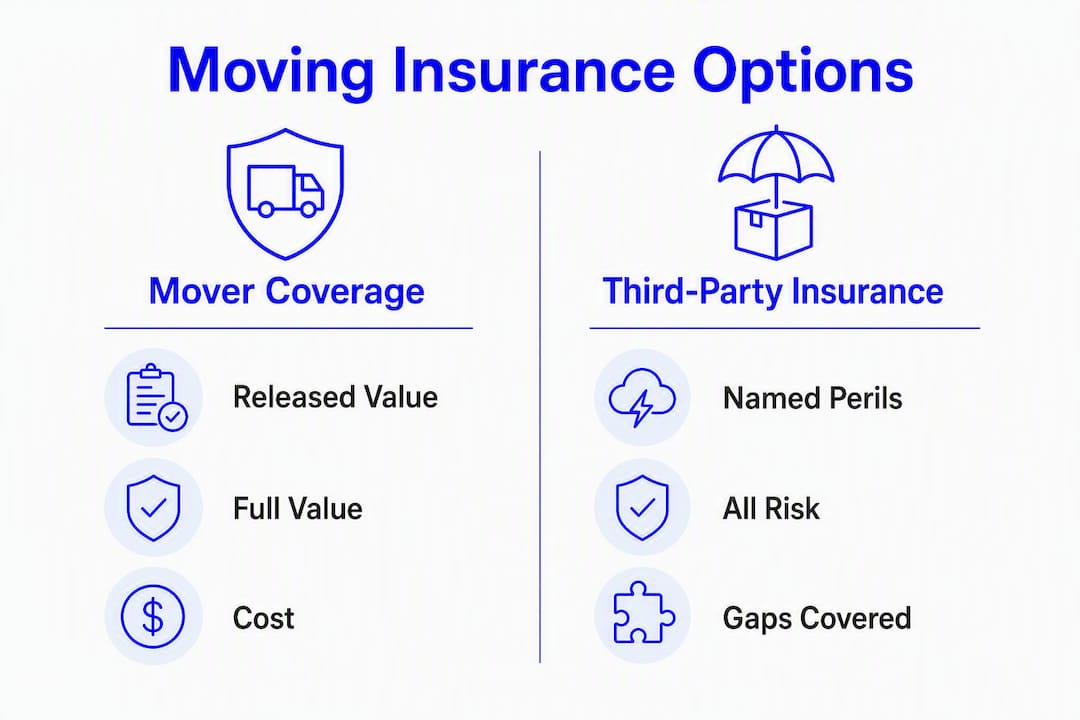
Private moving insurance, sold by companies like MovingInsurance.com, fills gaps that mover valuation doesn’t cover. It typically operates as a separate policy with its own deductible, premium, and claims process. Third-party policies can cover scenarios that mover valuation excludes, such as damage from natural disasters during transit or losses in storage facilities.
Named-perils vs. all-risk policies
A named-perils policy covers only the specific causes of loss listed in the policy (fire, theft, collision). An all-risk policy covers any cause of loss not explicitly excluded. For a move, all-risk coverage is generally stronger, especially for packed items where the cause of damage can be hard to pinpoint.
Key terms to know:
Term | What it means |
Valuation | The mover’s contractual liability for your goods, not a true insurance product |
Bill of lading | The contract between you and the mover; it governs liability |
Declaration of extraordinary value | A form listing items worth more than $100 per pound; required to preserve full recovery |
Rider / endorsement | An add-on to your homeowners or renters policy that extends transit or storage coverage |
Released Value | Weight-based liability at $0.60 per pound per article |
Statistic to remember: Under Released Value, a $500 tablet weighing 1 pound is covered for exactly $0.60. Full Value Protection would require the mover to replace or compensate at market value.
Where can you get moving coverage?
Three sources offer coverage for a move, and each comes with a different set of trade-offs.
Source | What it covers | Key pros | Key cons |
Mover valuation (Released Value) | $0.60/lb per article | Free | Pays almost nothing for high-value, low-weight items |
Mover valuation (Full Value) | Repair, replace, or cash settlement | Automatic default; claims handled through mover | Exclusions vary; settlement method at mover’s discretion |
Homeowners / renters policy | Varies by policy | May already cover transit | Often excludes or limits transit and storage; may need a rider |
Third-party private insurer | Varies by policy | Fills gaps; can cover storage and all-risk scenarios | Separate claims process; additional premium |
Mover-provided valuation
For interstate moves, FMCSA requires movers to offer both Released Value and Full Value Protection. The advantage of going through your mover is simplicity: one claims process, one point of contact. The downside is that the mover controls the settlement method under Full Value, and exclusions can be broad. FMCSA consumer advisories specifically warn against movers who pressure customers to accept Released Value or who inflate Full Value charges without clear written details. If a mover pushes you toward Released Value without explaining the difference, treat that as a red flag. The same caution applies when vetting any home-services vendor, a principle that extends well beyond moving.
Homeowners and renters policies
Many standard homeowners and renters policies exclude or limit coverage for possessions while in transit or in third-party storage unless specifically endorsed. State Farm’s guidance confirms this: don’t assume your policy travels with your furniture. Call your agent before moving day, confirm exactly what’s covered during transit and storage, and ask whether a rider or endorsement is needed. If your policy does cover transit, get that confirmation in writing.
Third-party moving insurance
Private insurers step in when mover valuation and homeowners coverage both fall short. They’re worth considering when you have high-value items, a long-distance move with multiple handling points, or storage time built into the plan. Claims go directly to the insurer rather than the mover, which can simplify disputes. Documentation requirements are typically stricter: expect to provide an itemized inventory, photos, and receipts at the time of purchase, not just at claim time.

How much does moving coverage cost?
Released Value costs nothing. Full Value Protection is where real pricing decisions begin.
Full Value Protection typically costs about 1%–2% of your shipment’s declared value, though the exact figure depends on the mover, the deductible you choose, and whether you have items of extraordinary value.
Sample cost estimates:
Small move, $10,000 declared value: Full Value at 1% = $100; at 2% = $200.
Medium move, $30,000 declared value: Full Value at 1% = $300; at 2% = $600.
Large move, $75,000 declared value: Full Value at 1% = $750; at 2% = $1,500.
Several factors push that percentage up or down:
Deductible selection. Choosing a higher deductible (say, $500 instead of $0) lowers the premium. The trade-off is that small claims become out-of-pocket costs.
Items of extraordinary value. Jewelry, antiques, and collectibles worth more than $100 per pound must be declared separately. Failing to list them can permanently cap your recovery at standard limits.
Distance and shipment weight. Longer hauls with heavier loads carry more handling risk, which some movers price into their Full Value rates.
Packing method. Items packed by the mover are generally covered more broadly than owner-packed boxes, where the mover may disclaim liability for internal damage.
Storage time. If your goods sit in a warehouse between pickup and delivery, confirm whether Full Value extends through that period or requires a separate endorsement.
Pro Tip: Request a quote for Full Value with a $500 deductible alongside the zero-deductible option. For most households, the premium savings outweigh the deductible risk on small claims.
What are the FMCSA rules for interstate moves?
The Federal Motor Carrier Safety Administration sets the rules for interstate household goods moves, and knowing them protects you.
Every licensed interstate mover must offer you both Full Value Protection and Released Value Protection before the move. If you don’t choose Released Value in writing, Full Value is your automatic coverage. That default is protective, but it also means you’re paying for Full Value unless you consciously opt out.
Critical claim timelines you must know: File your written claim within nine months following delivery; your mover must acknowledge receipt within 30 days and must offer a settlement decision within 120 days. Missing the nine-month window can forfeit your right to recover anything.
For items of extraordinary value, your mover may limit liability unless you list those items on a Declaration of Articles of Extraordinary Value before the move. A $5,000 violin weighing 5 pounds is worth $3 under Released Value and potentially nothing under Full Value if it wasn’t declared. Fill out that form.
One important limitation: FMCSA cannot force a mover to pay a claim. If a mover denies liability, you’ll need to negotiate, pursue arbitration, or file a lawsuit. The agency can record complaints and take regulatory action, but it doesn’t compel settlements. That’s why documentation before and during the move matters so much.
Regulatory checklist to save:
Signed bill of lading (keep your copy)
Written valuation selection (Released or Full Value)
Completed Declaration of Extraordinary Value (if applicable)
Delivery receipt with any noted damage
Written claim submitted within nine months of delivery; mover must acknowledge within 30 days and provide a settlement decision within 120 days.
How do you file a moving damage claim?
A well-documented claim filed promptly is far more likely to succeed than one assembled weeks later from memory.
Inspect everything at delivery. Don’t let the crew leave until you’ve checked visible condition on large items. Note any damage directly on the mover’s delivery paperwork before you sign.
Photograph damage immediately. Date-stamped photos taken at delivery carry more weight than photos taken days later.
Keep packing materials. If a box was crushed, the damaged box itself is evidence. Don’t break it down until the claim is resolved.
Write your claim within nine months. Send it to the mover in writing (email with read receipt or certified mail). Include: shipment ID or bill of lading number, an itemized list of damaged or missing items with estimated replacement values, photos, receipts or serial numbers, and your preferred remedy (repair, replace, or cash).
Track the response window. The mover has 30 days to acknowledge and 120 days to offer a decision. If they miss those windows, document it.
Escalate if needed. If the mover denies the claim or offers an unacceptable settlement, arbitration or court action are your options. Preserve every document.
Claim email checklist:
Bill of lading number and move date
Itemized damage list with replacement values
Date-stamped photos (before and after)
Receipts, appraisals, or serial numbers
Clear statement of your requested remedy
Should you buy moving insurance, and which option fits your situation?
The answer depends on four variables: what you own, how far it’s going, how it’s being handled, and what you can afford to lose.
Buy Full Value Protection or third-party insurance if:
Your total household replacement value exceeds $20,000.
You own electronics, antiques, jewelry, or art worth more than a few hundred dollars each.
You’re moving interstate or across multiple states with several handling points.
Your goods will be in storage for any period during the move.
Your homeowners or renters policy explicitly excludes transit coverage.
Released Value may be tolerable if:
You’re doing a small local move with items of modest replacement value.
Your homeowners policy confirms transit coverage in writing.
The cost of Full Value exceeds the realistic risk of loss for your shipment.
Questions to ask your mover before signing:
How is my declared value calculated, and what’s the minimum you’ll accept?
What deductible options are available for Full Value?
Do I need to complete a Declaration of Extraordinary Value, and what’s the deadline?
Does Full Value coverage extend through storage, or only during transport?
What’s your claims process, and who is my point of contact?
For a shipment of moderate declared value, Full Value typically costs a small percentage of that value. If that shipment includes a $2,000 laptop, a $3,000 camera, and a $5,000 antique dresser, the math strongly favors Full Value. For a studio apartment move with $8,000 in furniture and no high-value electronics, the calculus is closer.
Practical steps to protect your belongings before and during the move
Good documentation and careful packing reduce both the chance of damage and the risk of a denied claim.
Before the move:
Create a written inventory with item descriptions, estimated replacement values, and serial numbers for all electronics. Photos and receipts are the strongest claim evidence you can have.
For high-value items, get a written appraisal if you don’t already have one.
Confirm your homeowners or renters policy’s transit coverage in writing from your agent.
Packing high-risk categories:
Electronics: use original boxes when possible, or double-box with at least 2 inches of foam padding on all sides. Label as “Fragile” and “This Side Up.”
Glass and ceramics: wrap individually in packing paper, then bubble wrap. Never stack without dividers.
Antiques and art: consult a specialty packer for anything irreplaceable. Standard mover packing may not meet the care level these items need.
During loading:
Walk through with the crew and point out fragile or high-value items.
Keep a personal copy of the inventory list and check items off as they’re loaded.
Photograph the loaded truck before it leaves if you can.
Pro Tip: Photograph each box as you pack it, showing the contents before sealing. If a box arrives damaged and the mover disputes whether the contents were packed correctly, those photos are direct evidence of your packing method and the item’s pre-move condition.
For moving box rentals that are sturdy enough to protect your belongings and reduce the risk of damage claims, Atlaskings offers a practical option worth considering before packing day.
Frequently asked questions about moving coverage
Is it worth getting moving insurance? For long-distance moves or households with more than $15,000–$20,000 in replacement value, Full Value Protection or a third-party policy is generally worth the cost. For small local moves with low-value goods, your existing homeowners or renters policy may be sufficient if it covers transit.
What insurance do I need for moving? Start by calling your homeowners or renters agent to confirm transit coverage. For interstate moves, ask your mover for Full Value Protection in writing. If either falls short, a third-party moving insurance policy fills the gap.
How much should moving insurance cost? Full Value Protection typically runs 1%–2% of your declared shipment value. On a $30,000 move, that’s $300–$600. Released Value is free but pays only $0.60 per pound per article.
Does homeowners or renters insurance cover a move? Often not fully. Many standard policies exclude or limit transit and storage coverage unless you add a rider or endorsement. Call your agent before moving day to confirm.
Key Takeaways
Full Value Protection is the most reliable baseline for interstate moves, and filing a written claim within nine months of delivery is the single most important deadline to protect your rights.
Point | Details |
Verify homeowners coverage first | Call your agent before moving day to confirm whether transit and storage are covered. |
Get valuation in writing | Your mover must offer Released Value and Full Value; choose consciously and get the selection documented. |
Declare extraordinary-value items | Items worth more than $100 per pound must be listed on a special form or recovery may be capped. |
File claims within nine months | Written claim must reach the mover within nine months; mover has 30 days to acknowledge and 120 days to decide. |
Atlaskings offers transparent pricing | Atlaskings uses itemized and flat-rate pricing on local and multi-city moves, so valuation discussions start with a clear cost picture. |
The case for documentation over assumptions
Most families I speak with assume their homeowners policy covers the move, or that the mover’s default coverage is adequate. Neither assumption holds up under scrutiny. The $0.60-per-pound rule is not a safety net for anyone moving a laptop, a flat-screen TV, or a piece of inherited furniture. And homeowners policies, as State Farm’s own guidance confirms, routinely exclude transit and storage unless you specifically add coverage.
What actually protects you is the combination of Full Value Protection, a completed Declaration of Extraordinary Value for anything irreplaceable, and a photo inventory taken before the truck arrives. These aren’t bureaucratic formalities. They’re the difference between a claim that pays and one that gets denied on a technicality.
The other thing worth saying plainly: if a mover pressures you to accept Released Value without explaining what it means, that’s a signal about how they’ll handle a claim. FMCSA’s consumer advisories flag this behavior specifically. A mover that explains valuation clearly, puts your selection in writing, and walks you through the bill of lading is one that takes liability seriously. That transparency at the start of a move tends to predict how disputes get handled at the end.
Atlaskings makes valuation conversations straightforward
Choosing a mover that explains your options clearly is half the battle. Atlaskings offers local and multi-city moving and transport services with itemized and flat-rate pricing, so you know exactly what you’re paying before anything is loaded. There are no hidden fees, and valuation options are part of the conversation from the start, not an afterthought buried in the paperwork.

For in-home delivery of large or bulky items, furniture, and marketplace purchases, the in-home delivery service includes careful handling and clear documentation at every step. Since 2021, Atlaskings has completed over 500 moves with a focus on reliability and customer care. If you’re planning a move and want to talk through valuation options, pricing, and what to expect, reach out to book a service or get a quote.
Useful sources and where to learn more
These are the authoritative resources to consult for official rules, claim forms, and deeper reading on moving valuation and insurance:
FMCSA: Liability and Protection: The primary federal source for Released Value and Full Value rules, the $0.60-per-pound standard, and the Declaration of Extraordinary Value requirement. Save this page before your move.
FMCSA: Discovered Loss and Damage Resources: Explains what happens when a mover denies a claim and outlines arbitration and legal options.
FMCSA: Consumer Advisory on Loss and Damage: Flags specific mover behaviors to watch for, including pressure to accept Released Value.
FMCSA: Understanding Valuation and Insurance Options (fact sheet): A concise PDF covering both valuation types, pricing ranges, and what to ask your mover. Print it and bring it to your pre-move walkthrough.
FMCSA: Protect Your Move: The main consumer hub for interstate move rights, mover lookup tools, and complaint filing.
Surface Transportation Board: Household Goods Lost or Damaged Items: Explains the STB’s role in governing mover liability and when legal action may be necessary.
State Farm: The Ins and Outs of Moving Insurance: Practical guidance on what homeowners and renters policies typically cover (and don’t cover) during a move.
U.S. News & World Report: Do You Need Moving Insurance?: A consumer-facing explainer covering documentation best practices and when third-party coverage makes sense.
FMCSA governs all interstate mover valuation obligations and claim timelines. Print or bookmark the FMCSA fact sheet and the Liability and Protection page before your move date so you have the official rules on hand if a dispute arises.
This article provides general information about moving valuation and insurance options. It is not legal or financial advice. Confirm current rules and your specific coverage with FMCSA, your insurer, or a qualified professional before your move.
Recommended
Comments