

How to Ship Large Items: A Practical Family Guide


Shipping large items is defined as moving packages that exceed standard parcel carrier limits, requiring either oversized parcel handling or freight services. Whether you’re sending furniture across the country, shipping appliances from Niagara Falls to Vancouver, or selling bulky goods on eBay, the rules change fast once your package gets big. The wrong carrier choice or a sloppy packing job can cost you hundreds of dollars in surcharges. This guide walks you through size limits, packaging techniques, cost calculations, and the most common mistakes families make when shipping oversized items.
How to ship large items: parcel vs. freight explained
The single most important decision in large item shipping is choosing between parcel carriers and freight services. Get this wrong, and you pay oversized surcharges that can double your bill.
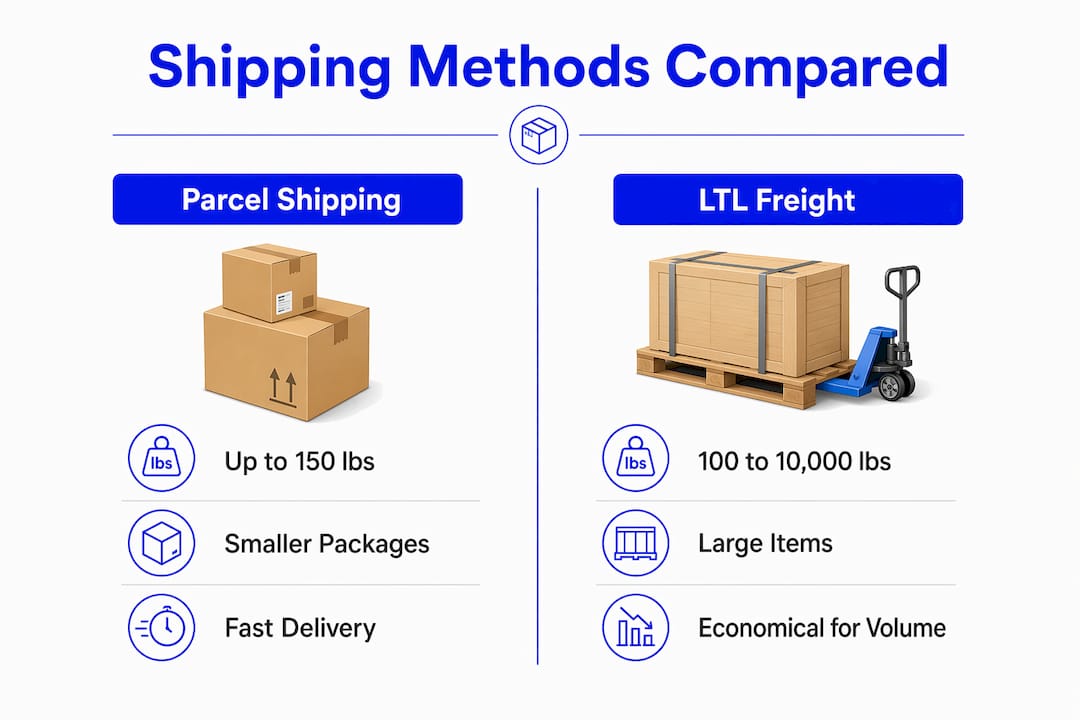
Standard parcel carriers cap packages at 150 lbs and 108 inches on the longest side, with a combined length plus girth limit of 165 inches. Anything beyond those numbers moves into freight territory. That threshold matters because freight pricing works on an entirely different model than parcel pricing.
Less-than-truckload freight, known as LTL, is the standard industry term for freight shipping where your goods share trailer space with other shipments. LTL freight handles shipments between 100 and 10,000 pounds and prices based on freight class, not just weight. Parcel shipping prices by weight and dimensions alone. Knowing which category your shipment falls into before you book saves you from surprise invoices after delivery.
Shipping type | Weight range | Best for |
Standard parcel | Up to 150 lbs | Boxes, small appliances |
Oversized parcel | 70–150 lbs, large dims | Furniture pieces, sports gear |
LTL freight | 100–10,000 lbs | Palletized goods, full furniture sets |
What size and weight limits apply to large packages?
Parcel carriers measure size two ways: single longest dimension and combined length plus girth. Girth is calculated as two times the width plus two times the height. A package that is 60 inches long, 20 inches wide, and 20 inches tall has a girth of 80 inches, giving a combined total of 140 inches. That fits within the 165-inch limit.
Once your package exceeds 108 inches on any single side, most parcel carriers either refuse it or apply a large package surcharge that can rival freight costs. At that point, LTL freight services become the practical choice. Standard Canadian LTL pallets measure 48 inches by 48 inches by 84 inches tall, with per-pallet weights ranging from 1,500 to 2,500 lbs depending on the carrier.
For families shipping large items across the country or internationally, these limits apply regardless of destination. Cross-border shipments to the United States or overseas add customs documentation requirements, but the physical size thresholds stay consistent with carrier rules.
How to package large items for safe transit
Proper packaging is the single biggest factor in whether your item arrives intact. Carriers handle thousands of packages daily, and yours will be stacked, tilted, and moved multiple times.
Choosing the right materials
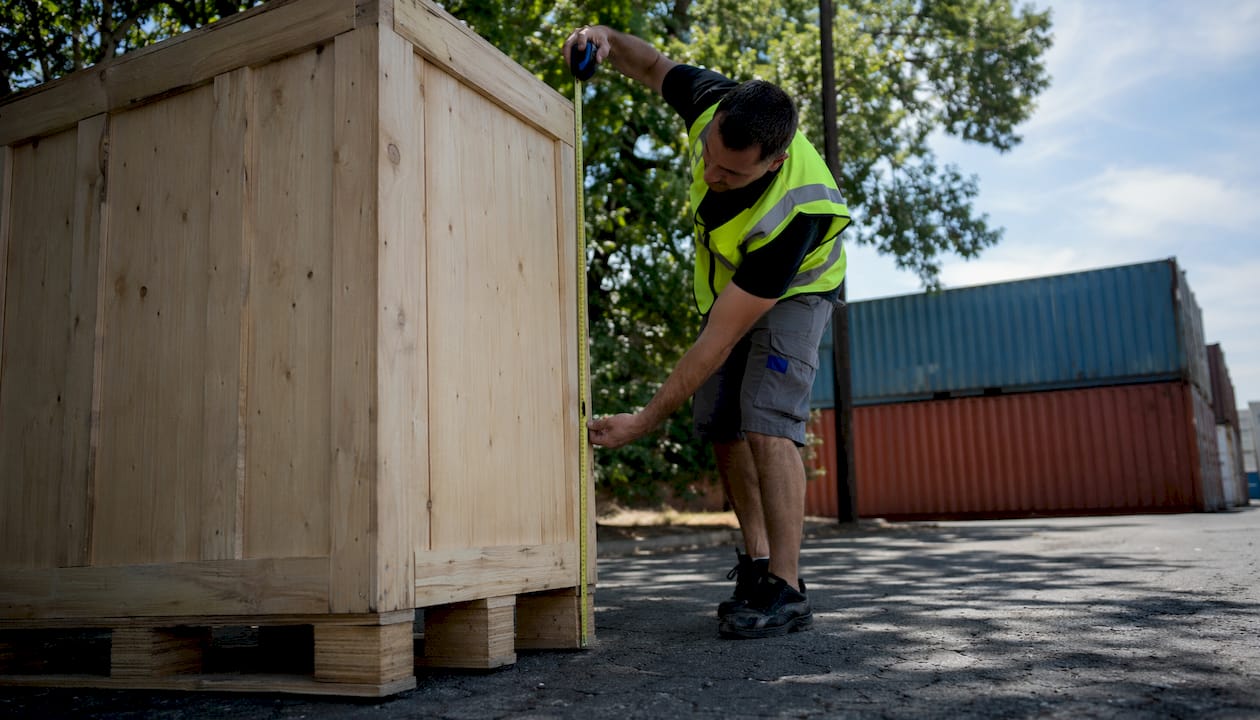
Use double-walled corrugated boxes for heavy items. Single-wall boxes collapse under stacking pressure. For very large or irregularly shaped goods, wooden crates offer the best protection. Pallets are the standard base for freight shipments, and the standard pallet size is 48 inches by 40 inches for most North American carriers.
Cushioning and securing your shipment
Fill all empty space inside boxes with foam, bubble wrap, or packing peanuts. Items that shift inside a box during transit are the leading cause of damage claims. For palletized freight, stack goods evenly to distribute weight, keep the load within pallet edges, and never let items overhang the sides.
Wrap the entire pallet load with stretch film. Proper pallet wrapping means covering the pallet base itself, not just the goods on top, using at least five full revolutions of 70-gauge stretch film. This bonds the freight and pallet into one solid unit and prevents tipping during loading.
Use double-walled boxes or wooden crates for heavy or fragile items
Fill all void space to prevent internal shifting
Stack pallet loads evenly within pallet edges, no overhang
Apply at least five full wraps of 70-gauge stretch film, including the pallet base
Label every side: “Fragile,” “Heavy,” “This Side Up” where applicable
Remove all old shipping labels to prevent misrouting
Pro Tip: Take photos of your packaged shipment before pickup. If a damage claim arises, photos showing proper packaging are your strongest evidence.
How to calculate shipping costs and find the cheapest option
Two pricing models drive large item shipping costs: actual weight and dimensional weight. Carriers bill you for whichever is greater.
Dimensional weight pricing means a large but light package, like a hollow lamp or an empty cabinet, gets billed as if it weighs far more than it actually does. The formula is length times width times height divided by a carrier-specific divisor, typically 139 for international shipments. A box measuring 40 by 30 by 30 inches calculates to a dimensional weight of roughly 260 lbs, even if the actual contents weigh 40 lbs.
For LTL freight, freight class is the primary pricing factor. Classes range from 50 for dense, easy-to-stack goods up to over 400 for fragile or bulky items. A dense steel part ships at a low class and low cost. A lightweight foam mattress ships at a high class and high cost. Knowing your freight class before requesting quotes prevents surprises.
Strategies to lower your shipping costs
Consolidating shipments and choosing ground delivery over express services can cut shipping costs by 30–50%. That is a meaningful saving on a $400 freight bill.
Breaking down large items into multiple smaller boxes shipped via standard ground courier can cost less than one oversized freight shipment. Disassembling a bookcase into flat panels, for example, reduces dimensional weight and eliminates freight handling surcharges. For families moving furniture or appliances, this approach often produces the cheapest result. You can also explore moving box rental as a cost-effective packaging option.
Pro Tip: Always get quotes from at least three carriers or use a shipping aggregator that compares rates across multiple providers. Rates for the same shipment can vary by 40% or more between carriers.
What common mistakes cost families the most when shipping large items?
Most expensive shipping mistakes are avoidable. They fall into a few predictable categories.
Inaccurate measurements. Carriers charge retroactively at a higher freight class if your declared dimensions or weight do not match what they measure at the terminal. Always weigh and measure your packaged shipment, not just the item inside, before requesting a quote.
Forgetting accessorial fees. Freight carriers do not include residential delivery or liftgate service by default. Requesting either service adds $50–$150 per delivery. If your home does not have a loading dock, you need a liftgate. Forgetting to request it means the driver cannot unload, and you pay a redelivery fee on top.
Overhanging freight. Items that extend beyond pallet edges get damaged and can damage other shipments. Carriers may refuse the load or charge a penalty.
Leaving old labels on packages. Old barcodes and addresses cause misrouting. Remove or black out every previous label before handing your shipment to a carrier.
Choosing the wrong service type. Shipping a 200-lb item via parcel when LTL freight would be cheaper, or vice versa, is a common and costly error. Always compare both options before booking.
For families shipping large items across Canada or internationally, planning for these fees upfront prevents budget surprises. Atlaskings handles large item transport with transparent, itemized pricing so you know exactly what you are paying before the truck arrives.
Key Takeaways
Choosing between parcel and LTL freight shipping, packaging correctly, and accounting for dimensional weight and accessorial fees are the three factors that determine whether large item shipping costs you a reasonable amount or a painful one.
Point | Details |
Know the size limits | Parcel carriers cap at 150 lbs and 165 inches length plus girth; beyond that, use LTL freight. |
Package for freight handling | Use double-walled boxes or crates, fill void space, and wrap pallets with at least five revolutions of stretch film. |
Understand dimensional weight | Carriers bill by volume or actual weight, whichever is greater; disassemble bulky items to reduce volume. |
Account for accessorial fees | Residential delivery and liftgate service each add $50–$150; request them upfront to avoid redelivery charges. |
Compare rates before booking | Consolidating shipments and choosing ground delivery can cut costs by 30–50% compared to express freight. |
What I’ve learned from watching families get blindsided by freight bills
Most families I talk to in Niagara Falls underestimate how much the details matter in large item shipping. They focus on the base rate and forget that the final invoice often looks nothing like the quote. The two biggest culprits are dimensional weight and accessorial fees, and both are entirely predictable if you know to look for them.
The advice I give every time is this: measure your packaged shipment, not the item. A sofa that is 84 inches long becomes a 90-inch package once it is boxed. That 6-inch difference can push you into a higher freight class or trigger an oversized surcharge. The same applies to weight. Packaging materials add more than people expect.
I also think families undervalue the option of disassembly. Breaking a large piece of furniture into flat components is not just about saving money on dimensional weight. It also reduces the risk of damage, because flat panels pack more securely than assembled furniture. The furniture assembly service at the destination end makes this approach practical even for families who are not handy.
The last thing I want families to overlook is timing. Freight carriers have pickup windows, not guaranteed times. If you are shipping large items across the country and need them by a specific date, build in at least two to three extra days. Ground freight across Canada typically takes five to ten business days, and delays happen. Plan for them.
— Natalie
How Atlaskings supports large item delivery in Niagara Falls
Shipping large items is one thing. Getting them safely inside your home is another challenge entirely.

Atlaskings is a family-run transport and delivery service based in Niagara Falls, and we have completed over 500 moves since 2021. Our in-home delivery service handles large items from the truck to the room of your choice, with careful handling and scheduling that works around your day. We offer itemized and flat-rate pricing with no hidden fees, so the number you see is the number you pay. Whether you need a single appliance delivered or a full furniture set moved across the city, our team is ready to help. Reach out to Atlaskings to get a quote and schedule your delivery at a time that works for you.
FAQ
What is the weight limit for shipping large items via parcel?
Standard parcel carriers cap packages at 150 lbs. Shipments above that threshold require LTL freight services.
How is dimensional weight calculated for large packages?
Dimensional weight is calculated by multiplying length times width times height, then dividing by a carrier-specific divisor. Carriers charge whichever is greater, dimensional weight or actual weight.
What is LTL freight and when should I use it?
LTL, or less-than-truckload freight, is the standard shipping method for items between 100 and 10,000 lbs. Use it when your shipment exceeds parcel carrier size or weight limits.
How can I ship large items cheaply?
Consolidating shipments, choosing ground delivery, and breaking large items into smaller boxes can reduce costs by 30–50%. Always compare rates across multiple carriers before booking.
Do freight carriers deliver to residential addresses?
Freight carriers do not include residential or liftgate delivery by default. Requesting these services adds $50–$150 per delivery, so confirm your delivery requirements when booking.
Recommended
Comments