

Heat Pump Rebates Ontario 2026: What Homeowners Need to Know

Ontario homeowners in 2026 have access to a meaningful stack of rebates for heat pump installations. The primary provincial program is the Home Renovation Savings Program (HRS), delivered through Save on Energy and Enbridge, offering significant rebates for a cold-climate air-source heat pump (ASHP) and for a ground-source (geothermal) system. Layer in the federal Oil to Heat Pump Affordability (OHPA) grant of up to $10,000 for oil-heated homes, and combined funding can be very substantial in qualifying scenarios. Your first two steps: confirm your equipment is on Natural Resources Canada’s (NRCan) qualified products list, and verify your installer is registered for the programs you plan to use.
Table of Contents
Which 2026 Ontario and federal programs apply to heat pump installs
How to stack HRS with federal programs and coordinate the timing
Step-by-step application checklist for your heat pump rebate
Funding windows, deadlines, and how to check live availability
Rough installed costs and net cost after rebates for a 2,000 sq ft home
Frequently asked questions about 2026 heat pump rebates in Ontario
Why a full home energy assessment still matters for many homeowners
Atlaskings can help you prepare for your heat pump installation
Which 2026 Ontario and federal programs apply to heat pump installs
Several programs are active in 2026, and they target different homeowner profiles. Here is a quick map so you can identify which ones apply to your situation.

Home Renovation Savings Program (HRS) / Save on Energy and Enbridge Ontario’s primary provincial rebate, administered by Save on Energy and Enbridge Gas as delivery partners. HRS covers cold-climate ASHPs and ground-source systems, with rebate amounts tied to installed system capacity (tons). Enbridge Gas customers fall into a lower per-ton tier than homeowners on electric, oil, propane, or wood heat.
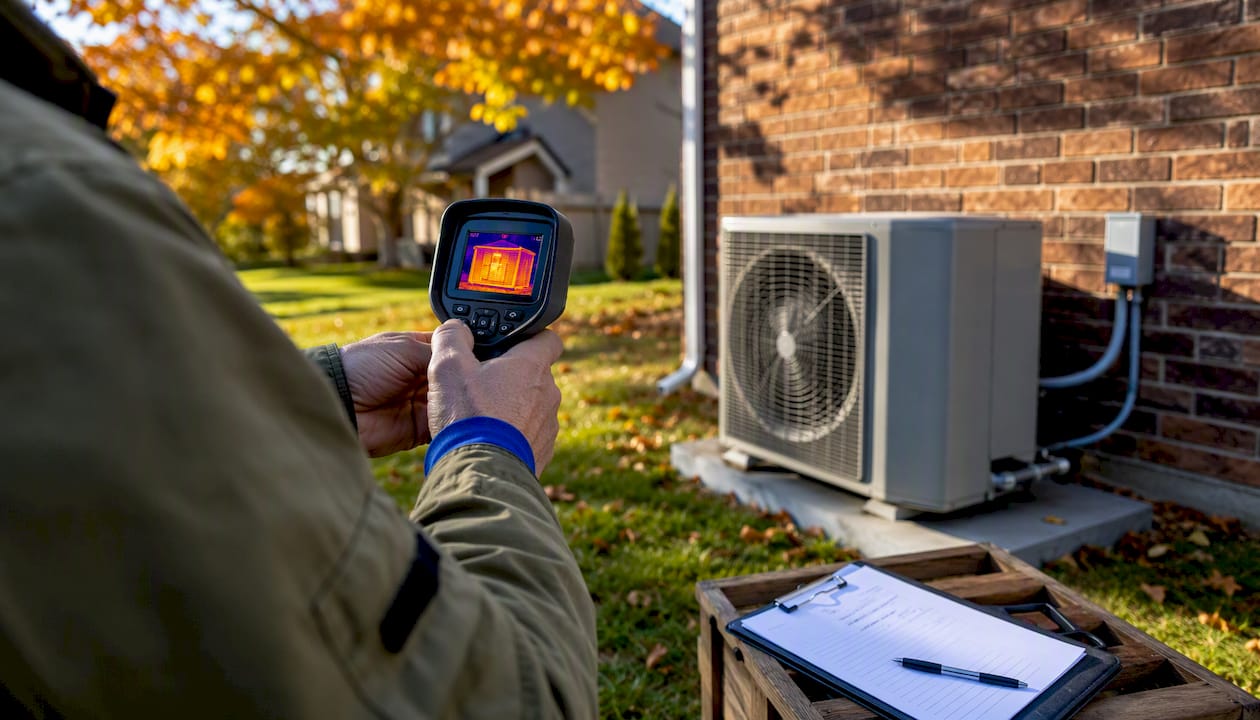
Oil to Heat Pump Affordability (OHPA) — federal A federal grant of up to $10,000 for low-to-median-income households currently heating with oil. Managed by Natural Resources Canada, OHPA is designed to stack with provincial programs like HRS when program rules allow.
Canada Greener Homes Initiative (federal) The broader federal umbrella, which includes affordability streams for income-qualified homeowners. Depending on your delivery region, support may come as a direct-install service or a grant that complements HRS.
Municipal financing — Toronto BetterHomesTO HELP Toronto’s BetterHomesTO HELP loan is a PACE-style program repaid through property taxes, with loan amounts reaching up to $125,000. It covers remaining installation costs after rebates and is available to Toronto homeowners who need to spread upfront expenses.
Other utility or dealer offers Some local utilities and equipment dealers run their own promotions alongside HRS. These vary by region and are worth asking about when collecting quotes, but they are separate from the programs above.
Canada Greener Homes affordability streams: — Income-qualified homeowners; delivery model varies by region
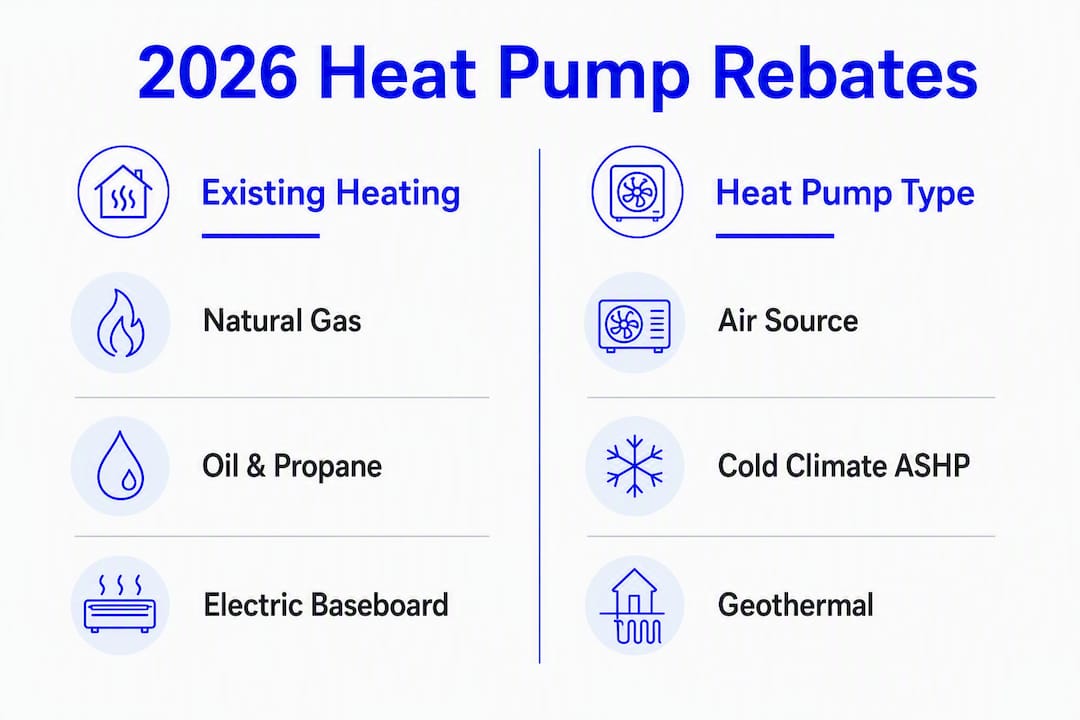
2026 rebate rates by heating source and heat pump type
Rebate amounts under HRS depend on two variables: your existing heating fuel and the rated capacity of the system your contractor installs. The per-ton tiers differ significantly between natural gas customers and everyone else.
Program | Max rebate | Eligible existing heating source | Heat pump type | Energy assessment required | Application flow | Stackable with federal grants | Typical processing |
HRS / Save on Energy | — | Natural gas, electric, oil, propane, wood | Cold-climate ASHP or ground-source | Not required for single-upgrade path | Pre-approval + installer-submitted post-install | Yes (OHPA, Greener Homes) | 6–12 weeks post-submission |
OHPA — NRCan | $10,000 | Oil only | Cold-climate ASHP or ground-source | Varies by delivery region | Pre-approval required; delivery partner manages | Yes (stacks with HRS) | Varies by delivery region |
Canada Greener Homes affordability | Varies by region | Income-qualified; all fuel types | Cold-climate ASHP or ground-source | Often required for bundled path | Direct-install or grant; region-dependent | Yes (stacks with HRS) | Varies |
BetterHomesTO HELP | Up to $125,000 (loan) | All fuel types (Toronto only) | Any eligible system | No | Post-rebate financing via property tax | N/A (financing, not grant) | Varies |
Worked example — natural gas home, ~2,000 sq ft, 3-ton system: Enbridge Gas customers receive approximately $500 per ton under HRS. A 3-ton system would yield roughly $1,500 in provincial rebate. Gas homes are not eligible for OHPA (oil-only program), so the provincial rebate stands alone unless a Greener Homes affordability stream applies.
Worked example — oil-heated home, ~2,000 sq ft, 3-ton system: Non-gas homes qualify for the higher HRS tier, approximately $1,250 per ton, producing roughly $3,750 for a 3-ton ASHP. Add the OHPA federal grant of up to $10,000, and total combined funding can reach a large amount before any municipal financing layer. For a geothermal system, the HRS cap is $12,000, and stacking with OHPA can bring combined funding up to $22,000 in certain cases.
Rates confirmed from HRS public program summaries and NRCan program pages. Verify current amounts directly on the Save on Energy HRS page before contracting, as program details can update mid-year.
HRS also lists heat pump water heaters (commonly eligible for $500) and smart thermostats for modest rebates, so homeowners replacing multiple systems can claim alongside a space heat pump.
Who qualifies and what the application path requires
Eligibility for HRS and the federal programs rests on a short set of conditions. Most Ontario homeowners will qualify, but a few specifics can disqualify a claim before it starts.
Ownership and property type
You must own the home and it must be your primary residence.
Rental properties and secondary residences have different or limited eligibility under most streams.
Existing heating fuel
HRS accepts natural gas, electric, oil, propane, and wood as baseline heating sources.
Homes that already have a heat pump as the primary heating system are generally excluded from the heat pump stream.
Equipment standards
The installed system must appear on NRCan’s qualified products list for cold-climate heat pumps.
Ground-source systems must meet separate NRCan criteria.
Application path: single-upgrade vs. bundled HRS allows homeowners to apply for a heat pump as a single upgrade without a full EnerGuide home energy assessment. This speeds up the process considerably. The bundled path, which includes an assessment, can unlock additional rebates for insulation or air-sealing but adds time and cost. Pre-approval from a participating contractor is still required for the heat pump stream before installation begins.
Documents to have ready
Proof of home ownership (property tax bill or title)
Evidence of current heating fuel (utility bill or fuel delivery receipt)
Contractor quote showing model number and rated capacity
Equipment spec sheet confirming NRCan qualification
Regional and utility-specific notes Enbridge Gas customers apply through Enbridge’s delivery channel, which sets the lower per-ton tier. Save on Energy handles non-Enbridge areas. If you are unsure which delivery partner covers your address, confirm before selecting a contractor, since the wrong channel can delay your application.
Which heat pumps actually qualify for rebates
Not every heat pump on a showroom floor qualifies for HRS rebates. The most common and costly mistake homeowners make is purchasing a model that looks like a cold-climate unit but is not on NRCan’s list.
What “cold-climate” means in practice NRCan’s cold-climate designation requires a heat pump to deliver rated heating capacity at temperatures as low as -15°C or -25°C, depending on the tier. Standard heat pumps lose efficiency rapidly below freezing; cold-climate models are engineered to maintain output in Ontario winters. The NRCan Product Listing for Energy Star certified products and the NRCan Product Listing database are the two official sources to cross-reference.
What to check on a contractor’s quote
Full model number (not just brand and series name)
Rated heating capacity in tons or BTU/h at the low-temperature test point
Confirmation that the model appears on NRCan’s current qualified products list
Verification checklist to give your installer
Confirm the exact model number against the NRCan list before ordering.
Request the equipment spec sheet showing rated capacity at -15°C.
Ask for written confirmation that the model qualifies for HRS rebates.
Verify the installer will document the serial number post-installation.
Pro Tip: Before signing any purchase or installation contract, ask your installer: “Is this exact model number currently on NRCan’s qualified products list for HRS?” If they cannot answer with the model number in hand, that is a signal to pause. A reputable installer will pull up the list on the spot.
How to stack HRS with federal programs and coordinate the timing
Stacking provincial and federal incentives is where the largest savings live, but it is also where the most denials happen. The order of operations matters.
Which programs stack with HRS
OHPA + HRS: Oil-heated homeowners can combine the OHPA federal grant (up to $10,000) with HRS provincial rebates. For a geothermal system, this combination can bring combined funding up to $22,000 in some cases.
Canada Greener Homes affordability + HRS: Income-qualified homeowners may access federal affordability streams on top of HRS. Delivery varies by region; some areas offer direct-install services rather than cash grants.
Coordination advice
The most reliable approach is to secure pre-approval for both programs before any installation work begins. Starting work before a required pre-approval is the primary avoidable cause of rebate denial. For OHPA, the federal delivery partner manages the application, and their timeline may differ from HRS’s provincial process. Confirm with your installer which program needs to be opened first.
Confirm your installer is registered for both HRS and the federal program you plan to use.
Ask explicitly: “Will you handle the pre-approval submissions for both programs?”
Do not schedule installation until written pre-approval is in hand for every program you are stacking.
Keep copies of all pre-approval confirmations; upload them with your post-install submission.
Timing warning Some federal affordability streams operate on a first-come, first-served basis within funding windows. If you are income-qualified and planning to stack, apply to the federal stream as early as possible, since funding can be exhausted before the window officially closes.
Contractors who manage stacking paperwork across provincial and federal portals are more valuable than a slightly lower install quote. Ask installers explicitly whether they are authorized for each program you plan to use, because a missed pre-approval step on one program can void the entire stack.
Step-by-step application checklist for your heat pump rebate
Follow this sequence to avoid the most common causes of rejected or delayed claims.
Confirm your delivery partner. Identify whether your address falls under Save on Energy or Enbridge Gas for HRS delivery. Check the program page or call the utility directly.
Select a registered installer. Only contractors on the participating contractor list for HRS can submit pre-approvals. Ask for their registration number before signing anything.
Verify the equipment model. Confirm the exact model number is on NRCan’s qualified products list. Get this in writing on the quote.
Submit pre-approval (if required). For the heat pump stream, your installer typically submits a pre-approval application before installation. Do not allow work to begin until this is confirmed.
Apply for federal programs. If you are stacking OHPA or a Greener Homes affordability stream, open those applications in parallel with or before the HRS pre-approval, depending on the delivery partner’s instructions.
Retain all documentation during installation. Keep the invoice, installer certification, equipment serial number, and photographs of the installed unit. Confirm the contractor records system sizing documentation.
Submit the final application post-installation. Upload all documents within the program’s submission window. Late submissions are a common cause of denial.
Follow up on processing. HRS typically processes claims within 6–12 weeks of a complete submission. OHPA timelines vary by delivery region. Note your submission date and follow up if you have not received confirmation within the stated window.
Approximate time estimates: pre-approval review, 1–3 weeks; installation scheduling, 1–4 weeks after approval; post-install submission to rebate payment, 6–12 weeks.
How to verify an installer is authorized for HRS and OHPA
Choosing the wrong contractor is one of the fastest ways to lose a rebate you have already planned around. Authorized installers are listed on the Save on Energy and Enbridge program pages; ask any contractor you are considering to confirm their registration before you discuss pricing.
Questions to ask every installer
“Are you currently registered as a participating contractor for HRS through Save on Energy or Enbridge?”
“Are you authorized to submit OHPA applications, and have you done so before?”
“Will you handle the pre-approval submission, or is that my responsibility?”
“Can you show me the model number on NRCan’s qualified products list before we sign?”
A contractor who answers these questions confidently and specifically, with registration numbers and model list references, is demonstrating real program familiarity. Vague answers like “we handle all the paperwork” without specifics are worth probing further.
Red flags to watch for
Pressure to start installation before pre-approval is confirmed in writing
Equipment quoted without a model number or NRCan list reference
Refusal to provide an itemized invoice (required for rebate documentation)
Claims of rebate amounts that exceed published program maximums
Where possible, ask the installer for references from recent HRS or OHPA submissions. A contractor with a track record of successful stacking applications is worth a modest premium over one who is figuring it out on your project.
Common mistakes that cause rebate denials
Most rebate denials are preventable. The errors below account for the majority of rejected claims.
Buying a non-listed model. Only NRCan-listed cold-climate models qualify for the higher HRS tiers. Confirm the model number before purchase, not after.
Starting work before pre-approval. This is the single most common avoidable cause of denial. Pre-approval must be in place before installation begins for programs that require it.
Missing the application order when stacking. Applying to OHPA after HRS has already closed out a claim can disqualify the federal layer. Coordinate both applications before installation.
Incomplete or non-itemized invoices. Program administrators require itemized invoices showing equipment model, serial number, labor, and materials separately. A single lump-sum invoice will not satisfy documentation requirements.
Failing to verify installer registration. An unregistered contractor cannot submit a pre-approval, which means the rebate process cannot start correctly.
Late post-install submission. Most programs have a submission window after installation. Missing it forfeits the rebate.
Pro Tip: Even if you are taking the single-upgrade path to speed up your rebate, consider booking a full home energy assessment before installation. Assessments often reveal insulation or air-sealing gaps that, when addressed, reduce the load your heat pump carries and improve long-term comfort. The assessment cost is modest relative to the efficiency gains, and it can open bundled rebate paths for additional measures.
A brief note on municipal financing: if your rebates do not cover the full upfront cost, Toronto’s [BetterHomesTO HELP loan] repaid through property taxes is a practical option for Toronto homeowners. For homeowners outside Toronto, check with your municipality for similar PACE-style programs.
Funding windows, deadlines, and how to check live availability
Program funding is not unlimited, and windows can close or pause without much public notice. Treating program pages as a one-time reference is a reliable way to miss a deadline.
HRS (Save on Energy / Enbridge): Public summaries indicate HRS is active through November 2026. Confirm current status on the Save on Energy HRS page before signing a contract.
OHPA: Application timelines vary by delivery region and are subject to federal funding availability. Check the NRCan OHPA eligibility page for current status.
Canada Greener Homes affordability streams: Availability depends on regional delivery partners. Some streams have been paused and reopened; check the NRCan Greener Homes page for current status.
BetterHomesTO HELP: Available to Toronto homeowners on an ongoing basis, subject to program terms. Confirm directly with the City of Toronto.
When a program shows “closed” or “paused” This usually means the current funding tranche is exhausted, not that the program is permanently ended. Check back within a few weeks, or contact the delivery partner directly to ask about reopening timelines.
Live-check routine Bookmark the official program pages and check them at two points: when you begin planning (to confirm the program is open), and again before you sign a contractor agreement (to confirm it is still open and rates have not changed). Do not rely on a contractor’s verbal confirmation alone.
Processing timeline reminder: HRS claims typically take 6–12 weeks from complete submission to payment. OHPA timelines vary. Build this into your cash-flow planning.
Rough installed costs and net cost after rebates for a 2,000 sq ft home
These figures are planning estimates. Actual costs vary by region, home envelope, and contractor pricing.
Scenario | System type | Gross installed cost (est.) | HRS rebate | OHPA rebate | Net cost (est.) |
Gas-heated home, 3-ton ASHP | Ducted cold-climate ASHP | — | ~$1,500 | Not eligible | — |
Oil-heated home, 3-ton ASHP | Ducted cold-climate ASHP | — | ~$3,750 | Up to $10,000 | ~$0 |
Oil-heated home, geothermal | Ground-source system | $20,000 | Up to $12,000 | Up to $10,000 | $0–$10,000 |
Gas-heated home, ductless mini-split | Ductless cold-climate ASHP | — | ~$500–$1,500 | Not eligible | — |
Rebate amounts are based on HRS public summaries and NRCan program pages. Gas-home HRS tier uses the Enbridge approximate rate of $500/ton; non-gas tier uses approximately $1,250/ton. Gross installed cost ranges reflect typical Ontario contractor pricing and will vary. Use these as planning estimates only.
Budgeting notes For oil-heated homes, the combination of HRS and OHPA can bring net cost to near zero on a standard ASHP installation, making 2026 one of the most favorable years to act. Gas-heated homes see a smaller provincial rebate but can still reduce net cost meaningfully. If the remaining balance after rebates is a cash-flow concern, Toronto’s [BetterHomesTO HELP loan] covers up to $125,000 repaid through property taxes. For homeowners outside Toronto, a moving cost calculator or similar budgeting tool can help you model total project costs alongside any financing options your municipality offers.
Lease and rental programs from some HVAC companies are another option for spreading costs, though they typically do not qualify for rebates in the same way a purchased system does. Confirm ownership requirements with your program delivery partner before choosing a lease arrangement.
Frequently asked questions about 2026 heat pump rebates in Ontario
Are heat pump rebates available right now in Ontario? Yes. The Home Renovation Savings Program (HRS) through Save on Energy and Enbridge is active in 2026, with public summaries indicating availability through November 2026. Confirm current status on the Save on Energy program page before contracting.
How much rebate can I get for a 2,000 sq ft house? It depends on your existing heating fuel and system size. An oil-heated home with a 3-ton cold-climate ASHP can access roughly $3,750 from HRS plus up to $10,000 from OHPA, for a combined total near $13,750. A gas-heated home with the same system would receive approximately $1,500 from HRS, since Enbridge customers fall into the lower per-ton tier.
What is Enbridge’s role in the heat pump rebate program? Enbridge Gas is a delivery partner for HRS in its service areas. Enbridge customers apply through Enbridge’s channel, which sets a lower per-ton rebate tier (approximately $500/ton) compared with the non-gas tier (approximately $1,250/ton) available through Save on Energy.
Do I need a home energy assessment to get the rebate? Not necessarily. HRS allows heat pumps as a single-upgrade option, meaning you can apply without a full EnerGuide assessment. However, a bundled assessment path can unlock additional rebates for insulation or air-sealing measures, and some federal streams may require an assessment depending on the delivery region.
Can I stack Ontario and federal heat pump rebates? Yes, in most cases. Oil-heated homeowners can combine HRS with the OHPA federal grant. Income-qualified homeowners may also access Canada Greener Homes affordability streams on top of HRS. The key is coordinating pre-approvals for both programs before installation begins.
Key Takeaways
Ontario homeowners in 2026 can access substantial provincial rebates through HRS for cold-climate ASHP and geothermal systems, as well as federal support through OHPA for oil-heated homes, with stacking potential that can reach up to $22,000 for geothermal systems when both programs apply.
Point | Details |
HRS is the primary provincial program | Cold-climate ASHP rebates provide tiered support; geothermal rebates can reach up to $12,000, based on system tonnage. |
OHPA stacks with HRS for oil-heated homes | Federal support can combine with HRS, bringing total support up to $22,000 in some geothermal cases. |
NRCan list verification is non-negotiable | Only models on NRCan’s qualified products list qualify; confirm the exact model number before purchase. |
Pre-approval must come before installation | Starting work before required pre-approval is the most common avoidable cause of rebate denial. |
Atlaskings supports your installation prep | Atlaskings offers in-home delivery and logistics support in Ontario to help homeowners prepare for large equipment installations. |
Why a full home energy assessment still matters for many homeowners
The single-upgrade path is genuinely useful. It shortens the time between decision and rebate, removes the cost of an EnerGuide assessment, and suits homeowners who have already done the research and simply need to replace an aging furnace or boiler. For a straightforward oil-to-heat-pump switch in a well-insulated home, it is often the right call.
That said, the single-upgrade path can leave real money and comfort on the table. A whole-home assessment frequently reveals that a house’s insulation and air-sealing are doing more work than the heating system, and that improving the envelope reduces the load the heat pump needs to carry. A smaller, correctly sized system costs less to install, qualifies for the same per-ton rebate structure, and runs more efficiently over its lifespan. The assessment cost is modest relative to those gains.
The practical question is timing. If your existing system has failed or is failing this season, take the single-upgrade path and get heat into the house. If you have a functioning system and six to twelve months to plan, the bundled assessment path is worth the extra step. It also positions you to claim rebates on insulation or air-sealing measures that the single-upgrade path would miss entirely.
One more thing: the homeowners who get the most out of these programs are the ones who treat the rebate as a planning tool, not a surprise at the end. Knowing your rebate range before you get quotes gives you a realistic budget and makes it easier to evaluate whether a contractor’s pricing is reasonable.
Atlaskings can help you prepare for your heat pump installation
Getting the rebate is one part of the project. The other part is making sure your home is ready when the installation crew arrives. Heat pump equipment is large, and installers work faster when the space is clear and accessible.

Atlaskings is a family-run service provider in Ontario that handles the logistics side of home upgrades: in-home delivery of large equipment, furniture moving to clear installation areas, and decluttering support through the ADHD Reset service. If your utility room, basement, or mechanical space needs to be cleared before your HVAC contractor arrives, that is exactly the kind of job Atlaskings is built for. Transparent, itemized pricing means you know the cost upfront, with no surprises. To book a delivery, in-home move, or space prep, visit the Atlaskings booking page and schedule your service around your installation date.
Where to check authoritative live program details
These are the official pages to monitor for current rates, qualified product lists, and program status. Check each one at the planning stage and again before signing a contractor agreement.
EV and energy rebates Ontario — EV Install Pro: A useful cross-reference for how provincial and federal energy incentives are delivered in Ontario, including contractor documentation practices.
Note the date when you check each page. Program rules, rebate amounts, and funding availability can change mid-year. A page that showed a program as open in January may show it as paused by April. Bookmarking these pages and checking them before you sign a contract is the simplest way to protect your rebate eligibility.
Recommended
Comments