

Facebook Marketplace vs. Kijiji: Which Platform Wins for Canadian Buyers and Sellers?


Facebook Marketplace is the better default for fast, high-volume local sales. Kijiji is the better default for high-value items, vehicles, and rental listings where buyer quality matters more than response speed.
Volume vs. quality: Identical listings on Facebook Marketplace generated 236 clicks versus 13 on Kijiji in one Canadian test, and 323 versus 14 in another. That gap is real, but more messages does not always mean better buyers.
Speed vs. seriousness: Facebook Marketplace responses tend to arrive within hours; Kijiji responses tend to come from buyers who have already filtered by category, price range, and location, making them more likely to follow through.
Key Takeaways
Facebook Marketplace wins on speed and volume; Kijiji wins on buyer quality and category depth, making the strongest strategy a deliberate combination of both.
Point | Details |
Default platform by scenario | Use Facebook Marketplace for fast everyday sales; use Kijiji for vehicles, rentals, and high-value items. |
Cross-posting strategy | Post on both with different lead photos to track performance; stagger timing to manage message volume. |
Top safety step | Never transfer money or pay a deposit before an in-person inspection; meet in a public place and screenshot all messages. |
Rental listings | Kijiji’s structured rental fields attract more qualified tenants; supplement with Facebook community group posts for reach. |
Atlaskings for post-purchase | Book Atlaskings for in-home delivery, heavy lifting, or assembly after buying bulky items on either platform in Ontario. |
Table of Contents
How Facebook Marketplace vs. Kijiji Compare for Canadian Users
Dimension | Facebook Marketplace | Kijiji |
Best for | Quick local sales, furniture, everyday items | Vehicles, rentals, high-value goods |
Audience / buyer intent | Casual browsers, impulse buyers, local community | Purposeful searchers, tenants, vehicle buyers |
Reach / visibility | Massive; algorithm surfaces listings to nearby users | ~14 million monthly Canadian visitors; category-driven |
Listing features | Photos, basic filters, Facebook Groups integration | Deep category filters, detailed specs, rental-specific fields |
Fees & paid features | Free to list; paid ad boosts available | |
Payment options | Cash, Interac e-Transfer, Facebook Pay (limited in Canada) | Cash, Interac e-Transfer; no in-platform payment |
Safety tools | Social profile verification, report/block features | Anonymous accounts allowed; report feature available |
Ease of use | Instant posting with existing Facebook account | Short account setup; more structured listing form |
Facebook Marketplace quick take: Unbeatable reach and response speed for everyday items. The social profile layer adds a layer of accountability that anonymous classifieds cannot match. The trade-off is a higher volume of low-effort messages and casual tire-kickers.
Kijiji quick take: Stronger for anything that needs detailed specs or a serious buyer. Filters for year, make, model, or lease length attract people who know exactly what they want. The downside is lower overall volume and a slower response cycle.
The social profile and algorithmic recommendation design of Facebook Marketplace is the core reason it outperforms traditional classifieds on raw engagement. When a listing goes up, the platform’s algorithm pushes it to nearby users who match the category, without any extra effort from the seller.
Rentals: How Kijiji and Facebook Marketplace Differ for Canadian Landlords and Tenants
For long-term rentals, Kijiji has a structural advantage. Its rental category includes fields for lease type, pet policy, utilities included, and parking, which means tenants searching for a two-bedroom in Hamilton or a basement suite in London can filter precisely. Landlords get fewer total inquiries, but those inquiries tend to come from tenants who have already self-screened against the listing’s details.

Facebook Marketplace handles rental listings, but the format is closer to a general classified post. There are no lease-specific fields, and the audience skews toward people browsing casually rather than actively searching for a place to live. In high-density cities like Toronto or Ottawa, the sheer volume of Facebook users can still generate strong lead counts, but landlords often report a higher share of unqualified inquiries.
City size changes the math
A Toronto landlord listing a condo rental can reasonably expect meaningful lead volume on both platforms. A landlord in a smaller Ontario city like Welland or Grimsby will likely find Kijiji’s category structure more useful, since it attracts the subset of local users who are actively searching rather than passively scrolling.
For tenants, the search experience on Kijiji is more efficient. You can filter by price, bedroom count, pet policy, and neighborhood in a single query. On Facebook Marketplace, rental searches require more manual scrolling and cross-referencing.
The protection gap
Neither Kijiji nor Facebook Marketplace offers payment protection or lender guarantees for rental transactions. Deposit requests, lease agreements, and tenant screening all happen off-platform, which transfers risk entirely to the landlord and tenant. For high-value rentals or landlords managing multiple units, a managed rental platform with escrow and verification adds meaningful protection that neither classifieds site provides.
If you are a landlord trying to fill a rental faster with paid promotion, tenant finder ad campaigns through a dedicated channel can supplement organic classifieds reach, particularly in competitive urban markets.
Pro Tip: Post your rental listing on Kijiji first with full details and photos, then share the Kijiji link in relevant Facebook community groups. This gives you Kijiji’s structured format and Facebook’s social reach without duplicating the full listing management.
Which Platform to Use When: A Decision Framework for Canadian Sellers and Buyers
The right platform depends on four variables: your location, the item or listing type, how fast you need to sell, and how much you want to screen buyers.
Quick decision checklist
Selling furniture, clothing, or household items in a city? Post on Facebook Marketplace first. Expect responses within hours.
Selling a car, motorcycle, or recreational vehicle? Start with Kijiji. Buyers searching vehicles on Kijiji are typically further along in the decision process.
Listing a rental property? Use Kijiji for the structured format. Add Facebook community group posts for supplemental reach.
Buying a kid’s item fast in a small town? Facebook Marketplace, because local Facebook groups often have more active members than Kijiji in smaller communities.
Selling something high-value (over $500) and want serious buyers? Kijiji’s category filters attract more purposeful shoppers. Consider posting both, but expect better lead quality from Kijiji.
Need maximum speed and do not mind screening messages? Post on both platforms with slightly different photos or a different lead photo to track which drives more responses.
Scenario snapshots
Quick furniture sale in Toronto: A sectional sofa listed on Facebook Marketplace on a Friday morning will typically generate multiple inquiries by afternoon. The same listing on Kijiji may take two to three days to gain traction. Post on Facebook first; add Kijiji if it has not sold by day two.
Selling a used car in London, Ontario: Kijiji’s vehicle category lets you list make, model, year, mileage, and condition in structured fields. Buyers arrive pre-filtered. Facebook Marketplace vehicle listings exist, but the search experience for buyers is less refined.
Hunting for a rental in Hamilton: Search Kijiji with filters set to your budget, bedroom count, and neighborhood. Use Facebook Marketplace as a secondary check, and join local Hamilton housing groups for off-market leads.
Buying a used stroller in a small town: Facebook Marketplace and local Facebook buy-and-sell groups are often more active than Kijiji in smaller communities. Cross-posting to both is a low-effort way to maximize reach when you are the buyer and want options fast.
How to Write a Listing That Gets Results on Each Platform
Facebook Marketplace posting checklist
Upload 8–10 photos: lead with a clean, well-lit front shot, then include angles, close-ups of any wear, and a size reference if relevant.
Write the first line as a plain description with the item name, condition, and price. The algorithm indexes it; buyers scan it.
Price 10–15% above your floor so you have room to negotiate without going below what you will accept.
Set your availability in the listing description (“available weekends, cash or e-Transfer only”) to pre-filter low-effort messages.
Repost the listing every few days if it has not sold. Deleting and reposting refreshes its position in local search results.
Kijiji posting checklist
Fill every available spec field. Buyers using Kijiji’s filters will not see your listing if you leave category-specific fields blank.
Lead your description with the most important detail: condition, year, or a key feature. Kijiji buyers read descriptions more carefully than Facebook browsers.
Use a paid Top Ad or bump if the item has been sitting for more than a week. The cost is modest and the visibility lift is immediate.
Price closer to your actual floor. Kijiji buyers tend to negotiate less aggressively than Facebook buyers, but they also walk away more readily if the price feels off.
Message handling and screening
For both platforms, a short screening reply saves time. Something like: “Thanks for your interest. It’s still available. Are you able to pick up this week? Cash or Interac e-Transfer only.” This filters out browsers who are not ready to commit.
For higher-value items, ask one qualifying question before sharing your address: “What’s your timeline for pickup?” A buyer who cannot answer that question is not ready to buy.
Pro Tip: For Facebook Marketplace, check the buyer’s profile before agreeing to meet. A profile with no photo, no friends, and a recent creation date is a red flag worth noting before you share your location.
Safety, Common Scams, and How to Avoid Losing Money in Canada
Both platforms have active scam patterns. Knowing the red flags before you list is the most reliable protection.
Top red flags to watch for
Deposit requests before viewing: Any buyer or landlord asking for a deposit, e-Transfer, or gift card before you have met in person is almost certainly a scam.
Prices that are unusually low: A listing priced 40–50% below market is either damaged, stolen, or bait for a scam. Verify before you travel.
Evasive answers about pickup: A buyer who keeps delaying, asks to ship instead of meeting locally, or wants to use an unusual payment method (cryptocurrency, wire transfer, gift cards) is a strong warning sign.
Overpayment scams: A buyer sends a cheque or e-Transfer for more than the asking price and asks you to refund the difference. The original payment reverses; the refund does not.
Rental deposit scams: A landlord posts a rental at below-market rent, claims to be out of the country, and asks for a deposit to “hold” the unit. Neither platform offers payment protection for these transactions.
Step-by-step reporting in Canada
Screenshot every message, listing, and payment record before reporting. Once you report, the account or listing may disappear.
On Facebook Marketplace: tap the listing, select “Report,” and choose the relevant category (scam, fraud, prohibited item). Follow up through Facebook’s Help Center if the account is still active.
On Kijiji: open the listing, click “Report Ad,” and select the appropriate reason. Kijiji’s Trust & Safety team reviews flagged listings.
File a report with the Canadian Anti-Fraud Centre (CAFC) at antifraudcentre.ca. The CAFC tracks patterns and can escalate to law enforcement.
Contact your local police if money has been lost. Bring your screenshots and any transaction records. Small-claims court is an option for disputes under $35,000 in Ontario.
Meetup safety checklist
Meet in a public place during daylight: a Tim Hortons, a mall parking lot, or a police station’s designated safe exchange zone (several Ontario police services offer these).
Bring a friend or let someone know where you are going and when to expect you back.
For high-value items, test or inspect before paying. Do not hand over cash until you have confirmed the item works.
Use Interac e-Transfer with autodeposit disabled so you can cancel if something feels wrong before the recipient accepts.
Never share your home address with a buyer you have not verified through at least a brief profile check.
Fees, Payment Options, and Dispute Handling in Canada
What listings actually cost
Both platforms are free to list. Kijiji offers paid promotion through Top Ads (which pin your listing near the top of search results) and an Urgent label that signals time-sensitive availability. Facebook Marketplace uses your existing Facebook account for instant posting; paid ad boosts are available if you want broader reach beyond your immediate area.
For most casual sellers, the free tier on both platforms is sufficient. Paid boosts make sense when an item has been sitting for more than a week or when you are listing something in a competitive category like furniture or electronics.
Payment recommendations
Cash remains the safest option for in-person transactions. There is no reversal risk, no fees, and no waiting period.
Interac e-Transfer is the most practical digital option for Canadian sellers. Send a request rather than accepting unsolicited transfers, and confirm the deposit has cleared before releasing the item. Disable autodeposit for high-value transactions so you retain the option to decline.
Avoid wire transfers, cryptocurrency, and any payment method that cannot be verified instantly. Facebook Pay has limited availability in Canada and does not offer buyer or seller protection comparable to a managed payment platform.
When disputes arise
Neither Kijiji nor Facebook Marketplace offers formal dispute resolution for private sales. If a transaction goes wrong, your options are: platform reporting (which may result in account suspension but rarely recovers money), the Canadian Anti-Fraud Centre, local police, or small-claims court for amounts under the provincial threshold.
The practical takeaway: treat every classifieds transaction as final. Inspect before you pay, and do not release an item until payment is confirmed. For landlords and tenants, a signed lease agreement and a written receipt for any deposit are the only real protections either platform’s structure allows.
What Canadian Sellers and Buyers Typically Notice
Sellers who use both platforms regularly tend to describe the same pattern: Facebook Marketplace fills the inbox fast, sometimes too fast. You get enthusiastic messages from buyers who ghost when you confirm availability, and low-ball offers from people who are browsing rather than buying. Kijiji moves slower, but the buyers who do reach out have usually already decided they want the item. That difference shows up most clearly in show-up rates: Kijiji buyers tend to follow through more often.
For buyers, the experience flips. Facebook Marketplace is easier to browse casually and surfaces things you were not specifically looking for, which can be a feature or a distraction depending on your patience. Kijiji rewards a more deliberate search: set your filters, check the category, and you will find what you came for without as much noise.
One practical note for anyone who has just bought a large item on either platform: getting it home is often the part that does not go as planned. Atlaskings’ in-home delivery service is built exactly for this, handling pickup, transport, and placement of bulky marketplace purchases across Ontario.
Getting Your Marketplace Purchase Home Without the Headache
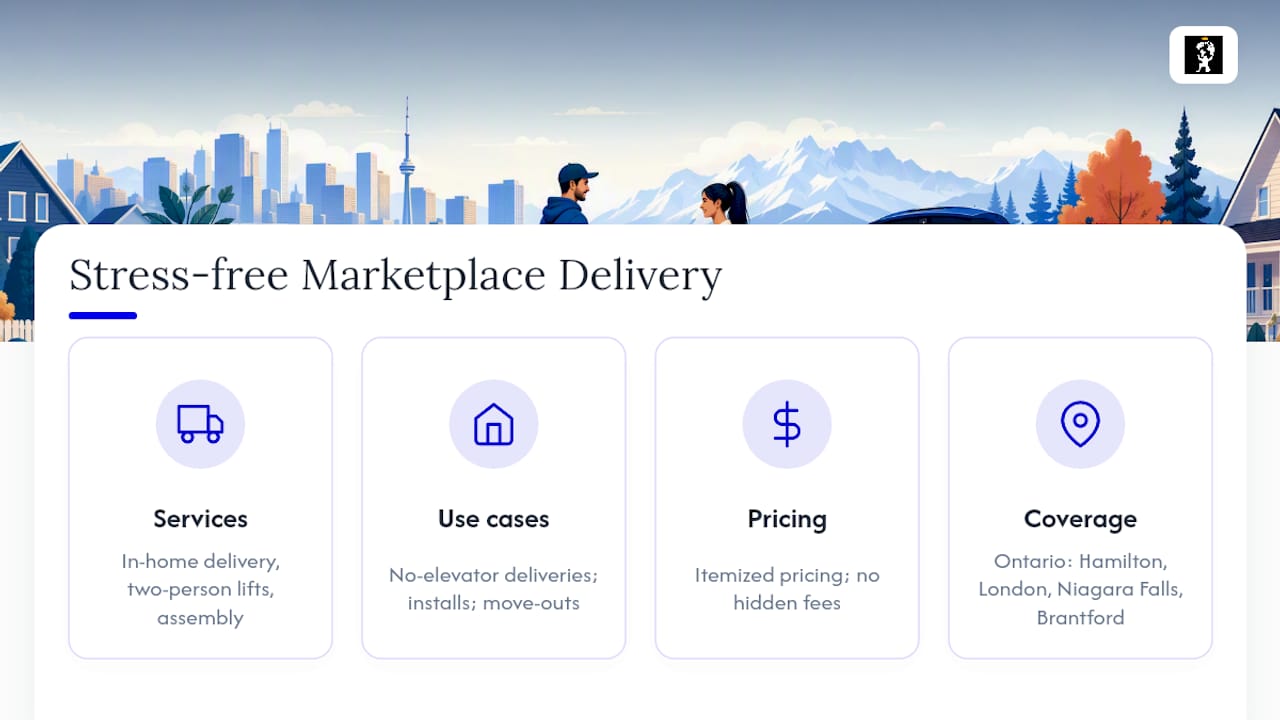
Buying a sofa, appliance, or piece of furniture on Facebook Marketplace or Kijiji is straightforward. Getting it from the seller’s driveway to your living room is where things get complicated, especially for anything heavy, awkward, or requiring assembly.
Atlaskings handles that last mile. With over 500 completed moves since 2021 and transparent itemized pricing, the team covers in-home delivery, heavy lifting, and assembly for bulky marketplace purchases across Ontario, including Hamilton, London, Niagara Falls, Brantford, and surrounding areas.

Three situations where booking Atlaskings makes sense: you just bought a sectional and the seller’s building has no elevator; you purchased a treadmill or large appliance and need it installed in a specific room; or you are selling furniture and need it moved out before the buyer arrives. The lift and transport service handles two-person jobs, stair carries, and same-day local pickups. For buyers who also need short-term storage between a sale and a move, itemized storage is available with no hidden fees. Get a quote or book your delivery online and skip the rental van math entirely.
Sources
Recommended
Comments