

Marketplace Sellers: Prevent Delivery Scams with Pro Delivery Checks

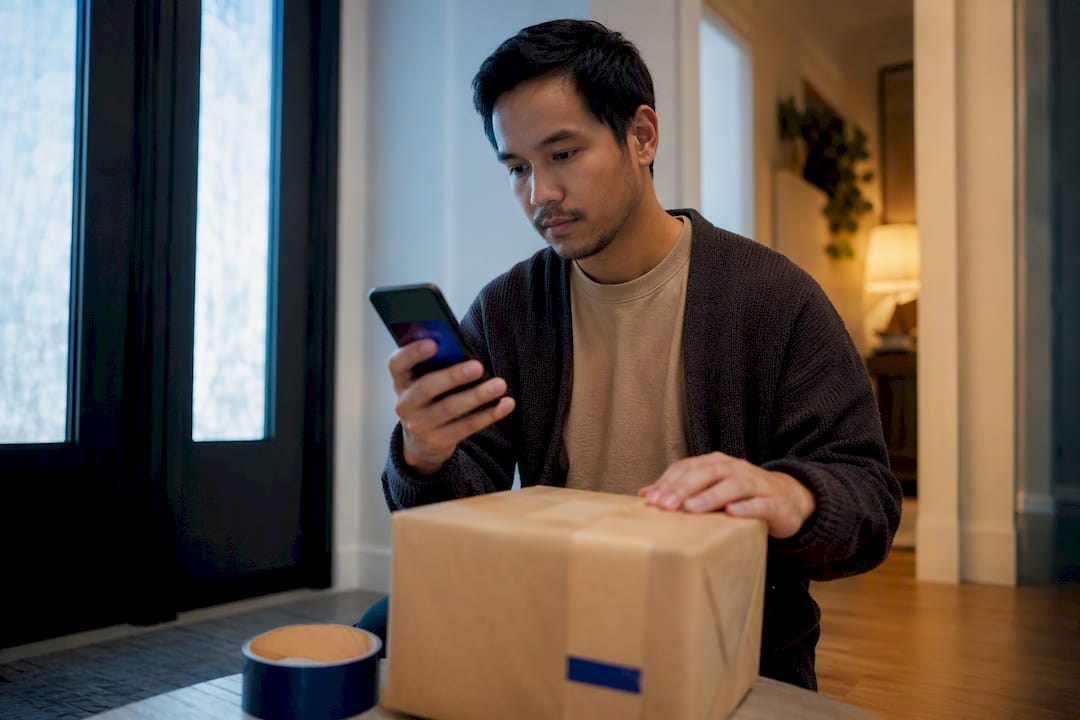
The one rule that stops most marketplace delivery scams: confirm the money has actually cleared in your own bank or payment app before you ship or hand over an item, and never let a buyer arrange the courier. If a buyer pushes you to use their shipping label, their “driver,” or a payment method outside the platform, stop the transaction. Verify independently, every time, before the item leaves your hands.
TL;DR:
Confirm that the payment has fully cleared in your own bank or payment app before shipping or releasing the item, and avoid using the buyer’s courier or shipping labels.
Verify all transaction details independently, including matching the transaction amount and checking carrier tracking through official channels rather than links or messages.
Be cautious of pressure tactics such as urgent requests, requests for codes, or pressure to act before verifying funds or identity.
Use official checkouts, generate your own shipping labels, and document buyer identities and conditions to prevent delivery scams.
Immediately stop communication and file disputes with your bank or card issuer if you suspect a scam, and report the incident to the marketplace and official fraud portals.
Table of Contents
How to Avoid Marketplace Delivery Scams: Common Tactics to Know
Delivery-related scams follow patterns you can learn to spot in seconds once you know what to look for. The most common plays share one trait: they create false confidence that money has moved when it hasn’t.
Fake payment screenshots are the simplest version. A buyer sends a doctored image showing a completed e-transfer or PayPal payment, then asks you to ship immediately because the funds are “processing.” Screenshots are not proof of anything. Only your own banking app tells the truth.
Spoofed courier scams work differently. The buyer claims they’ve already booked a shipping service and sends you a tracking link or asks you to pay a “release fee” or “courier deposit” before the driver arrives. The Government of Canada’s warning about AI-generated scams notes that these messages are increasingly polished. This means that the old advice of “watch for bad grammar” no longer holds up. A scam text can now read as cleanly as a real shipping notification.
Two other patterns round out the list:
Overpayment scams: the buyer “accidentally” sends too much and asks you to refund the difference before their original payment reverses or bounces.
Fake business-upgrade extortion: a message claims your account needs a paid “seller verification” or “business upgrade” to receive payment, which is never a real marketplace requirement.
Each of these hinges on urgency and a plausible-looking document. Neither should ever substitute for opening your own account and checking the actual balance.
Red Flags and a Verification Checklist Before You Ship
A handful of checks, done in the right order, catch nearly every delivery scam before an item or a dollar changes hands.
Open your own banking or payment app directly and confirm a cleared transaction, not a pending one, matching the exact amount agreed.
Never click a courier link a buyer sends you. Go to the carrier’s official app or website and enter the tracking number yourself.
Keep every message inside the marketplace’s chat. A request to move the conversation to text, email, or a messaging app is itself a warning sign.
Check the buyer’s or seller’s profile for account age, mutual friends, prior reviews, and marketplace history before agreeing to anything.
Watch for pressure tactics: urgency, guilt, requests for one-time codes, or insistence that “the driver is already on the way.”
Meta’s own marketplace safety guidance treats a buyer’s refusal to use standard checkout, or insistence on their own courier, as one of the clearest red flags a transaction has gone wrong.
Pro Tip: Screenshot every message the moment something feels off, even before you’re sure it’s a scam. If it turns out to be nothing, you’ve lost thirty seconds. If it’s real, you’ll have a timestamped record your bank or the platform will actually want to see.
Safe Payment and Shipping Practices That Minimize Risk
The safest transactions share a simple feature: whoever controls the money also controls the paper trail. When you hand that control to a stranger’s “courier” or a shipping label you didn’t generate, you lose the ability to prove what happened.
Credit cards remain the strongest option for buyers when a marketplace supports them, because card issuers offer formal dispute processes that gift cards, wire transfers, cryptocurrency, and most peer-to-peer apps simply don’t. The Competition Bureau of Canada is direct about this: paying outside a platform’s built-in checkout removes the protections that make recovery possible at all. Once money leaves through a wire transfer or a gift card code, it’s gone.
For local, high-value pickups, cash in person still beats shipping in most cases. It removes tracking numbers, carriers, and labels from the equation entirely. If a deposit is involved, set a simple rule in advance, such as a fixed amount held in cash at pickup rather than sent ahead electronically.
When shipping is unavoidable:
Generate the shipping label yourself, or use the marketplace’s own official checkout and shipping flow.
Never accept a label a buyer emails or texts to you.
Confirm the sender account and billing details on the label match the actual buyer.
Track the parcel independently through the carrier’s official app rather than a link provided by the other party.
Suspicious delivery texts and emails follow the same rule. Consumer Reports points out that legitimate carriers never request passwords or payment through a text message, and the fastest way to confirm a delivery’s real status is to open the carrier’s own app, not the link sitting in your inbox.
If You Already Shipped or Paid: A Step-by-Step Response Plan
Moving fast matters more than moving perfectly. Here’s the order that gives you the best shot at recovering money or the item.
Stop all communication with the other party immediately, but preserve it. Save every message, screenshot, timestamp, and receipt exactly as it appears.
Call your bank or card issuer the same day. Ask specifically about starting a dispute or chargeback, and give them the saved evidence.
Contact the carrier as soon as possible. Intercepting a parcel after pickup is time-sensitive, and reaching the carrier within the first 24 hours gives you the best chance of rerouting the shipment or at least locking in documented chain-of-custody records.
Report the scam to the marketplace itself and to an official fraud portal. The FTC’s guidance on buying online recommends documenting everything and reporting promptly, since early reports both improve your odds and help flag the account for other buyers.
None of these steps guarantees your money back. But skipping any one of them, especially the bank call, sharply lowers your odds of ever seeing it again.
Field-Tested Delivery Checks From Atlas Kings
Professional movers see the same scam patterns from the other side of the truck, and the safeguards that protect a delivery business apply just as well to a private Marketplace sale.
Verify the payer’s identity and address before pickup, never after.
Refuse any billing information a third party tries to hand over on the buyer’s behalf.
Require photo ID at the door and document the item’s condition with photos and a signed receipt.
Confirm pricing in writing before the truck ever moves, since a legitimate service quotes clearly and doesn’t improvise fees mid-delivery.
Atlas Kings applies these steps on every job, paired with itemized and flat-rate pricing so nothing gets negotiated once the item is already in the van.
Pro Tip: Ask any delivery service one question before booking: “Do you require ID and a signature at both pickup and drop-off?” A real operator will say yes without hesitation.
What Actually Prevents These Scams, and What Doesn’t
Most advice on this topic focuses on spotting bad grammar or sketchy profile photos, and that guidance is aging fast. AI-polished messages read cleanly now, which means the visual and verbal cues people were trained to catch are disappearing. What still works, reliably, is behavioral: does the other party want you to act before you verify? That single question catches nearly every version of this scam, regardless of how convincing the message looks.
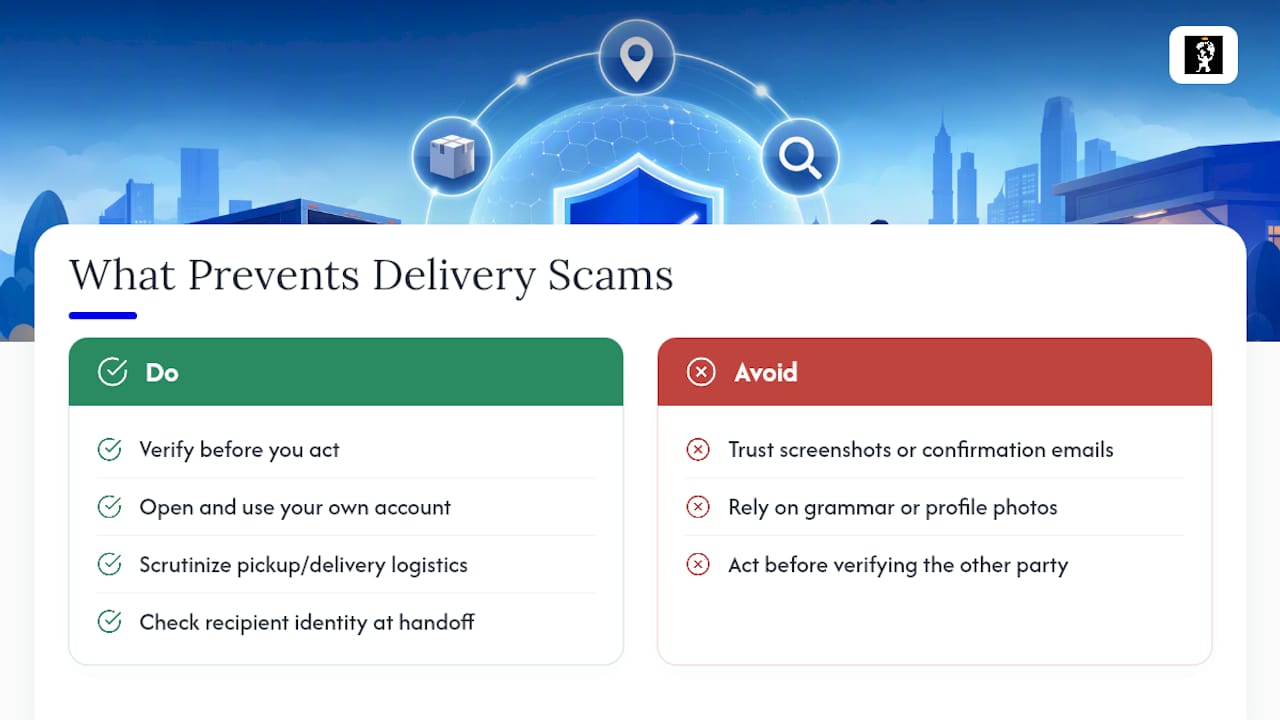
The overrated advice is trusting screenshots or “confirmation” emails at all. Open your own account. Every time.
If there’s one place readers underinvest, it’s in the pickup and delivery moment itself. Buyers focus heavily on payment safety and forget that a stranger showing up to move a couch is its own point of exposure. Treating delivery logistics with the same scrutiny as payment, checking identity, documenting condition, confirming who’s actually driving, closes a gap most scam advice skips entirely.
— Natalie
When a Professional Pickup Beats a Buyer-Arranged Courier
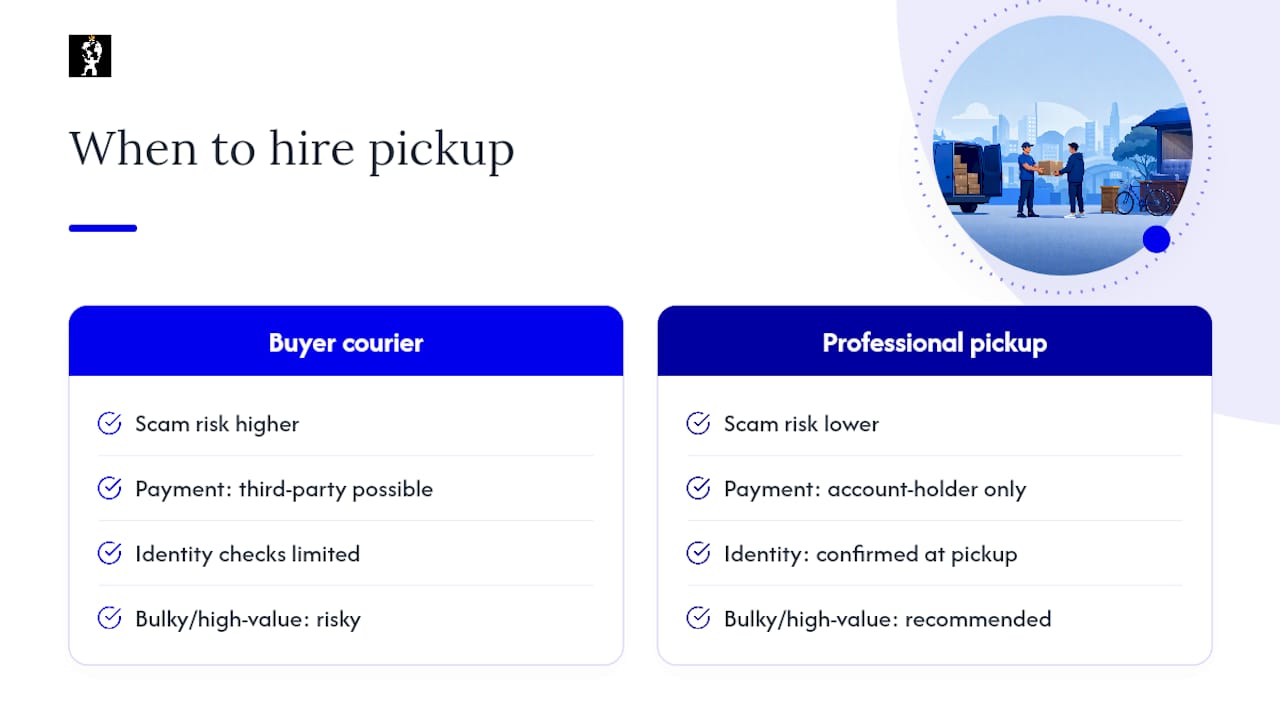
Some Marketplace purchases are worth handling yourself. Others, especially heavy furniture, high-value electronics, or anything where the buyer suggests “their guy” for delivery, are exactly where a professional pickup pays for itself. Atlas Kings handles in-home delivery of bulky or high-value Marketplace items with verified pickup steps: confirmed identity, documented condition, and no third-party billing accepted mid-job.

That last point matters more than it sounds. A courier who refuses to take payment instructions from anyone but the account holder closes off one of the most common delivery-scam entry points on its own. When the item is large enough to need assembly once it arrives, or the pickup location is a multi-city trip, the math tips further toward hiring it out rather than coordinating a stranger’s courier and hoping the tracking number is real.
Booking is straightforward: their pricing approach means the quote you get is the quote you pay, with no fees introduced once the truck is already loaded. If your next Marketplace purchase is too big to trust to a buyer-arranged shipper, get a transport quote from Atlas Kings before you agree to anything with a stranger’s “driver.”
Official Resources and Reporting Portals
Report suspected fraud directly to Competition Bureau Canada for prevention guidance and complaint filing. U.S. readers can file at Reportfraud for internet-enabled fraud. Review Meta’s Marketplace safety page for platform-specific reporting tools and account flags.
Sources
FAQ
Is Facebook Marketplace Delivery Safe?
Marketplace itself is generally safe when you stay inside the platform’s chat and checkout tools, but delivery introduces risk the moment a buyer suggests their own courier or shipping label.
How Do You Know if a Buyer Is Scamming You on Marketplace?
The clearest sign is pressure to ship before you’ve confirmed cleared funds in your own bank app, combined with a refusal to use standard marketplace checkout.
What Are the Current Scams on Facebook Marketplace?
The most active patterns right now are fake payment screenshots, spoofed courier tracking links with fake “release fees,” overpayment refund requests, and fake business-account upgrade extortion messages.
Will Facebook Refund You if You Get Scammed on Marketplace?
Facebook does not guarantee refunds for Marketplace transactions, which is why paying through a card or platform-protected checkout matters more than relying on the platform to make you whole after the fact.
What Should I Do First if I Think I’ve Been Scammed on a Delivery?
Contact your bank or card issuer the same day to start a dispute, then report the incident to the marketplace and to an official fraud portal like ReportFraud.FTC.gov or the Competition Bureau.
Recommended
Comments