

ADHD Decluttering Strategies That Actually Work for Adults
- William Wooldridge

- Aug 10
- 10 min read

Here are six things you can do right now to start decluttering with ADHD, each taking 10–15 minutes or less:
Set a timer for 10–15 minutes before you touch a single item.
Pick one shelf, one drawer, or one surface — nothing bigger.
Grab three boxes or bags and label them: Keep, Goes Somewhere Else, and Trash/Donate.
Sort everything on that surface into one of those three categories only.
Put the “Goes Somewhere Else” box outside the room so it doesn’t pull your attention.
When the timer goes off, stop — even if you’re not finished.
ADHD commonly affects executive functions such as planning, task initiation, and sustained attention, which is exactly why a full-room cleanout almost always stalls. Your brain isn’t broken. The task is just designed wrong for how you process it.
Pro Tip: Never start a decluttering session without a timer already running. The single biggest cause of mid-cleanup chaos is starting without a defined stop point, then following a distraction into a second room and leaving both spaces worse than before.
Key Takeaways
ADHD decluttering strategies work best when they reduce decisions, use timers, and build visible systems that hold up on difficult executive-function days.
Point | Details |
Start with one surface | Pick one shelf or counter, set a 10–15 minute timer, and stop when it goes off. |
Use a five-category sort | Keep, Goes Somewhere Else, Trash, Donate, and Not Sure — the “Not Sure” box removes decision pressure mid-session. |
Build a launch station | A hook, a tray, and a visible spot near your exit reduces daily lost-item searches and morning friction. |
Automate maintenance | A recurring 10-minute nightly reset and a Sunday basket catch drift before it becomes clutter again. |
Atlaskings ADHD Reset | Hands-on, timed decluttering sessions with transparent itemized pricing — book at atlaskings.ca/adhdreset. |
Table of Contents
What are the best ADHD decluttering strategies for week one?
The goal of week one isn’t a clean house. It’s three to five short wins that prove to your brain that progress is possible. CHADD recommends breaking organizing into short sessions, starting with the easiest space, and dividing areas into sections — so that’s exactly how this plan is built.
Choose your starting space wisely. Pick the area that causes you the most daily friction, but is also small enough to finish in one session. A bathroom counter, a nightstand, or the kitchen counter near the door are all good candidates. Avoid the garage, storage rooms, or any space that requires major decisions about sentimental items in week one.
Session length and frequency: Short timed sessions totaling a realistic amount of daily focus is recommended. Never plan an especially long session during week one.
Schedule sessions in your phone calendar like appointments, with a reminder 10 minutes before.
Attach a small, specific reward to each completed session — not to a perfect result.
If you miss a day, skip it entirely and pick up the next scheduled session. No catch-up guilt.
Coaching and peer support increase follow-through when rewards and short commitments are built in, so tell a friend your plan for the week.
How does the divide-sort-decide method work for ADHD?
This is the method that prevents the mid-cleanup explosion — the moment where you’ve pulled everything out of a closet, gotten distracted, and left the room looking worse than when you started. ADDitude advises strategies that reduce decision-making and reward short wins, and this method does both.
The four steps:
Pick one small area. One shelf. One drawer. One corner of a counter. Not the whole closet — one shelf inside it.
Divide it into sections. If it’s a shelf, mentally split it into left, center, and right. Work left to right, one section at a time.
Sort into categories. Use five labels: Keep here, Goes somewhere else, Trash, Donate, and Not sure. The “Not sure” box is critical — it removes the pressure of a hard decision mid-session.
Set a timer and finish the section. When the timer goes off, stop sorting. Seal the “Not sure” box, put it out of sight, and schedule a 10-minute revisit in two weeks.
Quick decision rules to speed up sorting:
Have you used it in the past 12 months? If no, it goes in Donate or Trash.
Does it have a home in this room? If no, it goes in “Goes Somewhere Else.”
Is it broken or expired? Trash, immediately.
Does keeping it require a decision you can’t make right now? “Not sure” box — move on.
Stopping the mid-cleanup explosion:
Keep a small “lost items” box with you as you work a single room. Anything that belongs elsewhere goes in that box, not in your hands walking to another room. CHADD recommends returning items from that box only at a scheduled time, not mid-session.
Never open a storage bin or bag that isn’t part of today’s target area. Mark it with a sticky note and come back another session.
One room, one surface, one timer. That’s the whole rule.
How do you handle emotions and sentimental items while decluttering?
Shame, grief, and decision fatigue are normal parts of decluttering with ADHD — not signs that you’re doing it wrong. ADDitude reports that accepting “done over perfect” is one of the most effective ways to prevent shame-driven avoidance and doom piles. The feelings are real, but they don’t have to stop the session.
Practical techniques for emotional moments:
Memory box rule: Designate one medium-sized box as your memory box. Sentimental items that you can’t decide about go in there, not in the trash and not back on the shelf. When the box is full, that’s the limit — nothing new goes in until something comes out.
Photo-first approach: Before letting go of something meaningful, photograph it. The photo preserves the memory; the object doesn’t have to.
Delayed-decision folder: For papers, cards, or printed items, a physical folder labeled “Decide Later” removes the pressure without creating a pile. Schedule a 10-minute review of that folder once a month.
Non-judgmental support: Ask a trusted friend to sit with you during a session, not to make decisions, but to keep you company. Their presence alone reduces avoidance.
Short decision questions that move things along:
When did I last use or look at this?
Does keeping it support my daily life right now?
Am I keeping this out of guilt, or because it genuinely matters to me?
If I saw this in a store today, would I buy it again?
Pro Tip: For sentimental items, set a 5-minute timer per item maximum. If you haven’t decided in 5 minutes, it goes in the memory box or delayed-decision folder. Schedule a revisit in 30 days — not sooner. Distance from the initial session almost always makes the decision easier.
Which tools and storage systems work best for ADHD brains?
The design principle behind every ADHD-friendly storage system is the same: make the right action the easiest action. GoToBetter recommends visible zones and launch stations because visibility reduces friction and helps ADHD brains remember and act without extra steps. Closed cabinets, complex labels, and multi-step systems tend to fail over time because they require decisions every single time you use them.
Storage types that work:
Clear bins and open baskets: You can see what’s inside without opening anything. Stackable clear bins work well for pantries, bathrooms, and closets.
Open shelving: Items in plain sight get used. Items behind closed doors get forgotten.
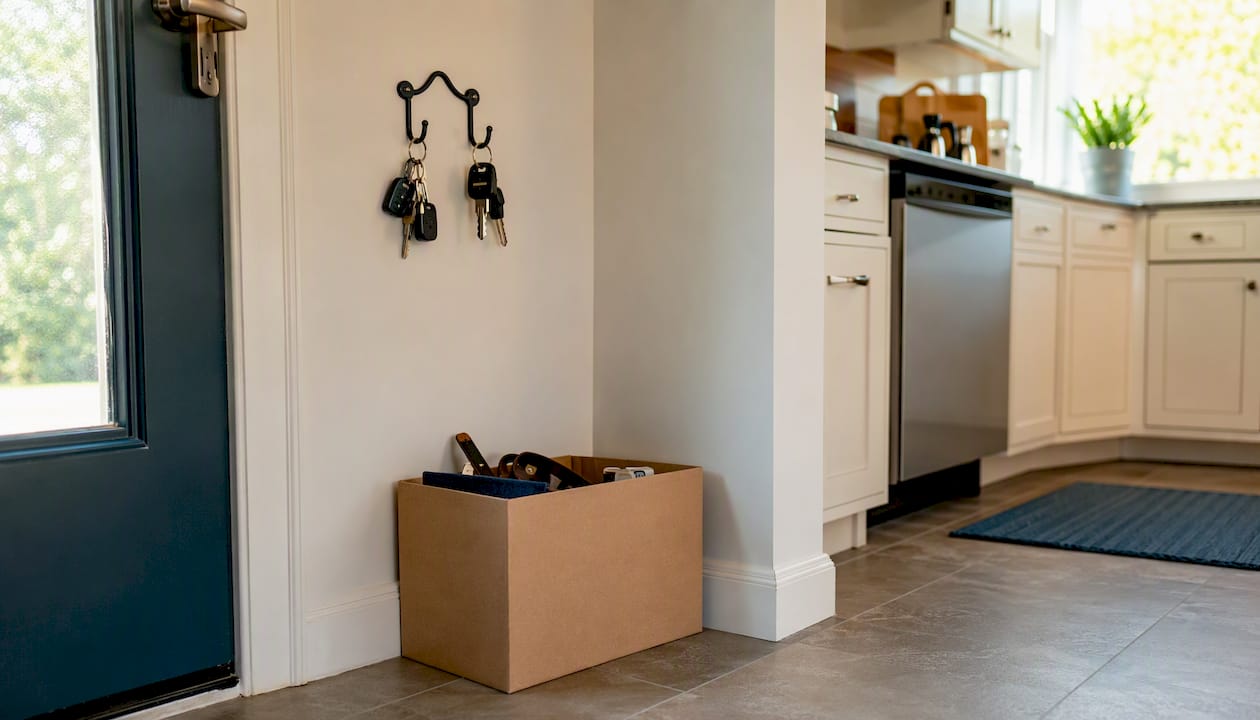
Wall hooks near the door: One hook per person for bags, keys, and jackets. No decision required — you walk in, you hang it.
Labeled trays on counters: A tray for mail, a tray for charging cables, a tray for daily medications. Trays contain the clutter without hiding it.
Three ADHD-friendly zones to set up first:
Entry launch station: A hook for your bag, a tray for keys and wallet, and a spot for tomorrow’s shoes. Everything you need to leave the house, in one visible spot. Neurolaunch notes that a launch pad near your exit reduces morning decision load and lost-item searches.
Bedroom morning station: A surface with your daily medications, a charger, and tomorrow’s outfit visible the night before.
Kitchen prep zone: A clear counter space with only the tools you use daily. Everything else goes in a drawer or cabinet.
For readers considering built-in closet or shelving upgrades, home organization systems that use open shelving and visible storage can make these principles permanent.
Cost-saving note: Use what you already own before buying anything new. A cardboard box works as a bin. A hook from a hardware store costs under $5. Buy storage only after you’ve decluttered — otherwise you’re organizing things you may not keep.
What daily and weekly habits keep clutter from coming back?
One good decluttering session won’t hold without a maintenance routine. The habits below are short by design — they’re built for executive-function dips, not ideal days.
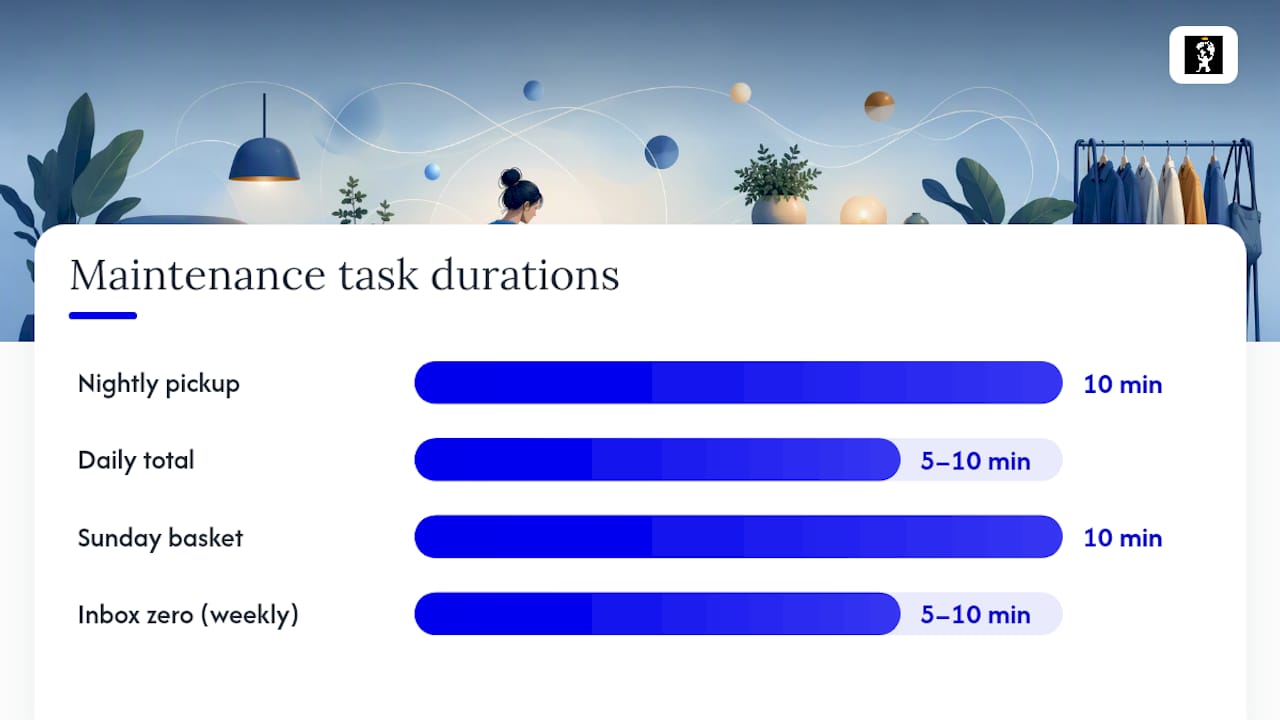
Daily habits (5–10 minutes total):
10-minute nightly pickup: Set a timer, walk through the main living areas, and return items to their home. No sorting, no decisions — just returning.
Launch pad reset: Every evening, reset your entry station. Keys in the tray, bag on the hook, tomorrow’s items staged.
One-in-one-out rule: When something new comes into the house, one item leaves. This prevents accumulation before it starts.
Weekly habits:
Sunday basket: Once a week, collect everything that has drifted from its home into one basket. Sort the basket in 10 minutes — keep, relocate, or trash.
Inbox zero for surfaces: Pick one counter or table per week and clear it completely. Takes 5–10 minutes when done regularly.
Reminder audit: Check your phone reminders and calendar events. Remove any that are outdated; add any new sessions you’ve planned.
Automating the routine:
Set recurring phone reminders for your nightly pickup and Sunday basket. A recurring calendar event labeled “10-min reset” at 8:30 PM every night removes the need to decide whether to do it. Mind X Associates recommends scheduling decluttering tasks like appointments and attaching small rewards to completion — the same logic applies to maintenance.
Realistic expectations matter here. A “good enough and done” nightly reset beats a perfect weekly overhaul every time. If you miss three nights in a row, the Sunday basket catches it. The system is designed to recover, not to demand perfection.
When does hiring a professional ADHD-focused declutter service make sense?
Some spaces, some seasons, and some emotional loads genuinely call for outside help. That’s not a failure — it’s a practical decision. ADDitude notes that professional organizers who specialize in ADHD use short, repeatable sessions and leave a small, usable system behind rather than attempting a perfect overhaul.
Questions to ask any decluttering or ADHD-focused service before booking:
Do they have experience working with ADHD adults specifically?
Do they work in short sessions, or do they expect a full-day commitment?
What happens to donated items — do they handle removal?
Is pricing flat-rate, itemized, or hourly, and what does each cover?
Do they offer a follow-up session or coaching component?
For context on how professional organizers structure their work and what credentials to look for, professional organizers in Canada offers a useful overview of what to expect from a credentialed service.
What a professional session typically includes:
An initial walkthrough to assess the space and identify priority areas.
Short, timed sorting sessions with the client present and making decisions.
A simple system setup (bins, labels, launch station) before the session ends.
Optional follow-up to reinforce habits and adjust the system.
Pricing models explained:
Model | What it covers | Best for |
Flat-rate | A defined scope of work for one fixed price | Predictable budgets, single-room projects |
Itemized | Charged per item, area, or task completed | Larger or multi-room projects with variable scope |
Hourly | Billed by time spent on-site | Shorter sessions or ongoing coaching support |
Pro Tip: Ask for itemized pricing even when a flat rate is offered. Knowing exactly what each part of the service costs helps you prioritize which areas to tackle first and prevents scope creep mid-session.
Atlaskings’ ADHD Reset service is built specifically for this situation. It uses short, timed sessions, hands-on sorting support, and a simple system setup — designed for adults who need a structured, low-pressure start. Transparent, itemized pricing means you know what you’re paying for before anyone walks through your door.
What working with ADHD clutter has taught us
Clutter in an ADHD household is almost never about laziness. It’s about a brain that struggles to initiate, sequence, and sustain the kind of repetitive, low-reward task that tidying up actually is. The shame that builds around it — the closed doors, the avoided rooms, the apologies before guests arrive — is often heavier than the clutter itself.
What we’ve seen work, consistently, is starting smaller than feels meaningful. A single shelf. A 10-minute timer. One box. Not because those things fix everything, but because they break the freeze. The first win creates the next one.
Setbacks are part of the process, not proof that the process doesn’t work. A week of missed resets doesn’t erase the systems you’ve built. Pick up the Sunday basket, run the timer, and keep going.
If you’re ready to try a 10-minute session tonight, start with the surface closest to your front door. That one small act tends to have the biggest daily payoff.
Atlaskings’ ADHD Reset: hands-on help when you’re ready for it
Decluttering with ADHD is genuinely harder than most guides acknowledge. The ADHD Reset from Atlaskings is a hands-on, professionally supported service built around that reality — short timed sessions, side-by-side sorting, and a simple system left in place when the session ends. No pressure to finish everything at once, and no hidden costs.

Atlaskings uses transparent, itemized pricing so you know exactly what each part of the service covers before booking. The team has supported clients through full-room resets, entry station setups, and everything in between — with the same calm, reliable approach that has carried over 500 completed projects since 2021.
This service fits you well if you’re dealing with decision fatigue that stalls every solo attempt, limited time or energy for multi-session DIY projects, or a space that has grown beyond what a timer and three boxes can fix on their own. For readers who need lighter-touch support, the in-home refresh option covers smaller-scope organizing sessions at a lower commitment level.
Ready to get started? Book your ADHD Reset online, and the Atlaskings team will confirm your session details and walk you through what to expect before anyone arrives.
Sources
The strategies in this article draw on guidance from organizations that specialize in ADHD and behavioral change. These sources are worth bookmarking for ongoing reference:
For readers managing a busy household alongside their own ADHD, organizing a busy family home offers additional routines that complement the systems above.
This article is general information, not a substitute for advice from a qualified doctor. Consult a qualified healthcare professional about your own circumstances before acting on anything here.
Recommended
Comments