

ADHD Body Doubling: Session Scripts for Decluttering and When to Hire Help

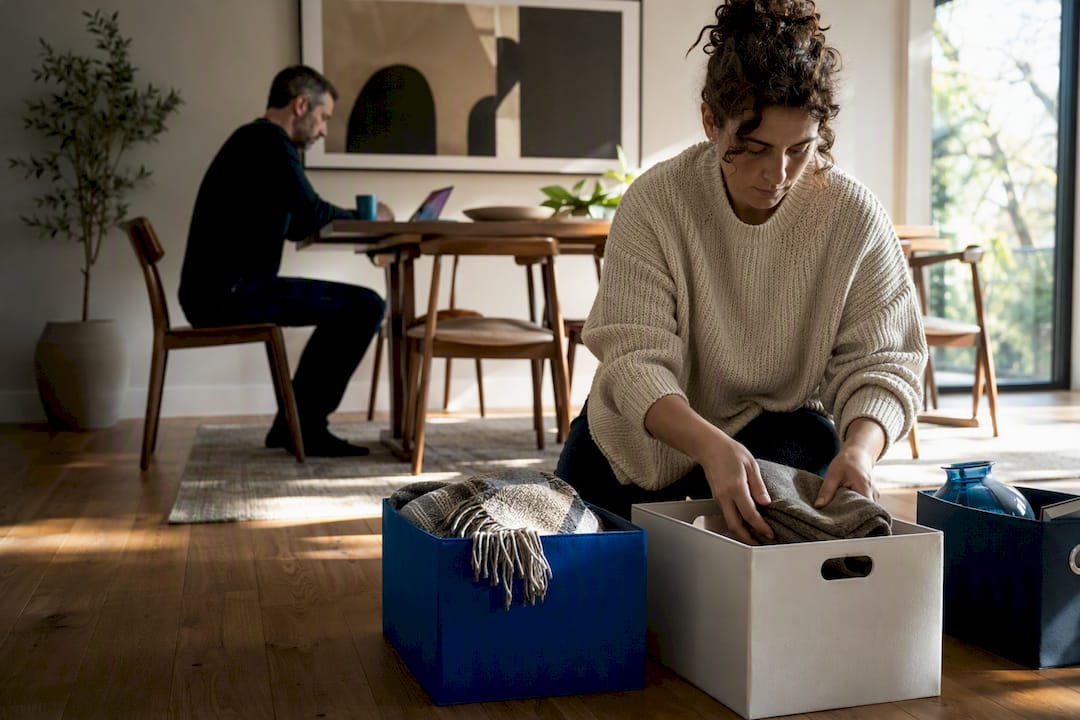
Body doubling is a low-cost, low-risk strategy many people with ADHD find helpful for starting and finishing routine tasks, though formal evidence is limited. The best first move isn’t research, it’s a test: block off 25 minutes, invite a calm friend or a virtual coworking stream, and each work on your own task silently. It won’t fix every stalled project, especially complex or unfamiliar ones, but for chores, paperwork, and decluttering, it costs nothing and takes fifteen minutes to try.
TL;DR:
Body doubling is most effective for starting and completing familiar, straightforward tasks such as chores and paperwork, rather than complex or novel work.
The strongest support structure involves a set time, a clear goal, and independent work, with sessions typically lasting 25 to 45 minutes in quiet, distraction-free conditions.
The presence of a supportive, steady-energy partner or virtual coworking platform enhances focus, while chatty or interruptive doubles can hinder progress.
In-person, online, or ambient settings like libraries provide accessible options for body doubling, with cheaper or free arrangements preferred for trial periods.
When decluttering exceeds the limits of body doubling, professional help is available to assist with larger or more persistent organizational challenges.
Table of Contents
What Is ADHD Body Doubling?
Body doubling means working alongside another person, in the same room or over video, while that person quietly handles their own task. They aren’t coaching you, checking your progress, or doing the work with you. Their job is simply to be present. Something about that presence makes starting easier and staying on task less of a fight.
The term did not come from a clinic or a diagnostic manual. It grew out of ADHD support groups and online communities in the 1990s and 2000s, where people traded strategies for getting through mundane tasks that felt impossible alone. Clinicians picked it up later, and now it shows up in Cleveland Clinic’s patient guidance as a recognized, if informal, coping tool. That community origin matters. Body doubling was never marketed or patented. It spread because it kept working for enough people that word got around.
People use it for a wide variety of stalled tasks:
Answering emails or doing paperwork that keeps getting pushed to tomorrow
Studying for an exam when the material itself isn’t the problem, starting is
Cleaning a kitchen or folding laundry that’s been sitting for days
Working through a decluttering pile that feels too big to touch
Filing taxes, scheduling appointments, or other single-step tasks with no obvious first move
A simple example: someone struggling to open their inbox for a week sits down with a friend on a video call. The friend is grading papers. Neither talks. Twenty minutes later, the inbox is empty. Nothing about the task changed. What changed was having a witness.
Why Body Doubling Can Work: Mechanisms and Evidence Summary
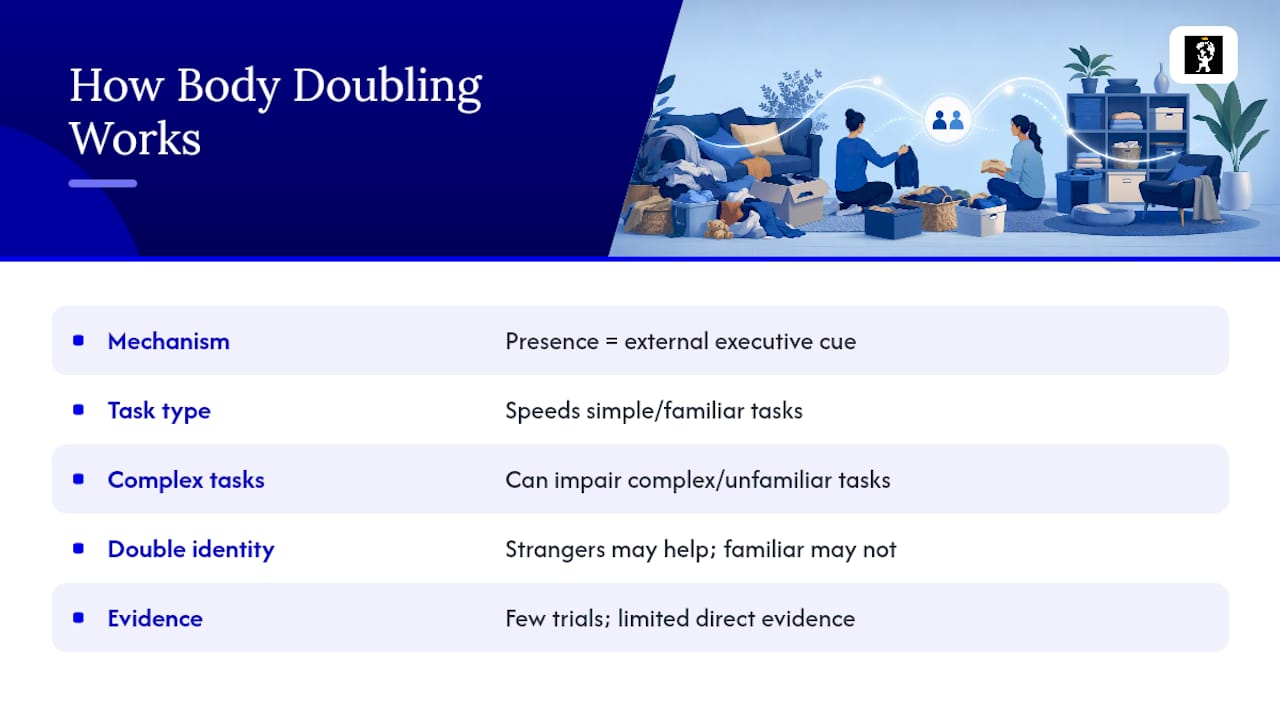
The leading explanation is that another person’s presence acts as a form of external executive functioning. Starting, sustaining attention, and resisting distraction are executive functions, and ADHD affects the brain systems that manage them. A body double doesn’t do the thinking for you, but their presence seems to anchor attention in a way that makes the task in front of you harder to ignore. Cleveland Clinic describes this as one of the clearer proposed mechanisms: the double doesn’t need to participate in your task at all for the effect to show up.
This isn’t a new idea dressed up in ADHD language. Psychologists have studied “social facilitation,” the effect of another person’s presence on performance, since the 1960s. A meta-analysis of social presence effects confirms the pattern holds up across decades of research: presence tends to speed up simple or well-practiced tasks, and can actually slow down or impair complex, unfamiliar ones. That distinction explains a lot about why body doubling helps some tasks and not others.
Presence changes performance in a task-dependent way. It speeds work you already know how to do and can complicate work you’re still figuring out.
An older study adds a wrinkle worth knowing: researchers found boys with hyperactivity showed improved attention when a stranger, an experimenter, was in the room, but not when their own mother was present, according to a 2026 writeup on ADHD body doubling. Who the double is seems to matter as much as whether one is there at all. A parent who tends to comment or correct may trigger the opposite of calm focus.
Here’s the honest limitation: dedicated clinical trials on body doubling specifically are scarce. One small controlled test with 26 participants found no statistically significant difference in outcomes, though it also found no harm and called for further study. What exists instead is a large body of adjacent research on structured external support for adults with ADHD, documented in NCBI’s clinical resource on ADHD therapies, showing that structure itself, start times, end times, a witness, a model of calm work, reliably helps. Body doubling may simply be an informal, accessible way to deliver that same structure.
The practical takeaway: expect body doubling to help most with tasks you already know how to do but can’t seem to start. Expect it to help less with genuinely difficult, novel, multi-step work that needs deep problem-solving. And expect your own results to vary. Some people report it working almost every time. Others find it useful only for certain categories of task. Both experiences are consistent with what the research shows.
How to Run an Effective Body-Doubling Session
Format matters less than most people assume. What matters is structure: a clear start, a clear task, and a clear end.
Formats that work:
In-person, sitting in the same room, each working independently
Virtual, video on, microphone muted, both visible but not talking
Coworking streams, joining a live video stream of someone else working, often used by remote workers and students
Public focused spaces, working near strangers in a library or café where the ambient presence of others creates a similar effect
Before you start, run through a short setup:
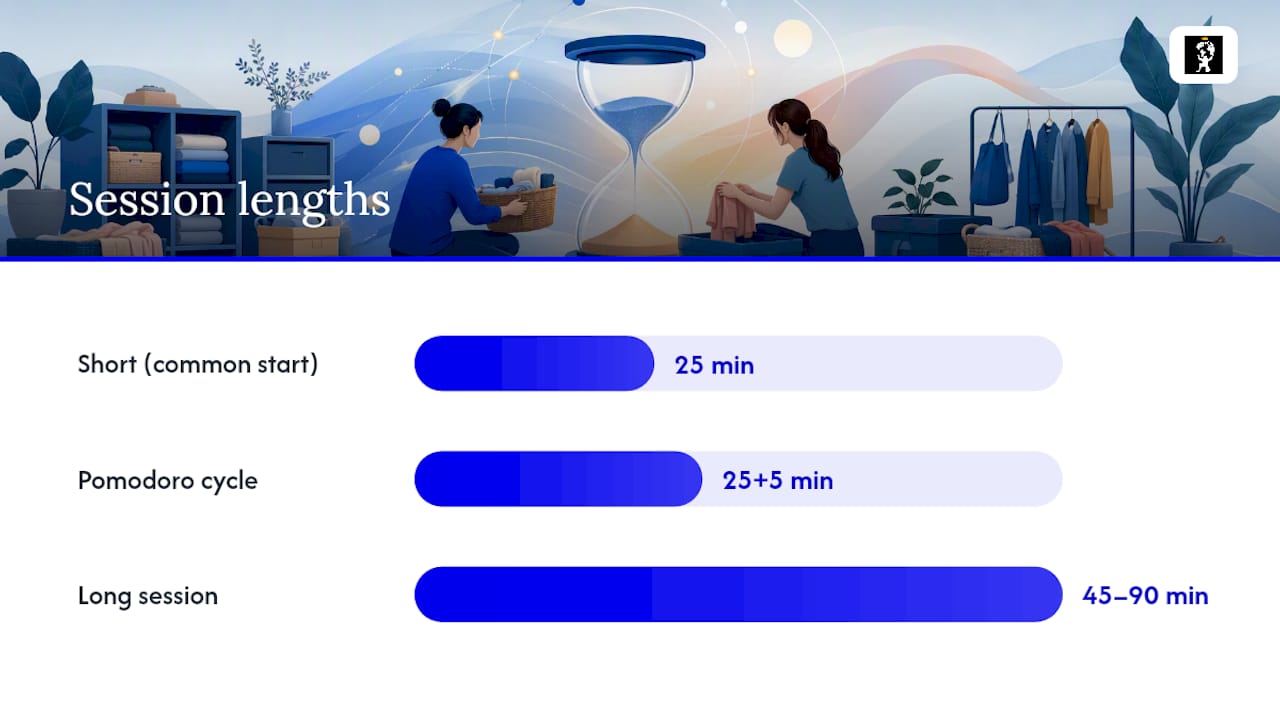
Set a time block. Fifteen to ninety minutes works, but 25 minutes is the most common starting point because it matches the Pomodoro Technique’s classic cycle.
State your goal out loud or in chat. One sentence: “I’m going to clear my inbox” or “I’m sorting the hall closet.” No details needed, just a target.
Agree that both people work independently. No coaching, no checking in mid-session, no narrating your own task to each other.
Start together. A simple “starting now” message or verbal cue removes the ambiguity of when the session actually begins.
End with a ritual. A short check-in, “got through half the pile,” is enough. It closes the loop and reinforces that the session had a result.
For timing, pair short sessions (25 minutes work, 5 minutes break) with tasks that are tedious but not overwhelming, paperwork, tidying, replying to messages. Save longer sessions (45 to 90 minutes) for tasks with more moving parts, like organizing a full closet or working through a backlog of forms. Add confirms that successful sessions tend to share this same shape: a blocked time, a stated goal, and independent, quiet work.
Pro Tip: If you’re the one being doubled for, pick someone whose energy is steady rather than chatty. A double who checks in every ten minutes or comments on your progress usually creates more friction than focus, not less.
A three-line script covers most sessions:
Start: “Starting a 25-minute block. I’m working on [task]. Talk after.”
Mid-session (only if needed): silence, or a single check mark in chat.
Close: “Done. Got through [result]. Thanks for doubling.”
Avoid doubles who narrate constantly, ask questions mid-task, or treat the session as a chat with background work attached. The value comes from quiet parallel presence, not conversation.
Where to Find or Schedule a Body Double
You don’t need a formal program to try this. The lowest-friction option is someone already in your life.
Friends, family, or roommates work well if you can be direct about the ask: “Can you just sit with me on a call while I do this for 25 minutes? You don’t have to talk or help, just be there.” Most people say yes because the ask is genuinely small.
Virtual coworking platforms and focus apps are the most scalable option for adults with unpredictable schedules, since WebMD notes that virtual sessions are widely reported as effective and don’t require finding someone in your specific city or time zone.
Online ADHD communities and local meetups often run scheduled group coworking calls, which solve the problem of not having a willing friend on standby.
Libraries, study cafés, and coworking spaces offer the ambient version of body doubling. No coordination required, but the effect tends to be milder than a dedicated double, since strangers around you aren’t invested in your task the way a chosen double might be.
Cost ranges from free (a friend, a public library, a community call) to modest subscription fees for dedicated coworking apps. If you’re unsure whether this will help you specifically, a short trial beats a long commitment: two weeks of three 25-minute sessions a week is enough to tell whether the structure is doing anything for you, without building a dependency you didn’t intend.
Using Body Doubling for Decluttering, and When to Bring in Professional Help
Clutter creates a specific kind of freeze. A room full of unsorted stuff presents dozens of tiny decisions at once, keep, toss, donate, figure out later, and that decision load is exactly what ADHD executive function struggles with most. The pile doesn’t get smaller because looking at it triggers avoidance, not laziness.
Body doubling lowers that barrier the same way it helps with paperwork: a calm presence narrows your focus onto the physical task instead of the mental weight of deciding. Pairing a session with a trash-first rule, clearing obvious garbage before making any keep-or-toss calls, cuts the cognitive demand further, since you’re moving instead of deciding for the first ten minutes. Our guide to ADHD decluttering strategies walks through this approach in more detail, and the trash-first framework used by home organization professionals backs the same sequence: remove waste, then decide.
A realistic workflow looks like this:
Run two or three body-doubling sessions to build momentum on visible, easy wins, a drawer, a closet shelf, a countertop
Notice when the task outgrows what a single session can handle, a garage, a storage room, years of accumulated furniture
At that point, decision fatigue and physical scale both work against you, and that’s the point where professional help earns its cost
The ADHD Reset service is designed to assist when body doubling reaches its limit, providing decluttering help with transparent pricing to avoid surprises about costs before sessions start.
What Actually Makes a Session Work
The sessions that succeed tend to share one trait: low stakes on both sides. Nobody’s grading anyone. The double isn’t invested in the outcome, just present for it. That’s what separates a good body double from a well-meaning parent or partner who can’t resist offering advice halfway through.
Three scenarios come up constantly: a student who can sit for hours in a lecture but can’t open their laptop alone to write the essay, an adult who can manage a demanding job but avoids their own mail for weeks, and someone staring at a cluttered spare room they’ve meant to sort for a year. In all three, the task itself was never the real obstacle. Starting was.
If a few sessions don’t move the needle, that’s not a personal failure, it just means the task needs a different kind of support, whether that’s breaking it down further or bringing in outside help.
— Natalie
Getting Help When a Room Outgrows a Single Session
This ADHD Reset service supports decluttering when body doubling is insufficient, featuring clear, upfront pricing to clarify scope and cost before work begins.

A typical engagement starts with a walkthrough of the space to establish what’s staying, what’s going, and what needs a decision later. From there, the team works room by room, often using the same trash-first sequence that makes body-doubling sessions effective, clearing obvious waste before tackling harder calls. If the decluttering turns up furniture or bulky items that need to leave the house entirely, in-home delivery support handles the transport side without a separate booking.
If a room, closet, or garage has been stuck for longer than a body-doubling session can fix, book an ADHD Reset session and get a straightforward quote before committing to anything.
Sources
Readers looking to dig deeper can start with Cleveland Clinic’s clinical explainer on body doubling and the PMC meta-analysis on social presence effects, which together cover most of the evidence base. Evidence remains limited to small studies and adjacent research rather than large dedicated trials.
FAQ
What Is the 10-3 Rule for ADHD?
Pomodoro-style work intervals, like 25 minutes of focused effort followed by a short break, are commonly used to make starting less daunting. These cycles work well alongside body doubling, since a double can help anchor both the work interval and the return from break.
What Is the ADHD Walk?
The “ADHD walk” typically describes short movement breaks, often paired with a task cycle, used to reset attention and burn off restlessness between focus intervals. It’s frequently combined with body doubling by scheduling a walk during the break portion of a session.
What Is Stacking in ADHD?
Stacking usually means attaching a new task to an existing habit, like doing five minutes of tidying right after brushing your teeth, so the existing routine cues the new behavior. It pairs naturally with body doubling by stacking a doubling session onto a time you already have set aside.
Can a Person With ADHD Live a Normal Life?
Yes. ADHD is manageable with the right combination of strategies, and structured supports like body doubling, medication where appropriate, and organizational systems all contribute to steady, functional daily routines. What “normal” looks like varies person to person, but a full, productive life is the expectation, not the exception.
Recommended
Comments